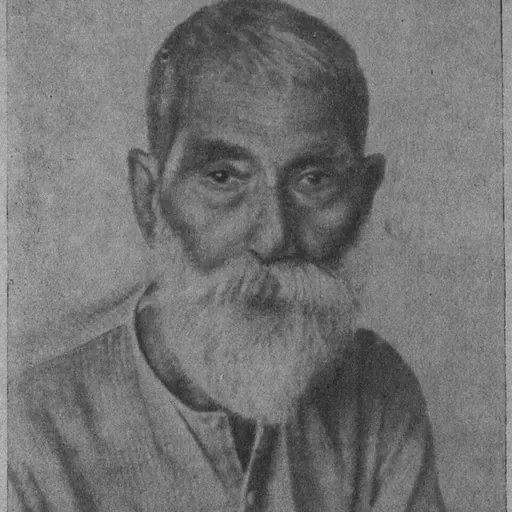
Prafulla Chandra Ray
Bengali chemist, educationist, poet, historian, industrialist and philanthropist
About Prafulla Chandra Ray
Lived 1861 – 1944 (aged 82). Prafulla Chandra Ray was an Indian chemist, university teacher, essayist and autobiographer.
Sir Prafulla Chandra Ray (also spelled Prafulla Chandra Roy; Prôphullô Côndrô Rāẏ; 2 August 1861 – 16 June 1944) was an Indian chemist, educationist, historian, industrialist and philanthropist from Bengal.
The Royal Society of Chemistry honoured his life and work with the first ever chemical landmark plaque outside Europe. He was the founder of Bengal Chemicals & Pharmaceuticals, India's first pharmaceutical company. He is the author of A History of Hindu Chemistry from the Earliest Times to the Middle of the Sixteenth Century (1902).
Biography Family background
Prafulla Chandra Ray was born in the village of Raruli-Katipara, then in Jessore District (now Paikgachha, Khulna), in the eastern region of the Bengal Presidency of British India (now Bangladesh) to a Bengali Hindu family. He was the third child and son of Harish Chandra Raychowdhury (d. 1893), a Kayastha zamindar and his wife Bhubanmohini Devi (d. 1904), the daughter of a local taluqdar. Ray was one of seven siblings, having four brothers – Jnanendra Chandra, Nalini Kanta, Purna Chandra and Buddha Dev – and two sisters, Indumati and Belamati, both born after their brothers. All except Buddha Dev and Belamati survived to adulthood. While deeply influenced by Sen, Ray preferred a more democratic environment than the mainstream Brahmo Samaj under Sen's guidance could provide; consequently, in 1879 he joined the Sadharan Brahmo Samaj, a more flexible offshoot of the original Samaj.
Though Ray had primarily focused on history and literature until this stage, chemistry was then a compulsory subject in the FA degree. As the Metropolitan Institution offered no facilities for science courses at the time, Ray attended physics and chemistry lectures as an external student at the Presidency College. During his student years at Edinburgh, Ray continued to nurture his strong interests in history and political science, reading works by prominent authors including Rousselet's L'Inde des Rajas, Lanoye's L'Inde contemporaine, Revue dex deux mondes. He also read Fawcett's book on political economy and Essays on Indian Finance. In 1885, he entered an essay competition held by the university for the best essay on "India before and after the Mutiny." His submission, which was strongly critical of the British Raj and warned the British government of the consequences of its reactionary attitudes, was nonetheless assessed as one of the best entries and was highly praised by William Muir, the recently appointed Principal of the university and a former lieutenant-governor of the North-Western Provinces in India.
Career
Scientific research Mercurous nitrite Around 1895 Prafulla Chandra started his work in the field of discovering nitrite chemistry which turned out to be extremely effective. In 1896, he published a paper on preparation of a new stable chemical compound: mercurous nitrite. This work made way for a large number of investigative papers on nitrites and hyponitrites of different metals, and on nitrites of ammonia and organic amines. He and his students had crumbled this field for several years, leading to a long discipline of research laboratories. Prafulla Chandra said that it was a new chapter in life that started with the unanticipated discovery of mercurous nitrite (NOT mercurous nitrate). Prafulla Chandra, in 1896, noticed the formation of a yellow crystalline solid with the reaction of excess mercury and dilute nitric acid.
This result was first published in the Journal of the Asiatic Society of Bengal. That was forthwith noticed by Nature magazine on 28 May 1896.
He was a synthetic Inorganic chemist with active research in organic molecules and reactions more specifically to thio-organic compounds. The initial work that made him famous was based on the chemistry of inorganic and organic nitrites, he was regarded as "Master of Nitrites". British Chemist, Henry H. Armstrong stated: 'The way in which you have gradually made yourself "master of nitrites" is very interesting and the fact that you have established that as a class they are far from being the unstable bodies, chemists had supposed, is an important addition to our knowledge.' Prafulla Chandra retired from the Presidency College in 1916, and joined the Calcutta University College of Science (also known as Rajabazar Science College) as its first "Palit Professor of Chemistry", a chair named after Taraknath Palit. Here also he got a dedicated team and he started working on compounds of gold, platinum, iridium etc. with mercaptyl radicals and organic sulphides. A number of papers were published on this work in the Journal of the Indian Chemical Society.
In 1936, at the age of 75, he retired from active service and became professor emeritus. Long before that, on the completion of his 60th year in 1921, he made a free gift of his entire salary to the Calcutta University from that date onward, to be spent for the furtherance of chemical research, and the development of the Department of Chemistry in the University College of Science.
He had written 107 papers in all branches of Chemistry by 1920.
Literary works and interests He contributed articles in Bengali to many monthly magazines, particularly on scientific topics. He published the first volume of his autobiography Life and Experience of a Bengali Chemist in 1932, and dedicated it to the youth of India. The second volume of this work was issued in 1935.
In 1902, he published the first volume of A History of Hindu Chemistry from the Earliest Times to the Middle of Sixteenth Century. The second volume was published in 1909. The work was result of many years' search through ancient Sanskrit manuscripts and through works of orientalists.
He donated money regularly towards welfare of Sadharan Brahmo Samaj, Brahmo Girls' School and Indian Chemical Society. In 1922, he donated money to establish Nagarjuna Prize to be awarded for the best work in chemistry. Knight Bachelor (1919 New Year Honours list)
Academic honours and fellowships Faraday Gold Medal of the University of Edinburgh (1887) Fellow of the Chemical Society (FCS; 1902) Honorary Member of the Deutsche Akademie, Munich (1919)
Honorary doctorates Honorary Doctor of Philosophy degree from the University of Calcutta (1908). Honorary D.Sc. degree from Durham University (1912) Honorary D.Sc. degree from Banaras Hindu University (1920) Honorary D.Sc. degree from the University of Allahabad (1937)
Other Felicitated by the Corporation of Calcutta on his 70th birthday (1932) Indian filmmaker Harisadhan Dasgupta made Acharya Prafulla Chandra Ray, a documentary film about the chemist in 1961.
Don’t just read it —
keep it.
Full-length biographies made to live with: read them, listen on the way to work, watch them tonight.
- E-book
- Audio
- Video
Instant download · yours to keep · every purchase keeps this site free
Important facts
People in Prafulla Chandra Ray's life
Named in this biography and alive at the same time



Related people
Same field, nearest in time



Contemporaries
People whose lives overlapped Prafulla Chandra Ray's

Frequently asked questions
Who was Prafulla Chandra Ray?
Bengali chemist, educationist, poet, historian, industrialist and philanthropist (1861–1944)
When was Prafulla Chandra Ray born?
Prafulla Chandra Ray was born on 2 August 1861 in Jashore District.
When did Prafulla Chandra Ray die?
Prafulla Chandra Ray died on 16 June 1944 in Kolkata.
What was Prafulla Chandra Ray's occupation?
Prafulla Chandra Ray was a chemist, university teacher, essayist and autobiographer.
What nationality was Prafulla Chandra Ray?
Prafulla Chandra Ray was Indian.
Sources & further reading
· Wikipedia: Prafulla Chandra Ray
· DBpedia: Prafulla Chandra Ray
Cite this page
APA: Biography.guide. (2026). Prafulla Chandra Ray. https://biography.guide/prafulla-chandra-ray/
MLA: "Prafulla Chandra Ray." Biography.guide, https://biography.guide/prafulla-chandra-ray/.
Chicago: "Prafulla Chandra Ray." Biography.guide. https://biography.guide/prafulla-chandra-ray/.
Data last updated: 2026-09-20 · Spot an error? Report a correction.
Portrait: Wikimedia Commons · author & licence
Page generated 2026-09-27 04:57 UTC