
About Potapy Emelianov
Lived 1884 – 1936 (aged 51–52). Potapy Emelianov was a Russian priest.
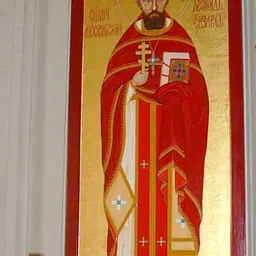
Potapy Emelianov Потапий Емельянов (c. 1889, Ufa Governorate, Russian Empire – 14 August 1936, Nadvoitsy, Segezhsky District, Karelian ASSR, USSR) was a Russian clergyman and Eastern Catholic martyr under Stalinism.
Pyotr Emelianov was born and raised in a family of Priestless Old Believers, who were received by Bishop Antony Khrapovitsky. As a special protege of Khrapovitsky, Emelianov followed him, first to Volhynia and then to Kharkiv. Emelianov eventually became a monastic priest, or Hieromonk, of the Pochaiv Lavra, and took the monastic name of Potapy.
Following the Russian Revolution, Emelianov was received by Exarch Leonid Feodorov into the Russian Greek Catholic Church and communion with the Holy See along with his entire Old Ritualist parish, which was located at Nizhnaya Bogdanovka, near Kadiivka in the Luhansk Oblast of modern Ukraine, in 1918. He was subjected three times to flogging at the insistence of local Orthodox priests, arrested repeatedly by the armies of multiple political factions during the Russian Civil War, and, after having refused to renounce his "Jesuit politics", narrowly escaped summary execution by General Anton Denikin's anti-communist White Army. After subsequently being released when Starobielsk was captured by the Red Guards, Fr. Potapy returned immediately to his parishioners and wrote in a letter to a fellow priest, "Do not worry that they persecute and torment us; we stand firmly upon the Rock of Peter." Potapy's current title is Servant of God.
Early life Two Old Believer sectarians in traditional dress from Nikolaevsk, Alaska. Pyotr Andreevich Emelianov was born in Ufa Governorate around 1889 into a peasant family of Bezpopovtsy, or Priestless Old Believers. His ancestors had left the Russian Orthodox Church in the mid-17th-century, over the liturgical reforms introduced by Patriarch Nikon of Moscow and Tsar Alexis of Russia, who both enforced conformity in vain using excommunication, Siberian internal exile, torture, and even burning at the stake for heresy. In about 1901, a nine year old Pyotr and his family were received into the Russian Orthodox Church as Edinovertsy, or Old Ritualist Orthodox, by the Bishop of Ufa and Menzelinsk, Anthony (Khrapovitsky).
When Kyr Anthony was named Bishop of Volhynia in 1902, he brought the young Pyotr Emilianov with him. He was tonsured at the Pochaiv Lavra, the monks of which are famous for their anti-Catholicism, by the Bishop, and took the monastic name of Potapy. Although a monk, Brother Potapy was briefly conscripted into the Imperial Russian Army, but was released for reasons of ill-health, and was sent by his Bishop to study for the Orthodox priesthood at Zhitomir.
A view of the still Greek-Catholic Pochaiv Lavra during the early 1800s. According to Deacon Vasili von Burman, "During his pastoral studies in Zhitomir, the monk Potapy became fascinated by the writings of the Holy Fathers of the Church and the proceedings of the Ecumenical Councils. He was struck most forcibly by the testimony of the Holy Fathers supporting the supremacy of the Roman Pontiff. In this way young Potapy gradually became possessed by the idea of reunion with Rome."
Zhitomir was the location of St Sophia's Cathedral and still remains today one of the main population centers of both Roman Catholicism and Poles in Ukraine. Even so, Deacon Vasili von Burman continues, "Until this time, Potapy had never in his life met a single Catholic; consequently there could be no question of Catholic influence on him from any external source."
According to Pavel Parfentiev, "Fr. Potapy gained the love of the town at once. His perfect knowledge of the liturgical services and his fine sermons attracted people from the other parishes and even from other villages." In response, the parishioners asked the Bishop to assign Fr. Potapy to them permanently, alleging that their regular Pastor was, "idle and lazy". The Bishop agreed to their request.
Before Fr. Potapy returned to Boganovka, Exarch Feodorov informed him that Ukraine had been excluded from the Russian Catholic Exarchate and that his parish was therefore subject to Metropolitan Andrey Sheptytsky. Exarch Feodorov promised, however, to soon send Fr. Gleb Verkhovsky to visit Bogdanovka in his name.
Fr. Potapy later wrote, "When I returned to the parish with the Catholic blessing of the Exarch, and with his commission and message, and read it aloud after a sung Moleben, the spiritual joy and the tears knew no bounds, because the message was filled with the warmest fatherly love and exhortation."
On 25 September 1918, Bishop Neophyte, the assistant to the Archbishop of Kharkiv, arrived in Nizhnaya Bogdanovka with a force of fifty soldiers of the Ukrainian People's Army. Most Old Ritualist Greek Catholics of the village fled, while those who remained listened as the Bishop, with tears in his eyes, pleaded with them to return to the Russian Orthodox Church.
In reply, the villagers said, "In our pastor's eyes we saw not only tears, but blood, caused by the floggings done at your orders." They then knelt down before the Bishop and said, "Please, leave us alone with our convictions and our pastor."
On May 3, 1922, the People's Commissariat of Justice granted Father Potapy and his parishioners a church. At the time, the Old Ritualist Greek Catholic parish at Nizhnaya Bogdanovka consisted of 828 members.
On January 27, 1927, Father Potapy was arrested and, in a search of his rectory, GPU agents found letters from These letters were used to charge Father Potapy with "counterrevolutionary activity." Father Potapy's distribution of money, food, and clothing during the 1921 famine was interpreted as bribing local peasants to convert to Catholicism. Until his arrest, Father Potapy was the last priest of the Russian Greek Catholic Church still living as a free man in the USSR.
On September 12, 1927, a special decree of the OGPU Collegium sentenced Father Potapy to 10 years in the GULAG.
Upon his arrival, Father Potapy was held with other priests, who included Roman Catholic priests, fellow priests of the Russian Greek Catholic Church led by Exarch Leonid Feodorov, and priests of the Servites of the Immaculate Conception of the Georgian Greek Catholic Church led by Exarch Shio Batmanishvili.
Anzer Island
In early 1929, along with other Catholic priests, Father Potapy was transferred to Trinity Monastery Penal Detachment, a prison camp located on nearby Anzer Island, where, according to Anne Applebaum, "prisoners worked felling trees with no respite, no breaks, and little food." The commandant of one Anzer Island camp, a Chekist named Ivan "Vanka" Potapov, regularly showed new arrivals at the camp a heap of human hands and feet that his prisoners had severed in a vain quest for a little rest. Potapov also boasted that he had killed more than 400 prisoners with his own hands.
According to Irina Osipova, "On Anzer Island the Catholic Clergy were housed in separate barracks and even at work were permitted no contact with other convicts."
Despite this, Father Potapy and his fellow priests secretly obtained the necessities for saying Mass and continued to carry out secret religious worship. When Fr. Felix Liubczynski, a dying Roman Catholic priest formerly stationed in the village of Kushelevka, in the Gaysinsky Uyezd of modern Ukraine, was moved to the camp infirmary, Father Potapy, who was also in the infirmary, helped lighten his colleague's last days.
Fr. Donat Nowicki, a Russian Greek Catholic priest of Polish ethnicity, later recalled, "To Fr. Felix's distress, his ward orderly was deliberately callous, denying him even the most basic aid. Fr. Potapy, aiming to relieve, as far as possible, the plight of his poor sick brother, secured his own transfer to the same ward and cared for the patient like a mother... Fr. Potapy was an excellent conversationalist and raconteur. His conversation offered more than a little comfort to Fr. Felix and lightened his last days. Observing that the end was approaching, Fr. Potapy reminded the sick man of confession, with a touching concern that gave the latter some moments of profound happiness. After confession, Fr. Felix repeatedly kissed his [benefactor's] hands, holding them in his own for a long time."
After Fr. Liubczynski's death on November 17, 1931, Fr. Potapy immediately offered a Greek Catholic funeral service, or Panikhida, which he knew by heart. Fr. Potapy and his fellow Catholic priests then successfully overcame seemingly impossible obstacles to build a coffin and give Fr. Felix Liubczynski a decent Christian burial within the GULAG.
Letter and aftermath After his release from the infirmary in December 1931, Father Potapy rejoined his fellow priests on Anzer Island. In addition to giving each other both moral and spiritual support, however, the priests on Anzer Island also sought to inform the Polish Red Cross and the Polish Foreign Ministry of the conditions under which they were being held.
Early in 1932, a letter written on Anzer Island by Fr. Adolf Filipp successfully reached the Second Polish Republic and was published in the Polish press. The letter read, "We, Catholic priests and almost all elderly or sick, are often forced to undertake the heaviest labor, as, for example, excavating trenches to build foundations, hauling great rocks, digging at the frozen ground in winter... We sometimes have to be outside on duty for 16 hours a day in winter, without a break and with no shelter... After heavy work we absolutely require a lengthy rest period but in our accommodation the space per man is at times reduced to less than one sixteenth of the volume of air a human being needs to survive."
In the summer of 1932, Father Potapy was one of 23 priests arrested as part of the GPU's investigation and prosecution of, "The anti-Soviet counterrevolutionary organization of Catholic and Uniate Clergy on Anzer Island."
The defendants all stood accused of the, "creation of an anti-Soviet group that conducted anti-Soviet agitation, clandestinely celebrated Mass and religious rites and maintained an illegal contact with a free worker for purposes of transmitting abroad information of an espionage character about the situation of Catholics in the USSR."
During interrogation, Fr. Potapy said: "In this place, I have become an even more committed Catholic and nothing can shake me."
Death The memorial at Povenets to the Gulag inmates who died during the building of the White Sea–Baltic Canal. On August 4, 1936, Fr. Potapy Emelianov, who had been one of the slave laborers who remained to run the canal after its completion, was finally released from the Gulag and sentenced to internal exile. He died on August 14, 1936, allegedly at Podvoitsy, Pavel Parfentiev, the former Postulator for his Sainthood cause, gives Father Potapy's place of death instead as the still extant railroad station at Nadvoitsy, but adds that, if he was buried, the location of his grave remains unknown. Fabijan Abrantovich, Anna Abrikosova, Igor Akulov, Potapy Emelianov, Halina Jętkiewicz, and Andrzej Cikoto; was submitted to the Holy See's Congregation for the Causes of Saints by the Bishops of the Catholic Church in Russia.
In June 2021, the Bishops of the Catholic Church in Russia announced, as part of a restructuring of the ongoing investigations and due to a delay in receiving necessary documents from Major Archbishop Sviatoslav Shevchuk of the Ukrainian Greek Catholic Church, that Fr. Potapy Emelianov's Beatification Cause has been moved to the back burner.
Don’t just read it —
keep it.
Full-length biographies made to live with: read them, listen on the way to work, watch them tonight.
- E-book
- Audio
- Video
Instant download · yours to keep · every purchase keeps this site free
Important facts
People in Potapy Emelianov's life
Named in this biography and alive at the same time



Related people
Same field, nearest in time

Contemporaries
People whose lives overlapped Potapy Emelianov's

Frequently asked questions
Who was Potapy Emelianov?
Russian priest
When was Potapy Emelianov born?
Potapy Emelianov was born in 1884 in Ufa Governorate.
When did Potapy Emelianov die?
Potapy Emelianov died on 14 August 1936 in Murmansk.
What was Potapy Emelianov's occupation?
Potapy Emelianov was a priest.
What nationality was Potapy Emelianov?
Potapy Emelianov was Russian.
Sources & further reading
Cite this page
APA: Biography.guide. (2026). Potapy Emelianov. https://biography.guide/potapy-emelianov/
MLA: "Potapy Emelianov." Biography.guide, https://biography.guide/potapy-emelianov/.
Chicago: "Potapy Emelianov." Biography.guide. https://biography.guide/potapy-emelianov/.
Data last updated: 2026-09-20 · Spot an error? Report a correction.
Page generated 2026-09-27 05:26 UTC