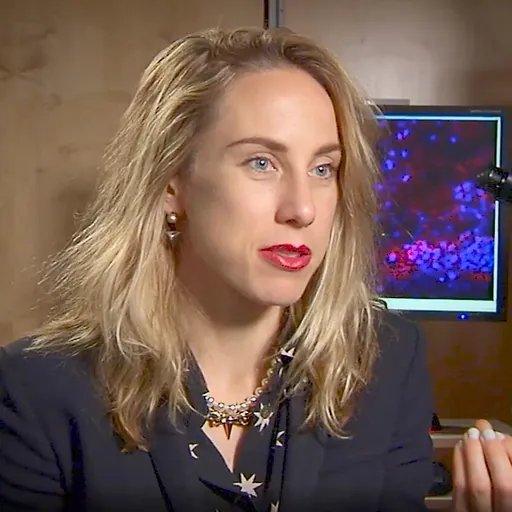
About Polina Anikeeva
Born 1982. Polina Anikeeva is a researcher.
Early life and education Anikeeva was born in Saint Petersburg, Russia (then Leningrad, Soviet Union), the daughter of mechanical engineers. At 12, Anikeeva was admitted to the Physical-Technical High School. She studied biophysics at St. Petersburg State Polytechnic University, where she worked under the guidance of Tatiana Birshtein, a polymer physicist at the Institute of Macromolecular Compounds of the Russian Academy of Sciences. During her undergraduate studies she also completed an exchange program at ETH Zurich While a graduate student, she was the lead author on a seminal paper that reported a method for generating QD light-emitting devices with electroluminescence tunable over the visible spectrum (460 nm to 650 nm). Her doctoral research was commercialized by the display industry, and acquired by a manufacturer that eventually became part of Samsung.
Research and career Anikeeva moved to Stanford University and was appointed to Karl Deisseroth's neuroscience laboratory as a postdoctoral scholar, where she created devices for optical stimulation and recording from brain circuits. The Deisseroth laboratory pioneered Optogenetics, a technique that utilizes light-sensitive ion channels such as Channelrhodopsins to modulate neuronal activity. Anikeeva worked on combining tetrodes, electronic modalities used to record neuronal activity, with optical waveguides to create optetrodes. In Deisseroth's lab, Anikeeva found a way to improve upon the fiber-optic probes they were using. Through her version, she incorporated multiple electrodes, allowing them to better capture neuronal signals. These optoelectronic devices could be used to record the electrical activity invoked by light delivered through the waveguide.
Anikeeva returned to Cambridge, Massachusetts as an AMAX Career Development Assistant Professor at MIT in 2011. The Anikeeva laboratory, which is also referred to as Bioelectronics@MIT, engineers tools to study and control the nervous system. By pursuing wireless technologies, Anikeeva's group has demonstrated techniques that use magnetic fields and injected nanoparticles to activate cells within mice brains. and include materials such as photoresists and hydrogels.
Anikeeva's second main research theme is using magnetic fields to wirelessly modulate neuronal activity. Unlike light, which has a limited penetration depth in biological tissues due to attenuation, weak alternating magnetic fields (AMFs) have minimal coupling to biological tissues due to tissues' low conductivity and negligible magnetic permeability. In 2015, Anikeeva and her students demonstrated in a key paper published in Science that magneto-thermal stimulation with magnetic nanomaterials could be used for wireless deep brain stimulation. Follow up studies from the Anikeeva laboratory then extended this concept to stimulate mechanosensitive channels. Anikeeva and her colleagues have also shown that these magnetic nanomaterials can additionally be used to trigger drug delivery, hormone release, and for stimulating acid-sensing ion channels. Now, Anikeeva emphasizes the reciprocal communication between the body and brain involving their two-way interaction. Her team continues to regulate and explore functions that had previously been attributed solely to central neural control. Her first device contains 6 tungsten microelectrodes, an optical channel for optogenetics and fiber photometry, and a fluidic channel.
During the BrainMind Special Forum on Neuromodulation + BCI + AI in June 2024, Anikeeva explained how traditional sharp materials are dangerous when injected into the brain's soft tissues. To address this, Anikeeva's team draws inspiration from the flexibility and signal transmission capabilities of natural nerves. Much of Anikeeva's recent work emphasizes the interconnectedness of the brain and body, noting that many neurological conditions also involve gastrointestinal (GI) symptoms. However, developing therapies concerning these disorders has proven a recent challenge as it is difficult to deliver them across the blood-brain barrier. Anikeeva's recent work on magnetic stimulation has raised the possibility to avoid the barrier altogether. Her future projects aim to investigate the interplay between digestive health and these neurological conditions. She discussed her work on neuroprosthetics and brain-machine interfaces, emphasizing her approach to match the brain's mechanical complexity through minimally-invasive materials. "Why You Shouldn't Upload Your Brain to a Computer," TEDxCambridgeSalon (2018). She explained the distinctions between the human brain and artificial intelligence, proposing them to collaborate.
Awards and honors 2013 National Science Foundation CAREER Award 2013 National Academy of Engineering Frontiers of Engineering Symposium 2013 DARPA Young Faculty Award (YFA) 2013 Sanofi Biomedical Innovation Award 2014 Dresselhaus Foundation Inaugural Award 2014 Outstanding Faculty Undergraduate Research (UROP) Mentor, MIT 2015 Junior Bose Teaching Award, School of Engineering, MIT 2015 MIT Technology Review Top Innovators Under 35 2016 National Institutes of Health Funded Award in Multi-Site Non-Invasive Magnetothermal Excitation and Inhibition of Deep Brain Structures 2017 SPIE Women in Optics planner 2020 Margaret MacVicar Faculty Fellowship 2021 National Institutes of Health Director's Pioneer Award for Fusion of Nanomagnetic and Viral Tools to Interrogate Brain-Body Circuits
Selected publications
Don’t just read it —
keep it.
Full-length biographies made to live with: read them, listen on the way to work, watch them tonight.
- E-book
- Audio
- Video
Instant download · yours to keep · every purchase keeps this site free
Important facts
People in Polina Anikeeva's life
Named in this biography and alive at the same time


Related people
Same field, nearest in time




Contemporaries
People whose lives overlapped Polina Anikeeva's





Frequently asked questions
Who is Polina Anikeeva?
Russian-American materials scientist
When was Polina Anikeeva born?
Polina Anikeeva was born in 1982 in Saint Petersburg.
What is Polina Anikeeva's occupation?
Polina Anikeeva is a researcher.
Sources & further reading
Cite this page
APA: Biography.guide. (2026). Polina Anikeeva. https://biography.guide/polina-anikeeva/
MLA: "Polina Anikeeva." Biography.guide, https://biography.guide/polina-anikeeva/.
Chicago: "Polina Anikeeva." Biography.guide. https://biography.guide/polina-anikeeva/.
Data last updated: 2026-09-23 · Spot an error? Report a correction.
Portrait: Wikimedia Commons · author & licence
Page generated 2026-09-27 05:07 UTC