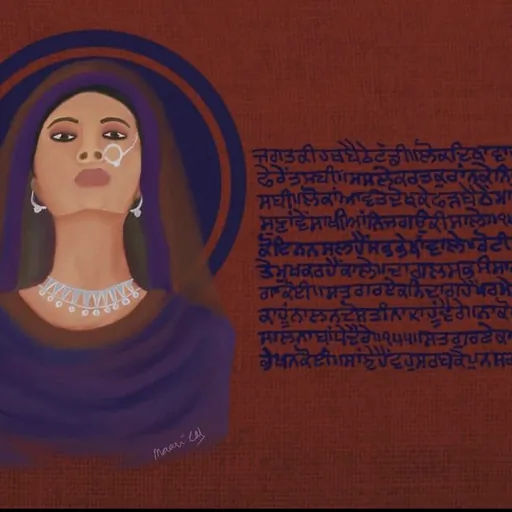
About Piro Preman
Lived 1832 – 1872 (aged 39–40). Piro Preman was a poet and writer.
Piro Preman (1832–1872 or 1875 ) was the first female Punjabi poet, and an ex-Muslim follower of the Gulabdasia sect. She was formerly a Dalit Mirasi Muslim courtesan(tawaif) and prostitute named Ayesha.
Biography
Little is known about Piro's life. She apparently had Dalit origins. Her mother is said to have died early after she was born and she accompanied her fakir father to various places of pilgrimage.
Most of the information about Piro comes from her own autobiographical verses, the Ik Sau Sath Kafian or the "One Hundred and Sixty Kafis (160 Kafis)", written in the mid-nineteenth century. In 160 Kafis, Piro describes a series of events in her life after she began living with Gulab Das in Chathian Wala. Piro refers to herself as a prostitute, and also a Muslim. Following her arrival in Chathian Wala, Piro writes that her "professional wardens" from Heera Mandi followed her and persuaded Gulab Das to send her back to Lahore. She ultimately agreed to return to Lahore, where she describes a confrontation with mullahs and qazis who assume that she has not only become an apostate, but also converted to the religion of her guru, thus becoming a kafir. Piro does not deny apostasy or conversion, but refuses to convert back to Islam. She abuses the mullahs and Islam, and praises the spirituality of her guru. According to historian Anshu Malhotra, "The unabashed use of language that might be considered vulgar among the respectable today, adds a colourful dimension to Piro’s speech."
Piro Preman refused to be an abandoned lover at the mercy of a cruel beloved. She refused to wait for a beloved who would deign to give her his acceptance. She wrote:
“Piro! I will not accept the companionship of a lie.
Those that are separated will never meet, just like a broken thread.
Nor family, nor your in-laws, not your age-mates, neither your friends.
They disperse as people do when they disembark from a boat.”
Piro and Gulab Das shared an intimate relationship despite social and religious pressures. The two were interred together at a tomb in Chathian Wala. Although the Gulabdasis were neither Hindu nor Sikh, following the Partition of India, they were expelled from Chathian Wala by the now Muslim-majority populace in Pakistan. The sect subsequently fled to India where they settled in Haryana.
In popular culture Piro's life has been the subject of two Indian plays – Piro Preman written by Shahryar in 1999, and Shairi written by Sawrajbir in 2004.
Don’t just read it —
keep it.
Full-length biographies made to live with: read them, listen on the way to work, watch them tonight.
- E-book
- Audio
- Video
Instant download · yours to keep · every purchase keeps this site free
Important facts
Related people
Same field, nearest in time

Contemporaries
People whose lives overlapped Piro Preman's



Frequently asked questions
Who was Piro Preman?
Punjabi poet
When was Piro Preman born?
Piro Preman was born in 1832 in Sikh Empire.
When did Piro Preman die?
Piro Preman died in 1872 in Punjab.
What was Piro Preman's occupation?
Piro Preman was a poet and writer.
Sources & further reading
Cite this page
APA: Biography.guide. (2026). Piro Preman. https://biography.guide/piro-preman/
MLA: "Piro Preman." Biography.guide, https://biography.guide/piro-preman/.
Chicago: "Piro Preman." Biography.guide. https://biography.guide/piro-preman/.
Data last updated: 2026-09-20 · Spot an error? Report a correction.
Portrait: Wikimedia Commons · author & licence
Page generated 2026-09-27 04:57 UTC