
About Pierre-Joseph Céloron de Blainville
Lived 1693 – 1759 (aged 65). Pierre-Joseph Céloron de Blainville was a French explorer.
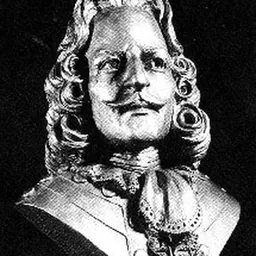
Pierre-Joseph Céloron de Blainville (29December 169314April 1759), also known as Celeron de Bienville (or Céleron, or Céloron, etc.), was a French Canadian Officer of Marine. In 1739 and 1740 he led a detachment to Louisiana to fight the Chickasaw in the abortive Chickasaw Campaign of 1739. In 1749 he led the "Lead Plate Expedition" to advance France's territorial claim on the Ohio Valley.
Biography
Pierre Joseph Céloron de Blainville was born at Montreal on 29 December 1693. He was the son of Jean-Baptiste Céloron de Blainville and Hélène Picoté de Belestre.
Céloron entered military service in 1713. At this time the French collaborated with the Indians in pressuring the New England colonies. He was promoted to lieutenant in 1731. He was appointed lieutenant commandant to the post at Michilimackinac in 1734 (Burton, 328). See picture. Map of the route followed by Pierre Joseph Céloron de Blainville along the Ohio River in 1749, drawn by Joseph Pierre de Bonnecamps.From 1743 to 1748, Britain and France fought King George's War. During this war, England blockaded New France, breaking down the French fur trade. The British became the major trading partners with Native Americans in the Ohio valley.
France claimed the Ohio Valley (and indeed the entire Mississippi basin) on the basis of the explorations made by La Salle in 1669 and 1682. Great Britain claimed the Ohio Valley on the basis of purchases from Native Americans in 1744. In fact, both the colonies of Virginia and Pennsylvania had claims on the Ohio valley, although in the 1740s and 1750s, Virginia was more active in pressing her claim.
According to R. E. Banta, author of The Ohio [Rivers of America series], in May 1749, the Ohio Company of Virginia received a grant from King George, which included 200,000 acres on the south bank of the Ohio between the Monongahela and the Great Kanawha Rivers. One goal of establishing this grant was to test the willingness of the French to defend the Ohio. The grant in turn provoked the immediate dispatch of Céloron's expedition from Montreal (page 65).
In 1748, Comte de la Galissoniere, the governor of Canada, ordered Céloron to strengthen the French claim on the Ohio Valley. Céloron carried out this mission in the summer of 1749 by means of an expedition through the contested territory. He set out from Montreal on June 15, 1749, in a flotilla consisting of large boats and canoes. The expedition included 216 French Canadians and 55 Native Americans. On the shore of Lake Erie, at the mouth of Chautauqua Creek in present-day Westfield, New York, the expedition cut a road over the French Portage Road, and carried their boats and equipment overland to Chautauqua Lake, then followed the Chadakoin River and Conewango Creek to the Allegheny River, reaching it on July 29, 1749, in what is now the City of Warren, PA..
As it progressed, the expedition sought to strengthen France's claim to the territory by marking it at the mouths of several principal tributaries. At each point, a tin or copper plate bearing the French royal arms was nailed to a tree. Below, an inscribed leaden plate was buried, declaring the claims of France. This was a traditional European mode of marking territory, but it might have contributed to Native American anxieties about the intentions of the French, and thus ultimately had a counterproductive effect.
Reaching the Monongahela River, the party boated past Shannopin's Town at the current site of Pittsburgh, and down the Ohio River. They paused at Kittanning, but found the village abandoned except for a Lenape chief, whom they invited to attend a council meeting with Céloron at Logstown. At Logstown, in present-day western Pennsylvania, Céloron discovered English traders. Incensed, he evicted the traders and wrote a scolding note to the governor of Pennsylvania. He then hectored the Native Americans about French dominance of the region. This overbearing behavior offended the Iroquois in his party, some of whom returned to their homeland in present-day New York, tearing down copper plates as they went.
A plate was buried at the mouth of the Muskingum River on August 15, 1749, and the mouth of the Kanawha River on August 18, 1749. Arriving at Lower Shawneetown at the Scioto River's mouth on August 21, he again encountered English traders. Céloron summoned them to his camp on August 25 and demanded that they leave, stating that "they had no right to trade or aught else on the [Ohio] River," but most refused.
The expedition then traveled up the Great Miami River to Pickawillany, arriving there on 13 September. They spent a week camped outside the village and met briefly with the chief Memeskia, who promised to consider returning to live near Detroit as a French ally. Céloron later remarked, speaking in general about his journey, that "the nations of these localities are very badly disposed towards the French, and are entirely devoted to the English."
Five months after the expedition began, it returned to Montreal, arriving November 10, 1749. Céloron's journal is archived at Archives of the de la Marine, Paris, France (Galbreath, 12).
In total, Céloron buried at least six lead plates. One was stolen by curious Indians almost immediately, possibly before it was even buried, and placed in British hands. Two more were found in the early 19th Century. Measuring about eleven inches long and seven and one-half inches wide, each lead plate was marked with an inscription as follows (Galbreath, 110–111):
The French continued to press their claim to the Ohio Valley, and colonial friction with the British finally contributed to outbreak of the Seven Years' War.
Last years and death Upon his return, Céloron was reappointed to the important post at Detroit, and in 1753, was promoted to Major and appointed to Montreal. He died at Montreal on April 14, 1759 (Burton, 332).
Family Céloron had three children by his first wife, Marie Madeline Blondeau, married December 30. 1724. His second wife was Catherine Eury de la Parelle, married in Montreal on October 13, 1743, and with whom he enjoyed nine children (Burton, 327).
Don’t just read it —
keep it.
Full-length biographies made to live with: read them, listen on the way to work, watch them tonight.
- E-book
- Audio
- Video
Instant download · yours to keep · every purchase keeps this site free
Important facts
Related people
Same field, nearest in time

Contemporaries
People whose lives overlapped Pierre-Joseph Céloron de Blainville's




Frequently asked questions
Who was Pierre-Joseph Céloron de Blainville?
French explorer (1693-1759)
When was Pierre-Joseph Céloron de Blainville born?
Pierre-Joseph Céloron de Blainville was born on 29 December 1693 in Montreal.
When did Pierre-Joseph Céloron de Blainville die?
Pierre-Joseph Céloron de Blainville died on 12 April 1759 in Montreal.
What was Pierre-Joseph Céloron de Blainville's occupation?
Pierre-Joseph Céloron de Blainville was an explorer.
What nationality was Pierre-Joseph Céloron de Blainville?
Pierre-Joseph Céloron de Blainville was French.
Sources & further reading
· Wikipedia: Pierre-Joseph Céloron de Blainville
· DBpedia: Pierre Joseph Céloron de Blainville
Cite this page
APA: Biography.guide. (2026). Pierre-Joseph Céloron de Blainville. https://biography.guide/pierre-joseph-celoron-de-blainville/
MLA: "Pierre-Joseph Céloron de Blainville." Biography.guide, https://biography.guide/pierre-joseph-celoron-de-blainville/.
Chicago: "Pierre-Joseph Céloron de Blainville." Biography.guide. https://biography.guide/pierre-joseph-celoron-de-blainville/.
Data last updated: 2026-09-20 · Spot an error? Report a correction.
Page generated 2026-09-27 05:07 UTC