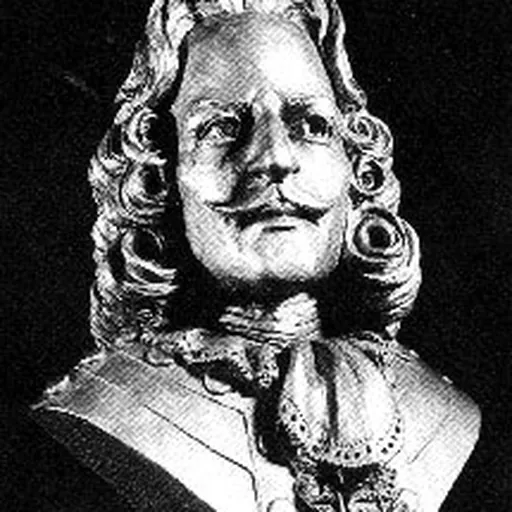
About Antoine de la Mothe Cadillac
Lived 1658 – 1730 (aged 72). Antoine de la Mothe Cadillac was a French explorer and military personnel.
Antoine de la Mothe, sieur de Cadillac (, ; March 5, 1658 – October 16, 1730), born Antoine Laumet, was a French explorer, military officer, colonial administrator in New France, and founder of Detroit, Michigan.
Born in Gascony, Cadillac arrived in Acadia in 1683 at age 25. He was the commander of Fort de Buade in St. Ignace and founded Fort Pontchartrain du Détroit in 1701. Cadillac envisioned Detroit as a major settlement in the Pays d'en Haut, which he referred to as the "Paris de la Nouvelle-France" (Paris of New France), and he planned its early development. In 1710, Cadillac was appointed colonial governor of French Louisiana. King Louis XIV awarded him the Order of Saint Louis.
Cadillac's bold personality and to a lesser extent his Franciscan affiliation earned him many enemies, including the Jesuits in Quebec, who accused him of various crimes. This led to his detention in 1704, although he cleared his name the following year. In 1717, Cadillac was removed from his colonial office and was briefly imprisoned twice during a power struggle with financier Antoine Crozat. Later, Cadillac held the mayoral office of Castelsarrasin, where he died in 1730.
In contrast to many French aristocrats and officials of his time, Cadillac, despite holding various high-ranking positions both in the colonies and in France, has no surviving authentic portrait. The images that do exist are primarily artistic sketches created long after his death. Historians suggest that the absence of an authenticated portrait of Cadillac is likely a damnatio memoriae instigated by his numerous enemies. Nevertheless, Cadillac's name is commemorated by an automobile company established in 1902 by William Murphy and Henry M. Leland. Western culture has historically idealized him as a hero, with numerous places named after him. However, contemporary liberal scholars often critique his colonial activities.
Early life
Cadillac was born Antoine Laumet on March 5, 1658, in Saint-Nicolas-de-la-Grave in the province of Gascony (today in the Tarn-et-Garonne, Occitanie). His father, Jean Laumet, was born in Caumont-sur-Garonne. He became a lawyer in the Parlement of Toulouse. In 1652 Jean was appointed lieutenant to the judge of Saint-Nicolas-de-la-Grave by Cardinal Mazarin and appointed as a judge in 1664. Antoine's mother, Jeanne Péchagut, was the daughter of a merchant and landowner. His youth included rigorous study at a Jesuit institution where he learned theology, law, agriculture, botany and zoology.
In a record of service he filled out in 1675, he said that he had enlisted in the military as a cadet at age 17 in the Dampierre regiment, in Charleroi, nowadays Belgium. Two years later in personal letters, however, he reported that he had been an officer in the Clérambault regiment in Thionville, and in 1682 he had joined the Albret regiment, in Thionville. The marriage certificate is the first document that records his new identity. He identified as "Antoine de Lamothe, écuyer, sieur de Cadillac", and signed as "De Lamothe Launay". Like many immigrants, he took advantage of emigrating to the New World to create a new identity, perhaps to conceal the reasons that drove him from France. This new identity "ne sort pas de son sac" ("I did not create this identity out of nowhere"), as he wrote later. Antoine Laumet based his new titles on those Sylvestre d'Esparbes de Lussan de Gout, baron of Lamothe-Bardigues, lord of Cadillac, Launay and Le Moutet; adviser to the Parliament of Toulouse. He knew him for at least two reasons: Bardigues, Cadillac, Launay and Le Moutet are villages and localities close to his birthplace, Saint-Nicolas-de-la-Grave, and Antoine's father Jean Laumet was a lawyer in the Parliament of Toulouse.
They had six daughters and seven sons: Judith (1689), Magdeleine (1690), Marie Anne (1701)? (1702), Marie-Thérèse (1704), Marie-Agathe (December 1707) and Joseph (1690), Antoine (1692), Jacques (1695), Pierre-Denis (1699–1700), Jean-Antoine (January 1707 – 1709), François (1709), René-Louis (1710–1714).
Les Douacques
In 1688, the Governor General of New France Jacques-René de Brisay de Denonville gave him the concession of the seigniory (estate) of Les Douacques (which later became Bar Harbor, Maine). His concession brought him no income, even from agriculture. Cadillac entered into a trading partnership with officers of Port Royal, an activity facilitated by using a ship owned by his brothers-in-law Guyon. In 1689, he was sent on an expedition in the vicinity of Boston. Upon his return, he asked the governor of Acadia, Louis-Alexandre des Friches de Méneval, for a job as notary, to bring in a minimum income; his request was turned down. Then, Cadillac was introduced to Governor Louis de Buade de Frontenac in Quebec, who sent him on an exploratory mission along the coasts of New England, aboard the frigate L'Embuscade (The Ambush). Strong head winds forced the ship to return to France.
In 1696, to mitigate the difficulties of fur trading, the king ordered the closing of all trading posts, including Michilimackinac. Cadillac returned to Montreal. In 1697, he was authorized to return to France to present his project of a new fort on the strait to Pontchartrain; Frontenac requested that Cadillac be promoted to lieutenant commander. However, Canadian notables strongly opposed the project, which they believed would lead to the ruin of Quebec and Montreal. In 1700 installation of the fort was approved, and its command was given to Cadillac.
Louisiana (1710–1716)
Antoine Crozat, a French financier, was persuaded by Cadillac to invest in Louisiana. However, conflicts arose between them, leading to Cadillac's removal from his colonial office in 1716.
In June 1713, the Cadillac family arrived at Fort Louis, Louisiana (now Mobile, Alabama). In 1714 Crozat recommended the construction of forts along the Mississippi River, whereas Cadillac wished to strengthen defenses at the river delta and to develop trade with nearby Spanish colonies.
In 1715, Cadillac and his son Joseph prospected in the Illinois Country (Upper Louisiana), where they claimed to have discovered a copper mine, although there is no copper ore in that area. They established a farm and founded the settlement of St. Philippe on the east side of the Mississippi River. Cadillac directed the first mining of lead in present-day Missouri at what is now called Mine La Motte on the west side of the river. The French brought in slaves to work at the mine; they were the first people of African descent in the future state of Missouri. The production of lead was important for ammunition in the colonies. The Southeast Missouri Lead District is still a major source of that metal. This settlement eventually transformed into Detroit. Additionally, Cadillac imagined a port to be established near the mouth of the Mississippi River, which was later founded by Jean-Baptiste Le Moyne de Bienville in 1718 as New Orleans. A museum in his birthplace opened in 1974, conceived of and funded by historians in Detroit.
A street in the Guybourg area in Longue-Pointe (now Mercier) on the island of Montreal was named in honour of Cadillac. In 1976, Cadillac station on the green line of the Montreal Metro was opened at this street.
In 1703, Cadillac proposed the establishment of a seminary in the parish of Sainte-Anne-de-Détroit in Detroit, aimed at educating both Indigenous and French children in piety and the French language. He pledged his future support for this seminary, which foreshadowed the founding of the Catholepistemiad, known today as the University of Michigan. In 2016, the public French high school in Windsor, Ontario, was renamed in Cadillac's honour.
Don’t just read it —
keep it.
Full-length biographies made to live with: read them, listen on the way to work, watch them tonight.
- E-book
- Audio
- Video
Instant download · yours to keep · every purchase keeps this site free
Important facts
People in Antoine de la Mothe Cadillac's life
Named in this biography and alive at the same time


Related people
Same field, nearest in time


Contemporaries
People whose lives overlapped Antoine de la Mothe Cadillac's




Frequently asked questions
Who was Antoine de la Mothe Cadillac?
French explorer
When was Antoine de la Mothe Cadillac born?
Antoine de la Mothe Cadillac was born on 5 March 1658 in Saint-Nicolas-de-la-Grave.
When did Antoine de la Mothe Cadillac die?
Antoine de la Mothe Cadillac died on 16 October 1730 in Castelsarrasin.
What was Antoine de la Mothe Cadillac's occupation?
Antoine de la Mothe Cadillac was an explorer and military personnel.
What nationality was Antoine de la Mothe Cadillac?
Antoine de la Mothe Cadillac was French.
Sources & further reading
· Wikipedia: Antoine de la Mothe Cadillac
· DBpedia: Antoine de la Mothe Cadillac
Cite this page
APA: Biography.guide. (2026). Antoine de la Mothe Cadillac. https://biography.guide/antoine-de-la-mothe-cadillac/
MLA: "Antoine de la Mothe Cadillac." Biography.guide, https://biography.guide/antoine-de-la-mothe-cadillac/.
Chicago: "Antoine de la Mothe Cadillac." Biography.guide. https://biography.guide/antoine-de-la-mothe-cadillac/.
Data last updated: 2026-09-23 · Spot an error? Report a correction.
Portrait: Wikimedia Commons · author & licence
Page generated 2026-09-27 05:06 UTC