
About Pierre Bouguer
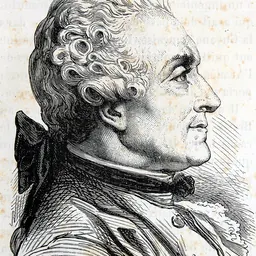
Lived 1698 – 1758 (aged 60). Pierre Bouguer was a French hydrographer, explorer, mathematician, physicist and astronomer.
Pierre Bouguer (16 February 1698, Le Croisic, Province of Brittany – 15 August 1758, Paris) was a French mathematician, geophysicist, geodesist, and astronomer. He is also known as "the father of naval architecture". In optics, he is known for making the first numerical photometric measurement.
Career
Bouguer's father, Jean Bouguer, one of the best hydrographers of his time, was Regius Professor of hydrography at Le Croisic in lower Brittany, and author of a treatise on navigation. He taught his sons Pierre and Jan at their home, where he also taught private students. In 1714, at the age of 16, Pierre was appointed to succeed his deceased father as professor of hydrography. In 1727 he gained the prize given by the French Academy of Sciences for his paper On the masting of ships, beating Leonhard Euler; and two other prizes, one for his dissertation On the best method of observing the altitude of stars at sea, the other for his paper On the best method of observing the variation of the compass at sea. He found the light of the sun to be 300,000 times more intense than that of the moon, and thus made some of the earliest measurements in photometry. In 1730 he was made professor of hydrography at Le Havre, and succeeded Pierre Louis Maupertuis as associate geometer of the Academy of Sciences. He also invented a heliometer, afterwards perfected by Joseph von Fraunhofer. He was afterwards promoted in the Academy to the place of Maupertuis, and went to reside in Paris.
Bouguer's Mémoire presented to the Academy of Sciences in 1734 and published in 1736 was the first treatise on the theory of dome.
In 1735 Bouguer sailed with Charles Marie de La Condamine on a scientific mission to the Viceroyalty of Peru, more specifically to the Royal Audience of Quito (today's Ecuador), to measure the length of a degree of latitude in the meridian arc near the equator. Ten years were spent in this operation, a full account of which was published by Bouguer in 1749, La figure de la terre (French for "the figure of the earth").
In 1746 he published the first treatise of naval architecture, Traité du navire, which among other achievements first explained the use of the metacenter as a measure of ships' stability. His later writings were nearly all upon the theory of navigation and naval architecture.
In January 1750 he was elected a Fellow of the Royal Society.
Works
Recognition A crater on Mars was named in his honour. A lunar crater and an asteroid were also named after him.
His name is also recalled as the meteorological term Bouguer's halo (also known as Ulloa's halo, after Antonio de Ulloa, a Spanish member of his South American expedition) which an observer may see infrequently in fog when sun breaks through (for example, on a mountain) and looks down-sun – effectively a "fog bow" (as opposed to a "rain-bow"). It is "An infrequently observed meteorological phenomenon; a faint white, circular arc or complete ring of light that has a radius of 39 degrees and is centred on the antisolar point. When observed, it is usually in the form of a separate outer ring around an anticorona."
The term Bouguer anomaly, referring to small regional variations in the Earth's gravity field resulting from density variations in underlying rocks, is named after him.
A large bronze statue of him stands at the port in Le Croisic; see Works by Jean Fréour.
Don’t just read it —
keep it.
Full-length biographies made to live with: read them, listen on the way to work, watch them tonight.
- E-book
- Audio
- Video
Instant download · yours to keep · every purchase keeps this site free
Important facts
People in Pierre Bouguer's life
Named in this biography and alive at the same time



Related people
Same field, nearest in time



Contemporaries
People whose lives overlapped Pierre Bouguer's



Frequently asked questions
Who was Pierre Bouguer?
French astronomer and mathematician (1698-1758)
When was Pierre Bouguer born?
Pierre Bouguer was born on 16 February 1698 in Le Croisic.
When did Pierre Bouguer die?
Pierre Bouguer died on 15 August 1758 in Paris.
What was Pierre Bouguer's occupation?
Pierre Bouguer was a hydrographer, explorer, mathematician, physicist and astronomer.
What nationality was Pierre Bouguer?
Pierre Bouguer was French.
Sources & further reading
Cite this page
APA: Biography.guide. (2026). Pierre Bouguer. https://biography.guide/pierre-bouguer/
MLA: "Pierre Bouguer." Biography.guide, https://biography.guide/pierre-bouguer/.
Chicago: "Pierre Bouguer." Biography.guide. https://biography.guide/pierre-bouguer/.
Data last updated: 2026-09-26 · Spot an error? Report a correction.
Page generated 2026-09-27 05:13 UTC