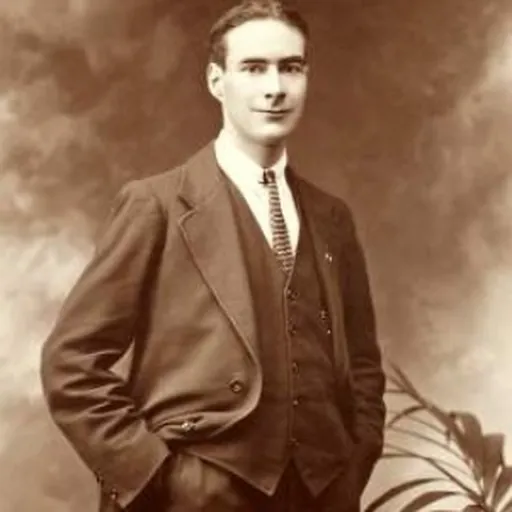
Piaras Béaslaí
Irish politician, author, playwright, biographer and translator
About Piaras Béaslaí
Lived 1881 – 1965 (aged 84). Piaras Béaslaí was a British and Irish linguist, politician, biographer, translator, editor and journalist.
Piaras Béaslaí (; 15 February 1881 – 22 June 1965) was an Irish author, playwright, biographer and translator, who was a member of the Irish Republican Brotherhood, fought in the Easter Rising and served as a member of Dáil Éireann.
Early life Piaras Béaslaí was born Percy Frederick Beazley in Liverpool, England on 15 February 1881 to Irish Catholic parents, Patrick Langford Beazley and Nannie Hickey. Patrick Langford Beazley, from Killarney, County Kerry, moved to Egremont, Cumbria and was the editor of The Catholic Times newspaper for 40 years; Nannie Hickey was from Newcastle West, County Limerick. Béaslaí's parents married in March 1878, in the West Derby district of the county of Lancashire. During his summer holidays in his younger years, he spent time in Ireland (near Kenmare, County Kerry) with his paternal uncle, Father James Beazley, where he began to learn Irish. Béaslaí was educated at St Xavier's Jesuit College in Liverpool, where he developed his keen interest in Irish; by the time he was aged 17 his Irish proficiency was exceptional.
After his early introduction to Irish poetry he became involved in staging Irish-language amateur drama at the Oireachtas annual music festival. Béaslaí began to write both original works and adaptations from foreign languages. One of these works, Eachtra Pheadair Schlemiel (1909), was translated from German into Irish. In an audio recording to which he contributed in 1958, he detailed his experience in the Rising, describing the rebels assembling before noon in Blackhall Street at battalion headquarters. After midday they marched out to the Four Courts, erecting barricades as they did so. The Four Courts was his main station.
In the audio, he recalls a green flag with a gold harp in the centre; this was the non-Sinn Féin flag at the time. On the Friday evening the General Post Office, Dublin. Béaslaí was in direct charge of the Four Courts area, and at one point during the fight he ordered a complete blackout. He recalled "things were going badly for the English soldiers" and described the whole event as "a weird experience". He remembers the streets being lit up with fires in the darkness as if it were bright as day. He speaks of the intensity of the firing line and then how it suddenly ceased on the Friday. He remembered falling asleep and when he woke being presented with PH Pearse's order to surrender. The rebels were brought to Richmond barracks. Béaslaí then spent fifteen months in English prisons.
Béaslaí served three years for penal servitude divided between a stringent Portland prison and a more lenient Lewes prison. He was then imprisoned two times within four months during 1919, both terms ending in celebrated escapes. Sinn Féin MPs who had been elected in the Westminster elections of 1918 refused to recognise the Parliament of the United Kingdom, and instead assembled the following January at the Mansion House in Dublin as a revolutionary parliament, Dáil Éireann. Béaslaí was noted for his translation of the democratic programme of the First Dáil, which he read aloud at the inaugural sitting.
He was a member of the Sinn Féin party for five years. Between 1919 and 1921 he represented the Kerry East constituency in the First Dáil. Then, at the 1921 general election, he was returned unopposed to the Second Dáil as a Sinn Féin Teachta Dála (TD) for Kerry–Limerick West. Following the signing of the Anglo-Irish Treaty, Béaslaí was re-elected there unopposed at the 1922 election as a pro-Treaty Sinn Féin candidate, and was thus a member of the 3rd Dáil, which was Pro-Treaty at this stage. In 1922 he went to the US to explain the Treaty to Sinn Féin's Irish-American supporters. He did not contest the 1923 election.
He and Con Collins share the distinction of having been elected in three Irish general elections unopposed by any other candidates.
Gaelic League
During Béaslaí's time in London, he gave a lot of his time to the Gaelic League. In the Keating branch of the league, in Ireland, Béaslaí developed an interest in the IRB. Cathal Brugha, a branch member, asked him to join the IRB. The Keating branch was where Béaslaí met Michael Collins, eventually introducing Collins to his cousin and fellow branch member, Elizabeth Mernin. Béaslaí was also instrumental in establishing An Fáinne, an Irish-speaking league whose members vowed to speak solely Irish among themselves and wore a membership badge of a circle. This coincided with his involvement in the Irish Republican Brotherhood. Béaslaí's love of the Irish language gave him an opportunity to delve into his other hobbies. He wrote for Banba, an Irish journal published by the Gaelic League. He was able to express his love for theatre, in the Gaelic League, forming a group of men called "Na hAisteoirí".
Death Béaslaí died, unmarried, aged 84 on 22 June 1965, in a nursing home in Dublin. He was buried in a plot in Glasnevin Cemetery, after a Requiem Mass in St Columba's Church, Iona Road, Glasnevin. The gravestone of Thomas Ashe, Peadar Kearney and Piaras Béaslaí at Glasnevin Cemetery.
Works Fear an sgéilín grinn: Dráma suilt (1900) Eaċtra Ṗeadair Schlemihl (1909) Michael Collins: Soldier and Statesman (1937)
Don’t just read it —
keep it.
Full-length biographies made to live with: read them, listen on the way to work, watch them tonight.
- E-book
- Audio
- Video
Instant download · yours to keep · every purchase keeps this site free
Important facts
People in Piaras Béaslaí's life
Named in this biography and alive at the same time


Related people
Same field, nearest in time

Contemporaries
People whose lives overlapped Piaras Béaslaí's



Frequently asked questions
Who was Piaras Béaslaí?
Irish politician, author, playwright, biographer and translator (1881–1965)
When was Piaras Béaslaí born?
Piaras Béaslaí was born on 15 February 1881 in Liverpool.
When did Piaras Béaslaí die?
Piaras Béaslaí died on 22 June 1965 in Dublin.
What was Piaras Béaslaí's occupation?
Piaras Béaslaí was a linguist, politician, biographer, translator, editor and journalist.
What nationality was Piaras Béaslaí?
Piaras Béaslaí was British and Irish.
Sources & further reading
Cite this page
APA: Biography.guide. (2026). Piaras Béaslaí. https://biography.guide/piaras-beaslai/
MLA: "Piaras Béaslaí." Biography.guide, https://biography.guide/piaras-beaslai/.
Chicago: "Piaras Béaslaí." Biography.guide. https://biography.guide/piaras-beaslai/.
Data last updated: 2026-09-21 · Spot an error? Report a correction.
Portrait: Wikimedia Commons · author & licence
Page generated 2026-09-27 05:00 UTC