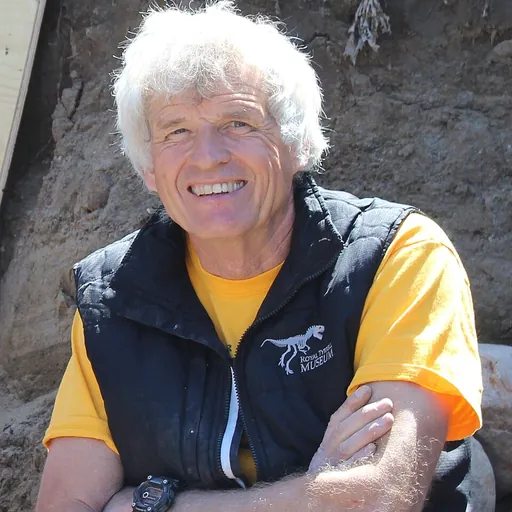
Philip J. Currie
Canadian paleontologist and museum curator
About Philip J. Currie
Born 1949. Philip J. Currie is a Canadian paleontologist, researcher, non-fiction writer and university teacher, known for Dinosaurs.
Philip John Currie (born March 13, 1949) is a Canadian palaeontologist and museum curator who helped found the Royal Tyrrell Museum of Palaeontology in Drumheller, Alberta and is now a professor at the University of Alberta in Edmonton. In the 1980s, he became the director of the Canada-China Dinosaur Project, the first cooperative palaeontological partnering between China and the West since the Central Asiatic Expeditions in the 1920s, and helped describe some of the first feathered dinosaurs. and his areas of expertise include theropods (especially Tyrannosauridae), the origin of birds, and dinosaurian migration patterns and herding behavior. He was one of the models for palaeontologist Alan Grant in the film Jurassic Park. His master's and PhD theses were on synapsids and early aquatic diapsids respectively. and later reversing this in 2017. He has also synonymised the ceratopsian taxon Rubeosaurus with Styracosaurus, the latter being the valid, senior synonym.
Bird-dinosaur link
One of Currie's main interests has been the evolutionary link between modern birds and non-avian dinosaurs. The similarities between troodontids and birds in particular made him a major proponent of the theory that birds are descended from dinosaurs, As part of the joint China-Canada Dinosaur Project, he helped describe two of the first dinosaur specimens from the lagerstätten of the Liaoning in China that clearly showed feather impressions: Protarchaeopteryx In contrast with the 1996 discovery of Sinosauropteryx, which only showed the impression of downy filaments, these were indisputably feathers.
Dinosaur behaviour
Currie became increasingly sceptical of the orthodox belief that large carnivorous dinosaurs were solitary animals, but there was no evidence for his hypothesis that they may have hunted in packs. However, circumstantial evidence came when he tracked down a site mentioned by Barnum Brown that featured 12 specimens of Albertosaurus from various age groups. Currie was also involved in the discovery of a bonebed which evidenced gregarious behaviour in the caenagnathoid Avimimus. In 2023, Currie co-authored a paper describing evidence from the Danek Bonebed that Albertosaurus engaged in cannibalism.
Phylogenetics
Currie has made important contributions to the study of phylogenetics. He contributed to a comprehensive revision of the phylogenetic relationships of ankylosaurid species in 2015. He also reassessed the phylogenetic status of Nipponosaurus sachalinensis, discovering that it was much more basal among the Lambeosaurinae than palaeontologists had previously thought. In 2022, he participated in a study that found Dineobellator to represent a novel dromaeosaurid outside any known clade of eudromaeosaurs.
Dinosaur anatomy
Currie has published multiple papers on the cranial anatomy of various dinosaurs. Together with Rodolfo Coria, he published a detailed description of the braincase of the large carcharodontosaurid Giganotosaurus carolinii in 2003, which led him to believe that Giganotosaurus and Carcharodontosaurus were very closely related genera. In 2017, he and Ariana Paulina-Carabajal wrote a paper on the anatomy of the well-preserved braincase of Murusraptor barrosaensis, finding it to be more similar to tyrannosaurids than to allosaurids or ceratosaurids. A year later, he coauthored a study detailing the endocranial morphology of the ankylosaurines Talarurus plicatospineus and Tarchia teresae. In 2019, together with David Christopher Evans, Currie described newly discovered cranial material of the dromaeosaurid Saurornitholestes langstoni and found the poorly known tooth taxon Zapsalis likely to represent the same taxon as Saurornitholestes.
Currie's contributions to the study of dinosaur dentition include helping discover the first known instance of alveolar remodelling in dinosaurs and revealing in a 2020 study that the dentition of Sinraptor bore extreme similarities to that of Allosaurus, further concluding that Sinraptor would likely have actively hunted medium-sized dinosaurs such as Jiangjunosaurus junggarensis.
Currie has extensively studied the subject of juvenile dinosaurs and dinosaur ontogeny. His publications on the subject have included studies on juveniles of Chasmosaurus, Pinacosaurus, Gorgosaurus, Daspletosaurus, and Saurornithoides.
In 1997, Currie teamed up with Microsoft's Chief Technical Officer Nathan Myhrvold to create a computer model demonstrating that diplodocids could snap their tails like whips, and create small sonic booms.
Pterosaurs
In addition to his work on dinosaurs, Currie has been involved in numerous research projects on pterosaurs. In 2011 and 2016, he was involved in the description of the first pterosaur fossils from the Northumberland Formation, a part of the Nanaimo Group, of Hornby Island in British Columbia, finding that they probably represented indeterminate members of Istiodactylidae and Azhdarchidae, respectively. However, subsequent reexamination identified the purported isodactylid as a saurodontid fish. In 2017, he assisted in the description of the first known pterosaur pelvic material from the Dinosaur Park Formation ; however a correction published by the authors re-identified it as a tyrannosaur squamosal. He has also helped study pterosaur material from the Cenomanian found in Lebanon.
Rediscovery of old localities
Currie helped rediscover the type localities of the Mongolian sauropods Nemegtosaurus mongoliensis and Opisthocoelicaudia skarzynskii in 2017; the location of both quarries had become unknown due to them being described several decades before and not having been studied for some time. The next year, he published a paper as the lead author in which he suggested the two taxa may represent the same species.
Ichnofossils
Currie's research interests have included ichnofossils as well as body fossils. In 1979, at the beginning of his career, he and William A. S. Sarjeant described Amblydactylus kortmeyeri from the Peace River Valley. In 1981, Currie authored in the Journal of Vertebrate Paleontology a description of the ichnospecies Aquatilavipes swiboldae from the Aptian Gething Formation of British Columbia. He went on to work on dinosaur footprints from the St. Mary River Formation. In 2004, he studied footprint assemblages from the Lance Formation and described the ichnospecies Saurexallopus zerbsti. In 2018, Currie coauthored a study describing dinosaur footprints at the Nemegt locality.
Descriptions of new species
Over the course of his career, Currie has described dozens of new species of dinosaurs as well as other animals. In 1980, he named the tangasaurid species Acerosodontosaurus piveteaui based on a partial skull and partial skeleton found in Madagascar. In 1993, he and Xi-Jin Zhao described Sinraptor dongi from the Shishugou Formation in Xinjiang. He was involved in the China-Canada Dinosaur Project as part of the research which described Protarchaeopteryx robusta In 2004, he was involved in the description of Atrociraptor marshalli. In 2009, he contributed to the scientific paper describing Hesperonychus elizabethae, the first known microraptorine found in North America. In 2012, Currie, along with David Christopher Evans and other colleagues, described the leptoceratopsids Gryphoceratops morrisoni and Unescoceratops koppelhusae from the Milk River Formation and Dinosaur Park Formation, respectively, of Alberta. In 2013, he worked with David Christopher Evans and Derek W. Larson to study and name the velociraptorine dromaeosaurid Acheroraptor temertyorum, and with Dong Zhiming and other palaeontologists to describe Nebulasaurus taito. In 2014, he and Victoria Megan Arbour described the ankylosaurid Zaraapelta nomadis. In 2015, Currie, as part of a team of twelve scientists, described Ischioceratops zhuchengensis from Shandong Province. In 2016, he and Gregory Funston described Apatoraptor pennatus, a novel caenagnathid taxon from the Horseshoe Canyon Formation of Alberta. In 2017, Currie helped describe Aepyornithomimus tugrikinensis, the first species of ornithomimosaur found in the Djadokhta Formation of Mongolia, Halszkaraptor escuilliei, a halszkaraptorine dromaeosaurid, and Latenivenatrix mcmasterae, the largest known troodontid. as well as one which described Mimodactylus libanensis, a pterosaur from that same locality.
Philip J. Currie Dinosaur Museum
In 2015, the Philip J. Currie Dinosaur Museum was opened in Wembley, Alberta. It is located about a 15-minute drive west of Grande Prairie, and about northwest of Edmonton. The museum was designed by Teeple Architects, and has won several awards. It celebrates the Pipestone Creek bone bed, one of the world's richest dinosaur-bearing bone beds.
Personal life
Currie is a lifelong fan of science fiction and the works of Edgar Rice Burroughs. He is married to the Danish palaeobotanist and palynologist Eva Koppelhus, and has three sons from a previous marriage.
Awards and recognition
1981: Doctoral thesis nominated for the Canadian Society of Zoologist's best thesis of the year 1998: Featured on the front cover of the Canadian issue of Time 1999: The American Association of Petroleum Geologists' Michel T. Halbouty Human Needs Award 2003: Ranked as one of Canada's top five explorers by Time 2019: The Elizabeth 'Betsy' Nicholls Award for Excellence in Palaeontology 2022: Distinguished Explorer Award from the Roy Chapman Andrews Society Dinosaur species named in honour of Currie include Quilmesaurus curriei (Coria, 2001), Epichirostenotes curriei (Sullivan et al., 2011), Teratophoneus curriei (Carr et al., 2011), Philovenator curriei (Xu et al., 2012), and Albertavenator curriei (Evans et al., 2017).
Don’t just read it —
keep it.
Full-length biographies made to live with: read them, listen on the way to work, watch them tonight.
- E-book
- Audio
- Video
Instant download · yours to keep · every purchase keeps this site free
Important facts
more
Philip J CurriePeople in Philip J. Currie's life
Named in this biography and alive at the same time





Related people
Same field, nearest in time


Contemporaries
People whose lives overlapped Philip J. Currie's



Frequently asked questions
Who is Philip J. Currie?
Canadian paleontologist and museum curator
When was Philip J. Currie born?
Philip J. Currie was born on 13 March 1949 in Brampton.
What is Philip J. Currie's occupation?
Philip J. Currie is a paleontologist, researcher, non-fiction writer and university teacher.
What is Philip J. Currie known for?
Philip J. Currie is known for Dinosaurs.
What nationality is Philip J. Currie?
Philip J. Currie is Canadian.
Sources & further reading
Cite this page
APA: Biography.guide. (2026). Philip J. Currie. https://biography.guide/philip-j-currie/
MLA: "Philip J. Currie." Biography.guide, https://biography.guide/philip-j-currie/.
Chicago: "Philip J. Currie." Biography.guide. https://biography.guide/philip-j-currie/.
Data last updated: 2026-09-20 · Spot an error? Report a correction.
Portrait: Wikimedia Commons · author & licence
Page generated 2026-09-27 04:57 UTC