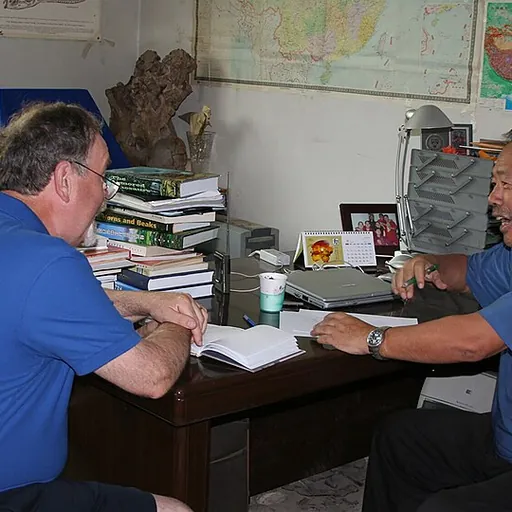
About Dong Zhiming
Lived 1937 – 2024 (aged 86–87). Dong Zhiming was a Chinese paleontologist.
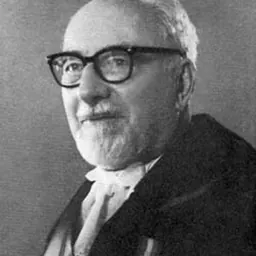
Dong Zhiming (; January 1937 – 20 October 2024) was a Chinese vertebrate paleontologist formerly employed at the Institute of Vertebrate Paleontology and Paleoanthropology (IVPP) in Beijing. He began working at the IVPP in 1962, studying under Yang Zhongjian, who was director at the time. He described fossil remains of many dinosaurs. He investigated and described the Shaximiao Formation; an important contribution to science since they are composed of Middle Jurassic beds which do not commonly yield fossils.
Early life and education Dong Zhiming was born in January 1937 in Weihai, Shandong. At the age of 13, Dong was introduced to dinosaurs by a museum exhibit showcasing hadrosaur fossils. On this expedition, Dong discovered fossils of a sauropod dinosaur.
Dashanpu bone beds
Dong Zhiming's palaeontology research halted in 1965 when he became one of many academics ordered to participate in the Down to the Countryside Movement, which saw him and 17 million other privileged youth in China sent to work on farms across the country. Dong worked on a farm in Henan for one year and returned to Beijing just as the Cultural Revolution was beginning. With the IVPP all but shut down, he was reassigned to work on geological surveys in southwestern China where he helped design irrigation systems. Nonetheless, his mentor Yang continued to study palaeontology and met with Dong often, encouraging him to continue his research in addition to his work for the state. Yang also returned to field work during this time, including a 1975 expedition in which he investigated reports of fossils being found by road crews in the town of Dashanpu, Sichuan. Around this time, Dong petitioned the government to reinstate the IVPP's journal - Vertebrata PalAsiatica - and returned to work at the IVPP. One of Dong's first missions after returning to palaeontology was to follow up on Yang's finds at Dashanpu, and in 1976 he discovered the first dinosaur fossils dating to the Middle Jurassic that had ever been found in China. Although this represented a monumental discovery, it would be the last he shared with his mentor: Yang Zhongjian died on 15 January 1979.
As international tensions eased, Dong Zhiming began to cooperate with international researchers in addition to Chinese scientists. After the discovery of fossils at Dashanpu by both him and Yang, Dong returned to the township in 1980 accompanied by a team of scientists from the British Museum. Being familiar with the area, Dong elected to begin their search for fossils at a construction site for a planned natural gas facility which had excavated the top of a nearby hill, and after entering the site he and his colleagues discovered an unexpected treasure trove of fossils. Dong and his team worked to end the construction on the hill, and by autumn the local government agreed to end development at Dashanpu despite having already invested over one million yuan into the project. Historically, all dinosaurs have been categorized as belonging to either the order Ornithischia or Saurischia, and Dong's suggestion of a third order sparked controversy. American palaeontologist Gregory S. Paul offered his support for Dong's theory in 1984, but that Segnosaurus represented evidence not of a third order of dinosaurs but instead that all dinosaurs belonged to a single order. Ultimately, further research into both Segnosaurus and Therizinosaurus proved that the latter was a theropod and that the two belonged to the same order, and so the dinosaurs once proposed as belonging to Segnosaurischia were assigned to the order Saurischia. However, Dong continued to push this third-order theory as late as 2008, shortly before his retirement. During his field work, Dong also occasionally encountered modern farmers who believed that large dinosaur fossils were the remains of dragons, and had to convince them otherwise in order to acquire the fossils for study. This 1992 review saw Dong and Sereno determine that Huayangosaurus had a parasacral spine, or a vertebral column which ran adjacent to the sacrum; and that the animal's heightened pedicles may have helped keep its dorsal plates in place without ossified tendons to hold them upright. a link that other scientists were less inclined to believe. Studies by Richard J. Butler, Qi Zhao, and other researchers cast doubt on Dong's placement of Micropachycephalosaurus, and in 2011 the genus was reassigned to the suborder Ceratopsia.
Dong is known among the palaeontological community for giving the dinosaurs he describes unusual names, such as T. nedegoapeferima, where the specific name is derived from each of the main cast members from the 1993 film Jurassic Park in recognition of a $25,000 USD donation to the IVPP by American director Steven Spielberg.
Dong is considered an instrumental part of the reason that China has such an array of known stegosaurid species. In the 2012 textbook The Complete Dinosaur (co-authored by researchers M. K. Brett-Surman, Thomas R. Holtz Jr., and James O. Farlow), Dong and his mentor Yang Zhongjian are praised for their efforts to advance palaeontology's understanding of stegosaurids:
Although the fossil record of stegosaurs for most of Asia is very fragmentary (Averianov et al. 2007; Maidment 2010), that of the People's Republic of China is the longest and most diverse (see Dong 1990, 1992; Olshevsky and Ford 1993; Galton and Upchurch 2004; Maidment et al. 2008; Maidment 2010). A partial skeleton of Chialingosaurus was described by Chung Chien Young (1958) from the Shangshaximiao Formation of Sichuan and, thanks to the efforts of Zhimin Dong, additional parts of this skeleton plus skeletons of two additional genera, Chungkingosaurus and Tuojiangosaurus, are also known (Dong et al. 1983; Peng et al. 2005).
In January 2025, a statue in honor of Dong Zhiming was erected at the Lufeng Dinosaur Valley of Yunnan.
Personal life and death While working as a surveyor in southwest China in the late 1960s, Dong married IVPP palaeoanthropologist Chen Dezhen.
Dong died on 20 October 2024, at the age of 87.
Don’t just read it —
keep it.
Full-length biographies made to live with: read them, listen on the way to work, watch them tonight.
- E-book
- Audio
- Video
Instant download · yours to keep · every purchase keeps this site free
Important facts
People in Dong Zhiming's life
Named in this biography and alive at the same time


Related people
Same field, nearest in time


Contemporaries
People whose lives overlapped Dong Zhiming's




Frequently asked questions
Who was Dong Zhiming?
Chinese paleontologist (1937–2024)
When was Dong Zhiming born?
Dong Zhiming was born in 1937 in Weihai.
When did Dong Zhiming die?
Dong Zhiming died on 20 October 2024 in Beijing.
What was Dong Zhiming's occupation?
Dong Zhiming was a paleontologist.
What nationality was Dong Zhiming?
Dong Zhiming was Chinese.
Sources & further reading
Cite this page
APA: Biography.guide. (2026). Dong Zhiming. https://biography.guide/dong-zhiming/
MLA: "Dong Zhiming." Biography.guide, https://biography.guide/dong-zhiming/.
Chicago: "Dong Zhiming." Biography.guide. https://biography.guide/dong-zhiming/.
Data last updated: 2026-09-23 · Spot an error? Report a correction.
Portrait: Wikimedia Commons · author & licence
Page generated 2026-09-27 05:08 UTC