
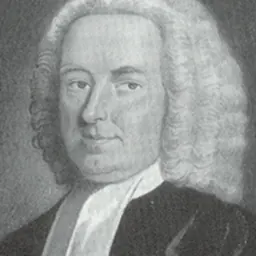
Philip Doddridge
English Nonconformist leader, educator, and hymnwriter
About Philip Doddridge
Lived 1702 – 1751 (aged 49). Philip Doddridge was a British theologian, hymnwriter, writer, university teacher, cleric and preacher.
Philip Doddridge D.D. (26 June 1702 – 26 October 1751) was an English Nonconformist (specifically, Congregationalist) minister, educator, and hymnwriter.
Early life Philip Doddridge was born in London, His father was a son of John Doddridge (1621–1689), rector of Shepperton, Middlesex, who was ejected from his living following the Act of Uniformity of 1662 and became a Nonconformist minister, and a great-nephew of the judge and MP Sir John Doddridge (1555–1628). considered to have been the greater influence on him, was the orphan daughter of the Rev John Bauman (d. 1675), a Lutheran clergyman who had fled from Prague to escape religious persecution, during the unsettled period following the flight of the Elector Palatine. In England, the Rev John Bauman (sometimes written Bowerman) was appointed master of the grammar school at Kingston upon Thames.
Before Philip could read, his mother began to teach him the history of the Old and New Testament from blue Dutch chimney-tiles on the chimney place of their sitting room.
His mother died on 12 April 1711, when he was eight years old. His father died on 17 July 1715.
Marriage On 22 December 1730 he married Mercy Maris after a seven-month courtship (1709–1790), daughter of Richard Maris, a baker and maltster of Worcester, and his second wife, Elizabeth Brindley. it is probably best known as Daventry Academy.
In 1729 he received Besides a New Testament commentary and other theological works, Doddridge also wrote over 400 hymns. Most of the hymns were written as summaries of his sermons and were to help the congregation express their response to the truths they were being taught.
Hymns Doddridge was known for ending his sermons with newly crafted hymns as summaries of the lessons, but his hymns were not published during his lifetime. The first posthumous edition contained 370 hymns. Many of Doddridge's hymns, such as "O God of Bethel, by whose hand", continue to be used to this day across the English-speaking world. "O God of Bethel" appears as № 497 in The Hymnal 1940, and № 709 in The Hymnal 1982 of the Episcopal Church, and as № 269 in the Presbyterian Hymnal (1990). "How Gentle God's Commands" appears as № 69 in the Methodist Hymnal (1939), № 53 in the Methodist Hymnal (1966), and as № 681 in the Trinity Hymnal (1990). The Advent section of Evangelical Lutheran Worship begins with № 239 "Hark the Glad Sound!" The Sacred Harp includes ten of his hymn texts, the most popular being "The Last Words of Copernicus" on page 112.
Doddridge's Youth's Scheme Concerned at the small number of students attending the Dissenting academies, in 1750 Doddridge initiated a Youth's Scheme, to provide capable boys from poor families with a grammar school education that would enable them to undertake further study at a Dissenting academy. Doddridge used this subscription-funded Youth's Scheme to attach a preparatory school to Northampton Academy, initially with six students.
Samuel Smith had been recommended and was supported by Doddridge's friend Robert Cruttenden. Doddridge now had thirty 'pupils' in his Academy, and six 'students' in his school. Initially, the senior students at the Academy were responsible for teaching the students, but had he lived, it was his intention to employ a third tutor, alongside himself and Samuel Clark. The Youth's Scheme did not survive Doddridge's death.
Death and legacy
In 1751, Doddridge's health, which had never been good, broke down. He sailed for Lisbon on 30 September of that year; the change was unavailing, and he died there of tuberculosis.
Doddridge worked towards a united Nonconformist body that would have wide appeal, retaining highly cultured elements without alienating those less educated. His best known work, The Rise and Progress of Religion in the Soul (1745), dedicated to Isaac Watts, was often reprinted and became widely influential. It was through reading it, together with Isaac Milner, that William Wilberforce began the spiritual journey which eventually led to his conversion. It is said that this work best illustrates Doddridge's religious genius, and it has been widely translated. His other well-known works include: The Family Expositor (6 vols., 1739–1756); Life of Colonel Gardiner (1747); and a Course of Lectures on Pneumatology, Ethics and Divinity (1763). Doddridge also published several courses of sermons on particular topics.
John Wesley stated, in the Preface to his Notes on the New Testament, that he was indebted to "the Family Expositor of the late pious and learned Dr. Doddridge" for some "useful observations".
Doddridge's academy evolved into New College, Hampstead, later known as New College London, a centre for training Congregational and then United Reformed Church ministers. (This college is not connected with Royal Holloway, University of London, also a constituent college of the University of London and briefly known as Royal Holloway and Bedford New College when those two colleges merged in the 1970s.) The library of the college, which held a large collection of his manuscripts, was transferred to Dr Williams's Library in 1976.
Doddridge United Reformed Church The Doddridge United Reformed Church (formerly the Castle Hill URC) in Doddridge Street, Northampton, was formerly Congregational, Doddridge and Commercial Street URC. It was the scene of the ministry of Doddridge from 1729 to 1751. The church was founded in 1662, built in 1695 and enlarged in 1842. It united with Commercial Street church in 1959 and became a United Reformed Church in 1972. The interior has galleries and box pews and a memorial to Doddridge. The building was Grade II listed by English Heritage in 1952.
Works The Rise and Progress of Religion in the Soul (1745) The Family Expositor (6 vols., 1739–1756) Life of Colonel Gardiner (1747) Course of Lectures on Pneumatology, Ethics and Divinity (1763) Practical Discourses on Regeneration Ten sermons on the power, & grace of Christ, and on the evidences of His glorious gospel A Dissertation on the Inspiration of the New Testament
Hymn List Awake, my soul, stretch every nerve [published posthumously] Hark the glad sound! the Saviour comes [based on Luke 4:18-19] O God of Bethel, by whose hand
Don’t just read it —
keep it.
Full-length biographies made to live with: read them, listen on the way to work, watch them tonight.
- E-book
- Audio
- Video
Instant download · yours to keep · every purchase keeps this site free
Important facts
People in Philip Doddridge's life
Named in this biography and alive at the same time




Related people
Same field, nearest in time



Contemporaries
People whose lives overlapped Philip Doddridge's



Frequently asked questions
Who was Philip Doddridge?
English Nonconformist leader, educator, and hymnwriter (1702-1751)
When was Philip Doddridge born?
Philip Doddridge was born on 26 June 1702 in London.
When did Philip Doddridge die?
Philip Doddridge died on 26 October 1751 in Lisbon.
What was Philip Doddridge's occupation?
Philip Doddridge was a theologian, hymnwriter, writer, university teacher, cleric and preacher.
What nationality was Philip Doddridge?
Philip Doddridge was British.
Sources & further reading
Cite this page
APA: Biography.guide. (2026). Philip Doddridge. https://biography.guide/philip-doddridge/
MLA: "Philip Doddridge." Biography.guide, https://biography.guide/philip-doddridge/.
Chicago: "Philip Doddridge." Biography.guide. https://biography.guide/philip-doddridge/.
Data last updated: 2026-09-20 · Spot an error? Report a correction.
Page generated 2026-09-27 05:33 UTC