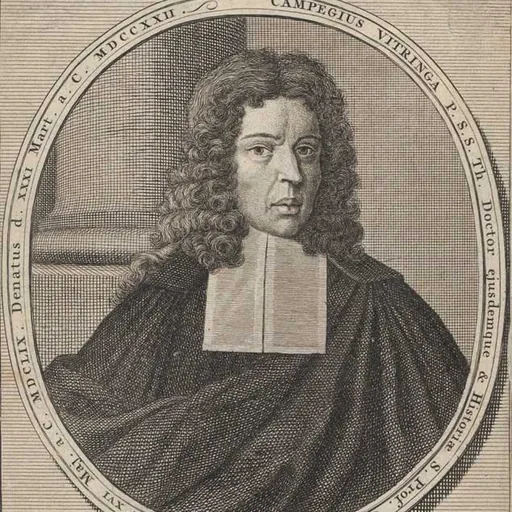
About Campegius Vitringa
Lived 1659 – 1722 (aged 62). Campegius Vitringa was a Dutch theologian, professor, university teacher and writer.
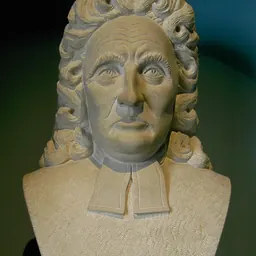
Campegius Vitringa Sr., or Kempe Vitringa (May 16, 1659 at Leeuwarden – March 31, 1722 at Franeker) was a Dutch Protestant theologian and Hebraist. His youngest of four children was Campeius Vitringa (1693-1723).
Vitringa, a follower of Johannes Cocceius, was a supporter of prophetic theology. He was educated at the universities of Franeker and Leiden, and became professor of Oriental languages at the former in 1681. When locating prophetic outcomes, he would associate events to the near rather than the far-off future, placing a distinct focus on the period of the Maccabees (2nd Century BC). His most important student is considered Herman Venema (1697-1787), who was a theology professor at Franeker.
Vitringa’s two chief works are his dissertation on the synagogue, De Synagoga Vetere Libri Tres (Franeker, 1685; 2d ed. 1696); and his Commentary on Isaiah (Leeuwarden, 1714–20), which was frequently republished in the eighteenth century. The latter was up to the time of Gesenius the most considerable contribution to the exegesis of Isaiah. His other works include, Sacrarum Observationum Libri Sex (Franeker, 1683-1708) and Anacrisis Apocalypseos Joannis Apostoli (1705).
Anacrisis Apocalypseos Vitringa’s most notable work was Anacrisis Apocalypseos Joannis Apostoli (1705), which was considered a major event, in the history of prophetic theology at the turn of the 18th century. He drew extensively on the Clavis Apocalyptica (1627), by Joseph Mede (1586-1638). Vitringa’s work was regarded the first major study to analyze the Book of Revelation as a structured chronological outline of the history of the Christian church. His interpretation of the Apocalypse was that of a coded description of the history of the New Testament Church. Though Vitringa had integrated the historical method of Hugo Grotius in past work, he rejected the view of Grotius and Bossuet that associated John’s visions exclusively to early Christendom.
Don’t just read it —
keep it.
Full-length biographies made to live with: read them, listen on the way to work, watch them tonight.
- E-book
- Audio
- Video
Instant download · yours to keep · every purchase keeps this site free
Important facts
People in Campegius Vitringa's life
Named in this biography and alive at the same time
Related people
Same field, nearest in time




Contemporaries
People whose lives overlapped Campegius Vitringa's


Frequently asked questions
Who was Campegius Vitringa?
Dutch theologian
When was Campegius Vitringa born?
Campegius Vitringa was born on 16 May 1659 in Leeuwarden.
When did Campegius Vitringa die?
Campegius Vitringa died on 21 March 1722 in Franeker.
What was Campegius Vitringa's occupation?
Campegius Vitringa was a theologian, professor, university teacher and writer.
What nationality was Campegius Vitringa?
Campegius Vitringa was Dutch.
Sources & further reading
· Wikipedia: Campegius Vitringa
Cite this page
APA: Biography.guide. (2026). Campegius Vitringa. https://biography.guide/campegius-vitringa/
MLA: "Campegius Vitringa." Biography.guide, https://biography.guide/campegius-vitringa/.
Chicago: "Campegius Vitringa." Biography.guide. https://biography.guide/campegius-vitringa/.
Data last updated: 2026-09-23 · Spot an error? Report a correction.
Portrait: Wikimedia Commons · author & licence
Page generated 2026-09-27 05:05 UTC