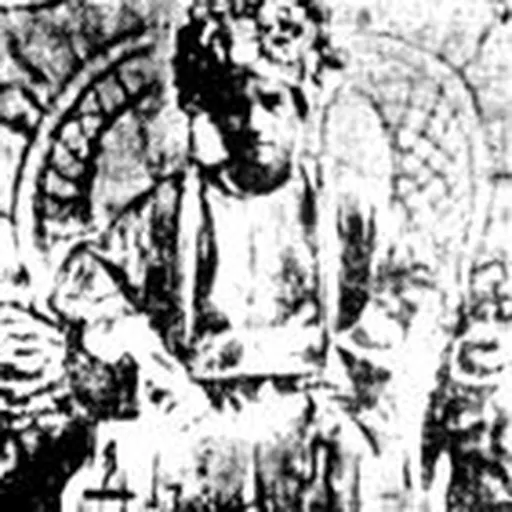
About Phan Xich Long
Lived 1893 – 1916 (aged 23). Phan Xich Long was a Vietnamese revolutionary.
alt=A map depicting bodies of water in light blue and land in beige. The countries in French Indochina, Vietnam, Laos and Cambodia are in a lighter shade than the other countries. Vietnam is an S shaped country bordering the sea. The various towns located on the map detailing Phan Xich Long's locations are in the southern third of the country.
Phan Xích Long, also known as Hồng Long, born Phan Phát Sanh (1 January 1893 – 22 February 1916), was a Vietnamese mystic and geomancer who raised an unsuccessful uprising against French rule in Cochinchina from 1913 to 1916. He attempted to exploit religion as a cover for his own political ambitions, having started his own ostensibly religious organisation. Claiming to be a descendant of Emperor Hàm Nghi, Long staged a ceremony to crown himself as the emperor of Vietnam, before trying to seize power in 1913 by launching an armed uprising against the colonial rule of French Indochina. His supporters launched an attack on Saigon in March 1913, drinking potions that purportedly made them invisible and planting bombs at several locations. The insurrection against the French colonial administration failed when none of the bombs detonated and the supposedly invisible supporters were apprehended.
The French authorities imprisoned Long and many of his supporters, who openly admitted their aim of overthrowing French authorities at the trial. During the 1916 Cochinchina uprisings against French rule, many of Long's supporters attempted to break him out of jail. The French easily repelled the attack on the jail, decimating Long's movement. Following the attempted breakout, Long and his key supporters were put to death. Many of the remnants of his support base went on to join what later became the Cao Đài, a major religious sect in Vietnam.
Early career Phan was born in 1893 in southern Vietnam as Phan Phát Sanh. His place of birth is disputed; the historians R. B. Smith and Hue-Tam Ho Tai say that he was from Cholon, the Chinese business district of Saigon, From then on, the French retained the monarchy of the Nguyễn dynasty, exiling any emperors who rose against colonial rule and replacing them with more cooperative relatives. Sanh also claimed descent from the Lê dynasty, which ruled Vietnam in the 15th and 16th centuries. He was a strong warrior, further presenting himself as the founder of China's Ming dynasty.
At the time of Sanh's activities in the 1910s, there were two members of the Nguyễn dynasty who commanded respect among Vietnamese monarchists. The first was the boy emperor Duy Tân, who was himself deported in 1916 after staging an uprising. Duy Tan's grandfather, Emperor Dục Đức, was the adopted son of the childless Emperor Tự Đức, the last independent emperor of Vietnam. After the completion of the funeral rites, Sanh and his followers staged an impromptu coronation ceremony at Battambang in October 1912. During the 19th century, there was a Buddhist revival and many people masqueraded as monks claiming to have supernatural powers. These false monks were frequently able to start new religious movements and secret societies based on millenarianism. Quickly gathering large numbers of disciples, they staged rebellions against Vietnamese imperial and French colonial armies alike. However, these uprisings were typically incoherent and caused minimal disruption to the ruling authorities. On the other hand, the French were often troubled by resistance movements in southern Vietnam that were led by more conventionally motivated nationalist militants, such as the guerrilla outfits of Trương Định and Nguyễn Trung Trực.
Military buildup During the time he spent in Battambang for the coronation, Long organised the construction of a pagoda in the town, and in December, he unsuccessfully applied for a land concession. After the coronation, Long was taken to the Thất Sơn region in Châu Đốc, in the far south of the Mekong Delta. There the peasants built a temple for him. They used a small restaurant in a nearby village as a reception centre for the temple, as the temple was increasingly used as a military base, where fighters, weaponry and munitions were being assembled for an uprising. Long's supporters presented them in the form of a royal edict on wooden blocks, declaring their intention to attack French military installations.
On 28 March, the second phase of the operation started when several hundred rebels marched into Saigon dressed all in white, During the trial, some community leaders wrote to the governor-general of Indochina, blaming French oppression of the populace through corvee labour and the confiscation of land, for the discontent that led to the uprising. The prosecutor also criticised the way in which colonial authorities operated. The prosecutor claimed that activists from northern and central Vietnam, the main source of the VNQPH's followers, were behind the plot. while the VNQPH were dominated by members of the scholar-gentry.
Before daybreak on 15 February 1916, sailed along the Arroyo Chinoise waterway and disembarked near the centre of Saigon. Although some of the disciples reached the prison, none managed to breach its defenses. Ten of Long's men were killed, whereas only one sentry perished. The French arrested 65 rebels on the spot, including Tri. The French governor-general of Indochina wrote to the French minister of colonies, describing the incident as "a serious attempt to put in execution a vast plot that has been prepared carefully and for a long time by a secret society which grouped together with professional bandits all the enemies of our domination". At Vũng Tàu, an armed group made a failed attempt to seize the military post. In all, riots or uprisings broke out in 13 of the 20 provinces of Cochinchina.
Long's demise did not end the sequence of self-proclaimed mystics who raised armies and engaged in politics. During the interwar period, a sorcerer named Chem Keo claimed to be Long's reincarnation. During World War II, Huỳnh Phú Sổ claimed to be a living Buddha and quickly gathered more than a million supporters. He raised a large peasant army and battled both the French and the communist Viet Minh independence movement, before being killed by the latter. In another case in 1939, a Taoist attempted to demonstrate that he was immune to French bullets. Furthermore, in the years immediately after World War II, the Cao Đài's numbers swelled to 1.5 million.
After 1975, Thái Lập Thành Street in Province of Gia Định (to distinguish with the same name street in Saigon, now is known as Đông Du Street) was renamed as Phan Xích Long Street. Once was a street through swampy area before the renovation of Nhiêu Lộc – Thị Nghè Channel, now it is a quickly developing street with many F&B services are restaurants, coffee shops also other service like hotels, karaoke, hospitals and offices through the districts of Bình Thạnh and Phú Nhuận after the channel renovation and the development of Rạch Miễu residential area, a former area of the same name tributary canal of the Nhiêu Lộc canal, was filled in for the project.
Don’t just read it —
keep it.
Full-length biographies made to live with: read them, listen on the way to work, watch them tonight.
- E-book
- Audio
- Video
Instant download · yours to keep · every purchase keeps this site free
Important facts
People in Phan Xich Long's life
Named in this biography and alive at the same time

Related people
Same field, nearest in time




Contemporaries
People whose lives overlapped Phan Xich Long's
Frequently asked questions
Who was Phan Xich Long?
Self-proclaimed religious leader and Emperor of Vietnam
When was Phan Xich Long born?
Phan Xich Long was born on 1 January 1893 in Tân An, Cholon.
When did Phan Xich Long die?
Phan Xich Long died on 22 February 1916 in Ho Chi Minh City.
What was Phan Xich Long's occupation?
Phan Xich Long was a revolutionary.
What nationality was Phan Xich Long?
Phan Xich Long was Vietnamese.
Sources & further reading
Cite this page
APA: Biography.guide. (2026). Phan Xich Long. https://biography.guide/phan-xich-long/
MLA: "Phan Xich Long." Biography.guide, https://biography.guide/phan-xich-long/.
Chicago: "Phan Xich Long." Biography.guide. https://biography.guide/phan-xich-long/.
Data last updated: 2026-09-22 · Spot an error? Report a correction.
Portrait: Wikimedia Commons · author & licence
Page generated 2026-09-27 05:01 UTC