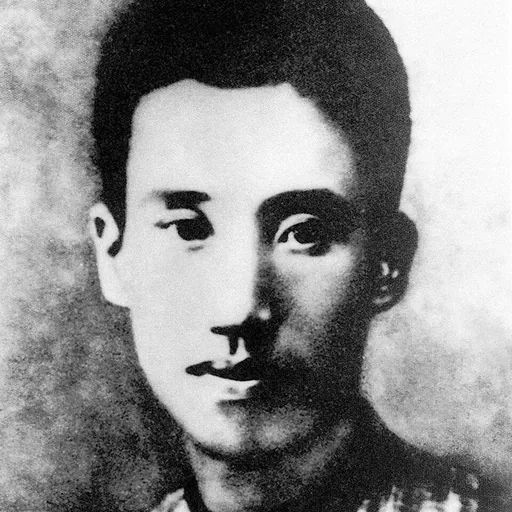
About Peng Pai
Lived 1896 – 1929 (aged 32). Peng Pai was a Chinese politician.
Peng Pai (; October 22, 1896 – August 30, 1929) was a pioneer of the Chinese agrarian movement and a leading revolutionary in the Chinese Communist Party (CCP) during its early years. He was born in Haifeng, Guangdong Province, China. Peng Pai was one of the few Chinese intellectuals who were aware in the early 1920s that peasantry and land issues caused the most critical problems for Chinese society. He believed that the success of any revolution in China must depend on the peasants as its base foundation. After his death, Peng was praised by Mao Zedong as "the king of peasant movement".
Early life Peng Pai was born on October 22, 1896, in Haifeng, Guangdong province. His father Peng Xin , was part of an elite Hokkien-speaking landlord and merchant family that rented land to more than 1,500 tenant farmers. His mother, Zhou Feng , came from an impoverished family. When she was eighteen, her parents had sold her as a concubine to Peng Xin. Peng Pai was the second of three sons they would have together. His brothers Peng Hanyuan and Peng Shu would later join Pai's revolutionary movement in Haifeng. All three brothers lost their lives for this cause and would be honored as "Revolutionary Martyrs" by the People's Republic of China.
Reports on the Haifeng Peasant Movement by Peng Pai, published in 1926. The title's Chinese Characters were handwritten then by Zhou Enlai
Education commissioner of Haifeng (1921–1922) Peng Pai finished his study in Japan and returned to Haifeng in the summer of 1921. He was appointed as the Commissioner of the Education Bureau of Haifeng County in October.
In 1924, Peng Pai became a member of Kuomintang (KMT or Nationalist Party) as individuals and served as the Secretary of Peasant Department of KMT Central Committee, as the KMT-CCP Alliance had been formed since 1923. The KMT was then led by Sun Yat-sen and carried out the policies of "alliance with Soviet Russia, cooperation with the Communists, and assistance to peasant and worker movements". Based on Peng Pai's idea and suggestion, the KMT Central Committee decided to set up the Peasant Movement Training Institute (PMTI) to train young idealists who then went out to educate the masses in rural China.
In July 1928, on the 6th National Congress of the CCP, Peng Pai was elected as a Politburo member and served as the Secretary of the Central Agrarian Movement Committee and a member of the Central Military Affairs Commission of the CCP. Zhou Enlai, leading the Central Special Task Units (CSTU) of the CCP, organized an action attempting to rescue Peng Pai but this failed. On August 30, Peng Pai was secretly killed at Longhua, Shanghai by the KMT government on the orders of Chiang Kai-shek. On November 11, per Zhou Enlai's order, Chen Geng and Gu Shunzhang directed the CSTU with its Red Squad to kill Peng's betrayer, Bai Xin, outside of his hidden shelter in Shanghai.
In memory of Peng Pai and Yang Yin, the CCP named its military academy the "Peng-Yang Military Academy of the Red Army".
Works Report on the Haifeng Peasant Movement (海丰农民运动) He was selected as a member of the Chinese Academy of Engineering for his contributions and expertise in nuclear propulsion and Nuclear Power Engineering.
Peng Shige, a grandson of Peng Pai's elder brother Peng Hanyuan, is a distinguished mathematician and an academician of the Chinese Academy of Sciences. He is noted for his contributions in stochastic analysis and founding of Mathematical Finance in China.
Legacy In 1957, Haifeng County High School (where Peng Pai had attended) was renamed the "Peng Pai Memorial High School".
During the Chinese Cultural Revolution, the Anti-Peng Pai Incident (反彭湃事件) broke out in Shanwei, Guangdong, targeting the relatives of Peng Pai. Peng Pai's mother was jailed, and his third son Peng Hong (彭洪) was killed and buried secretly; a cousin and a nephew of Peng Pai were also killed in a massacre which resulted in the deaths of over 160 people, and the head of the nephew was hung up on the pole and shown to the public for three days. In 1978 after the end of the Cultural Revolution, Xi Zhongxun was in charge of Guangdong province and officially redressed this incident as well as rehabilitated Peng Pai's relatives and all the related victims.
Don’t just read it —
keep it.
Full-length biographies made to live with: read them, listen on the way to work, watch them tonight.
- E-book
- Audio
- Video
Instant download · yours to keep · every purchase keeps this site free
Important facts
People in Peng Pai's life
Named in this biography and alive at the same time



Related people
Same field, nearest in time






Contemporaries
People whose lives overlapped Peng Pai's



Frequently asked questions
Who was Peng Pai?
Chinese agrarian movement and peasants' rights activist (1896-1929)
When was Peng Pai born?
Peng Pai was born on 22 October 1896 in Haifeng County.
When did Peng Pai die?
Peng Pai died on 30 August 1929 in Shang-hai.
What was Peng Pai's occupation?
Peng Pai was a politician.
What nationality was Peng Pai?
Peng Pai was Chinese.
Sources & further reading
Cite this page
APA: Biography.guide. (2026). Peng Pai. https://biography.guide/peng-pai/
MLA: "Peng Pai." Biography.guide, https://biography.guide/peng-pai/.
Chicago: "Peng Pai." Biography.guide. https://biography.guide/peng-pai/.
Data last updated: 2026-09-20 · Spot an error? Report a correction.
Page generated 2026-09-27 05:09 UTC