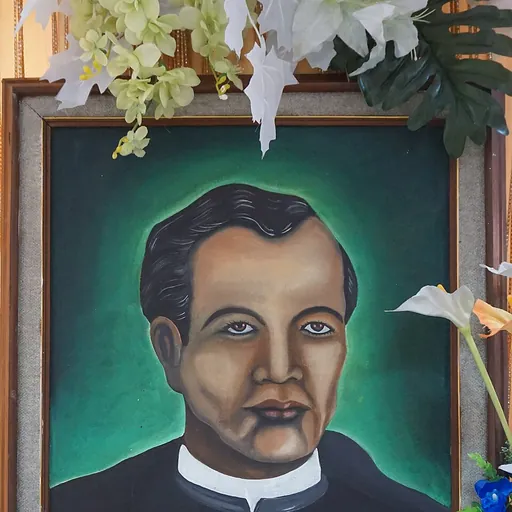
Pedro Peláez
Roman Catholic archbishop
About Pedro Peláez
Lived 1812 – 1863 (aged 50). Pedro Peláez was a Filipino writer, catholic priest and priesthood (Catholic Church), known for Secularization movement in the Philippines.
Pedro Pablo Peláez y Sebastián (June 29, 1812 – June 3, 1863) was a Filipino Catholic priest who favored the rights for Filipino clergy during the 19th century. He was diocesan administrator of the Archdiocese of Manila for a brief period of time. In the early 19th century, Peláez advocated for the secularization of Filipino priests and is considered the "Godfather of the Philippine Revolution." His cause towards beatification has been initiated, and he is designated with the title "Servant of God."
Life Pedro Pablo Peláez was born on June 29, 1812, to José Peláez Rubio, the Spanish alcalde (mayor) of Laguna and his wife Josefa Sebastián, a Filipino from Manila. As was common custom, he was baptised for the day of his birth, which was the Feast of Saints Peter and Paul. When both of his parents died in 1823, he was taken in by Dominican friars in Manila, who sent him to study at the Colegio de San Juan de Letrán where he obtained a Bachelor of Arts degree. He then enrolled at the University of Santo Tomás to finish his studies for the priesthood. Among his professors was Francisco Ayala.
Peláez was ordained in 1837, and although he chose to be a secular priest, he kept close ties with the Dominicans all his life. A gifted theologian, he served at the Metropolitan Cathedral of the Immaculate Conception, and was sometime the Diocesan administrator of the Archdiocese of Manila.
From 1836 to 1839, he taught philosophy at the Colegio de San José, and later various subjects at his alma mater, the University of Santo Tomás, from 1843 to 1861.
Defense of local clergy In the mid-19th century, the Philippines was still a Spanish possession despite the empire losing territory to independence movements. Travel between the metropole and the colony became easier due to the 1859 opening of the Suez Canal. An increase of Peninsulares from the Iberian Peninsula threatened the secularization of the Philippine churches. In state affairs, Criollos, known locally as Insulares (lit. "islanders"), were displaced from government positions by the Peninsulares, whom the Insulares regarded as foreigners.
In 1849, a royal decree removed a few parishes from control of the secular clergy, which was mainly Filipinos, and gave those parishes to the Recollects and Dominicans. Peláez countered that these parishes had been successfully managed for the past eighty years, and the parishioners were happy. Along with Father Mariano Gómez, Peláez began organizing activities calling for the return of these churches to secular priests, considered among the first signs of Filipino nationalist awakening. With his knowledge of canon law, Peláez wrote against this policy, criticising both secular and regular clergy, Spaniards or Filipinos when appropriate.
Peláez died in the collapse of the Manila Cathedral during the deadly 1863 earthquake in Manila.
In popular culture Peláez was portrayed by Piolo Pascual in the 2023 period film, GomBurZa.
Don’t just read it —
keep it.
Full-length biographies made to live with: read them, listen on the way to work, watch them tonight.
- E-book
- Audio
- Video
Instant download · yours to keep · every purchase keeps this site free
Important facts
Related people
Same field, nearest in time


Contemporaries
People whose lives overlapped Pedro Peláez's





Frequently asked questions
Who was Pedro Peláez?
Roman Catholic archbishop (1812–1863)
When was Pedro Peláez born?
Pedro Peláez was born on 29 June 1812 in Captaincy General of the Philippines, Laguna (province), Pagsanjan.
When did Pedro Peláez die?
Pedro Peláez died on 3 June 1863 in Manila.
What was Pedro Peláez's occupation?
Pedro Peláez was a writer, catholic priest and priesthood (Catholic Church).
What was Pedro Peláez known for?
Pedro Peláez was known for Secularization movement in the Philippines.
What nationality was Pedro Peláez?
Pedro Peláez was Filipino.
Sources & further reading
Cite this page
APA: Biography.guide. (2026). Pedro Peláez. https://biography.guide/pedro-pelaez/
MLA: "Pedro Peláez." Biography.guide, https://biography.guide/pedro-pelaez/.
Chicago: "Pedro Peláez." Biography.guide. https://biography.guide/pedro-pelaez/.
Data last updated: 2026-09-22 · Spot an error? Report a correction.
Portrait: Wikimedia Commons · author & licence
Page generated 2026-09-27 04:57 UTC