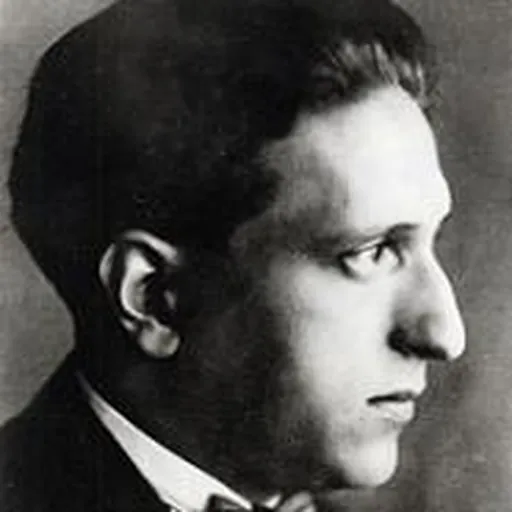
About Pavel Haas
Lived 1899 – 1944 (aged 45). Pavel Haas was an Austrian composer.
Pavel Haas (21 June 189917 October 1944) was a Czech composer who was murdered during the Holocaust. He was an exponent of Leoš Janáček's school of composition, and also utilized elements of folk music and jazz. Although his output was not large, he is notable particularly for his song cycles and string quartets.
Pre-war Haas was born in Brno, into a Moravian-Jewish family. His father, Zikmund, a shoemaker by trade, was from the Moravian region, while his mother, Olga (née Epstein), was born in Odesa. His brother, Hugo Haas (1901–1968), was a popular actor in interwar Czechoslovakia. After studying piano privately, Haas began his more formal musical education at the age of 14 and studied composition at the Brno Conservatory from 1919 to 1921 under Jan Kunc and Vilém Petrželka. This was followed by two years of study in the master class of the noted Czech composer Leoš Janáček. Janáček was by far Haas's most influential teacher, and Haas, in turn, proved to be Janáček's best student. In 1935, he married Soňa Jakobson, the former wife of Russian linguist Roman Jakobson.
Of the more than 50 works Haas wrote during the rest of his life, only 18 were given opus numbers by the self-critical composer. While still working in his father's business, he wrote musical works of all kinds, including symphonic and choral works, lieder, chamber music, and scores for cinema and theatre. His opera, Šarlatán (The Charlatan), was first performed in Brno to sincere acclaim in April 1938. He received the Smetana Foundation award for the opera (sharing the award with Vítězslava Kaprálová who received it for her Military Sinfonietta).
The war
In 1941, Haas was deported to the Theresienstadt concentration camp (Terezín). He was one of several Moravian-Jewish composers there, including Viktor Ullmann, Gideon Klein and Hans Krása. Prior to his arrest, he had officially divorced his wife Soňa in order that she and their young daughter, Olga, would not suffer a similar fate. In 1938, in desperation, he wrote to relatives of his wife in New Jersey, and also to Frank Rybka in New York, who was a former student of Janáček. An attempt was launched by these Americans to help Haas secure passage, but this came too late to help. On his arrival at Theresienstadt, he became very depressed and had to be coaxed into composition by Gideon Klein. Haas wrote at least eight compositions in the camp, only a few of which have survived. They include a set of Four Songs on Chinese Poetry for baritone and piano, a work for men's choir titled "Al s'fod" (his first and only work in Hebrew), and the Study for String Orchestra which was premiered in Theresienstadt under the Czech conductor Karel Ančerl and is probably Haas's best-known work today. The orchestral parts were found by Ančerl after the liberation of Theresienstadt and the score was reconstructed.
In 1944 the Nazis remodeled Theresienstadt just before a visit from the Red Cross, and a propaganda film, Der Führer schenkt den Juden eine Stadt (The Führer Gives the Jews a City), was made by director Kurt Gerron, under the coercion of the camp commandant, Karl Rahm. In the film, Theresienstadt, children are seen singing Hans Krása's opera, Brundibár, and Haas can be seen taking a bow after a performance, conducted by Karel Ančerl, of his Study for Strings. When the propaganda project was over, the Nazis transferred 18,000 prisoners, including Haas and the children who had sung in Brundibár, to Auschwitz-Birkenau, where they were murdered in the gas chambers. According to the testimony of Karel Ančerl, Haas stood next to him after their arrival at Auschwitz. Doctor Mengele was about to send Ančerl to the gas chamber first, but the weakened Haas began to cough, so the death sentence was chosen for him instead. After the war Ančerl met with Haas's brother Hugo and told him the story.
Post-war Haas's large-scale symphony, which he began prior to his deportation to Theresienstadt, remained unfinished, but the extant material was orchestrated by Zdeněk Zouhar in 1994. Haas's music, stemming from Bohemian and Moravian roots, is sometimes tinted by Hebrew melody. Haas has been described as "a reserved but eloquent student of Janáček" by Alex Ross in his history of classical music in the 20th century, The Rest is Noise: Listening to the Twentieth Century.
Works Principal publishers: Boosey & Hawkes, Bote & Bock, Sádlo, Tempo
Genre Opus Date composed Czech title English title Scoring Notes Vocal 1 1918–1919 Šest písní v lidovém tónu 6 Songs in Folk Tone for soprano and piano orchestrated 1938 Vocal 2 1919–1920 Tři písně 3 Songs for soprano and piano words by Josef Svatopluk Machar Chamber music 3 1920 Smyčcový kvartet č. 1 String Quartet No. 1 in C minor for 2 violins, viola and cello Vocal 4 1919 Čínské písně Chinese Songs for medium voice and piano words by Kao Shi, Tsui Hao, Thu Fu Orchestral 5 1921 Zesmutnělé scherzo Scherzo triste for orchestra Vocal 6 1923 "Fata morgana" Klavírní kvintet se sólovým zpěvákem tenorového hlasu Fata morgana for tenor, 2 violins, viola, cello and piano words by Rabindranath Tagore Chamber music 7 1925 Smyčcový kvartet č. 2 "Z opičích hor" String Quartet No. 2 From the Monkey Mountains for 2 violins, viola, cello and percussion 'ad libitum' Vocal 8 1927 Vyvolená for tenor, flute, horn, violin and piano poems by Jiří Wolker Choral 9 1928–1929 Karneval Carnival for male chorus words by Dalibor Chalupa Chamber music 10 1929 Dechový kvintet Wind Quintet for flute, oboe, clarinet, horn and bassoon Orchestral 11 1931 Předehra pro rozhlas Overture for Radio for small orchestra and male voices words by Hugo Haas Choral 12 1932 Žalm 29 Psalm XXIX for baritone, female chorus and chamber orchestra with organ Film score – 1933 Život je pes Life Is a Dog for orchestra music for the film Film score – 1934 Mazlíček for orchestra music for the film Piano 13 1935 Suita pro klavír Suite for piano Opera 14 1936 Šarlatán for soloists, chorus and orchestra opera in 3 acts; libretto by the composer Film score – 1937 Kvočna Mother-Hen for orchestra music for the film Piano – 1937 Allegro moderato Allegro moderato for piano Chamber music 15 1937–1938 Smyčcový kvartet č. 3 String Quartet No. 3 for 2 violins, viola and cello Choral 16 1938 Od večera do rána muzika nám vyhrává... From Evening Until Morning Music Plays For Us... for soloists, chorus and orchestra Medley of songs from the Moravian Slovakia region Chamber music 17 1939 Suita pro hoboj a klavír Suite for oboe and piano Vocal 18 1940 Sedm písní v lidovém tónu 7 Songs in Folk Style for high voice and piano words by František Čelakovský Orchestral – 1940–1941 Symfonie Symphony for orchestra unfinished; orchestration completed by Zdeněk Zouhar Choral – 1942 Al s'fod Do Not Lament for male chorus words by David Shimoni Orchestral – 1943 Studie pro smyčcový orchestr Study for string orchestra Vocal – 1944 Čtyři písně na slova čínské poezie 4 Songs on Chinese Poetry for bass (or baritone) and piano poems by Wei Jing-wu, Wang-wei, Tchang Tiou-ling, Han I Vocal – for mezzo-soprano, tenor and quintet – Fantasy on a Jewish Melody Piano – Partita in Olden Style for piano lost Vocal – Terezín Songs Vocal – Tři skladby 3 Pieces for mezzo-soprano, tenor, flute, clarinet, 2 violins, viola and cello lost Concertante – Variace pro klavír a smyčcový orchestr Variations for piano and string orchestra
Recordings Šarlatán (complete opera) – Prague Philharmonic Choir, Prague State Opera Orchestra, Israel Yinon (conductor); Decca Record Company 460 042-2 (1998) Pavel Haas: Orchestral Music – Staatsphilharmonie Brünn, Israel Yinon (conductor); Koch Schwann (1996) Scherzo triste, Op. 5 Charlatan (opera suite), Op. 14 Symphonie (unfinished; orchestration ) Janáček/Haas/Szymanowski: String Quartets Arranged for String Orchestra – Australian Chamber Orchestra, Richard Tognetti (conductor); Chandos CD 10016 String Quartet No. 2 "Z opičích hor", Op. 7 Pavel Haas: String Quartets 1-3 (Czech Degenerate Music, Volume 2) – Kocian Quartet; Praga Productions 250 118 (1998) Haas and Janáček String Quartets – Pavel Haas Quartet, Supraphon SU 3922-2 String Quartet No. 1 in C-sharp minor, Op. 3 String Quartet No. 3, Op. 15 Haas/Korngold/Haydn string quartets: String quartet No. 2. Adamas Quartett; Gramola 2013. Pavel Haas: Bläserquintett, Suiten Op. 13 • Op. 17, Vyvolená – Jörg Dürmüller (tenor), Dennis Russell Davies (piano), Stuttgarter Bläserquintet; Orfeo International Music C 386 961 A (1996) Wind Quintet, Op. 10 Suite for Piano, Op. 13 Suite for Oboe and Piano, Op. 17 Vyvolená, Op. 8 Chamber Music of Pavel Haas – Ensemble Villa Musica; MD&G 304 1524-2 Wind Quintet, Op. 10 Suite for Oboe and Piano, Op. 17 String Quartet No. 3, Op. 15 Risonanza – Vilém Veverka (oboe), Ivo Kahánek (piano); Supraphon SU 3993-2 Suite for Oboe and Piano Music from Theresienstadt – Wolfgang Holzmair (baritone), Russell Ryan (piano); Bridge Records 9280 4 Songs after Words of Chinese Poetry 4 Songs on Chinese Poetry, sung by Christian Gerhaher, appear on a CD Terezín/Theresienstadt initiated by Anne Sofie von Otter, Deutsche Grammophon, 2007. KZ Musik: Encyclopedia of Music Composed in Concentration Camps, Volume 4 – Petr Matsuszek (baritone), Francesco Lotoro (piano); KZ Music 231787 Four Chinese Songs The whole music written in Concentration Camps (including P. Haas's Study for Orchestra, 4 Chinese Songs and Al s'fod) are contained in the CD-Encyclopedia KZ MUSIK created by Francesco Lotoro (Musikstrasse Roma- Membran Hamburg), 2007 The Bohemian Album - Dvořák, Haas, Schulhoff – Amsterdam Sinfonietta, Candida Thompson; Channel Classics 24409, 2009. String Quartet No. 2 "Z opičích hor", Op. 7
Haas in literature Haas is a central character in David Herter's First Republic trilogy, comprising the novels On the Overgrown Path, The Luminous Depths and One Who Disappeared.
Haas is mentioned in Simon Mawer's The Glass Room.
Don’t just read it —
keep it.
Full-length biographies made to live with: read them, listen on the way to work, watch them tonight.
- E-book
- Audio
- Video
Instant download · yours to keep · every purchase keeps this site free
Important facts
People in Pavel Haas's life
Named in this biography and alive at the same time






Related people
Same field, nearest in time



Contemporaries
People whose lives overlapped Pavel Haas's


Frequently asked questions
Who was Pavel Haas?
Czech composer (1899–1944)
When was Pavel Haas born?
Pavel Haas was born on 21 June 1899 in Brno.
When did Pavel Haas die?
Pavel Haas died on 17 October 1944 in Auschwitz II-Birkenau concentration camp, Oświęcim.
What was Pavel Haas's occupation?
Pavel Haas was a composer.
What nationality was Pavel Haas?
Pavel Haas was Austrian.
Sources & further reading
Cite this page
APA: Biography.guide. (2026). Pavel Haas. https://biography.guide/pavel-haas/
MLA: "Pavel Haas." Biography.guide, https://biography.guide/pavel-haas/.
Chicago: "Pavel Haas." Biography.guide. https://biography.guide/pavel-haas/.
Data last updated: 2026-09-20 · Spot an error? Report a correction.
Page generated 2026-09-27 05:09 UTC