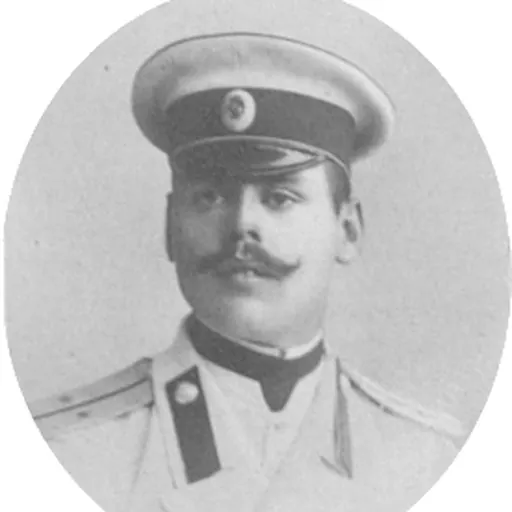
About Paul Rodzianko
Lived 1880 – 1965 (aged 84). Paul Rodzianko was a Russian military officer.
Paul Rodzianko (Russian: Павел Павлович Родзянко; 1880–1956) was a Russian cavalry officer, soldier, and later a British Army colonel. He served in the Imperial Russian Army during the First World War, fought with the White movement in the Russian Civil War, and after emigration continued his military service with Britain. He later became known for his equestrian writings and for his work as an instructor in Ireland.
Family background Rodzianko was a member of the prominent Rodzianko family of Ukrainian-Polish origin. The family belonged to the landed nobility of the Russian Empire and produced several statesmen and military officers. His uncle, Mikhail Rodzianko, served as chairman of the State Duma in the years leading up to the Russian Revolution.
Military career Paul Rodzianko was born in 1880. Around 1900 he was commissioned into the Imperial Russian Army and assigned to the elite Chevalier Guard Regiment. In 1911 he published a pamphlet on Italian cavalry methods, reflecting the influence of Federico Caprilli's forward-seat system.
During the First World War, Rodzianko rose to the rank of colonel and served on the Eastern Front. He took part in the campaigns in East Prussia and Galicia in 1914 and later fought on the Southwestern Front.
After the February Revolution of 1917, Rodzianko remained in service under the Russian Provisional Government. Following the Bolshevik seizure of power, he joined the White movement and was sent abroad on diplomatic and liaison missions aimed at securing Allied support.
After the defeat of the White armies, Rodzianko went into exile and eventually settled in Britain.
Later life and death Rodzianko lived in Britain during and after the Second World War and remained active in émigré and military circles until his death in 1956.
Role in the fate of Joy Rodzianko became associated with the fate of Joy, cocker spaniel owned by Alexei Nikolaevich, Tsarevich of Russia. After the execution of the Imperial family in 1918, the dog survived and was later taken abroad by Rodzianko, eventually living in Britain.
Publications Modern Horsemanship (London: Seeley Service, 1936–37). Tattered Banners: An Autobiography (London: Seeley Service, 1939). Mannerheim: An Intimate Picture of a Great Soldier and Statesman (London: Jarrolds, 1940).
Decorations and honors Order of St. Anna, 2nd and 3rd Class Order of St. Vladimir, 3rd and 4th Class Order of St. Stanislaus, 2nd Class Companion of the Order of St Michael and St George (CMG)
Don’t just read it —
keep it.
Full-length biographies made to live with: read them, listen on the way to work, watch them tonight.
- E-book
- Audio
- Video
Instant download · yours to keep · every purchase keeps this site free
Important facts
People in Paul Rodzianko's life
Named in this biography and alive at the same time

Related people
Same field, nearest in time



Contemporaries
People whose lives overlapped Paul Rodzianko's



Frequently asked questions
Who was Paul Rodzianko?
(died 1965)
When was Paul Rodzianko born?
Paul Rodzianko was born on 11 December 1880.
When did Paul Rodzianko die?
Paul Rodzianko died on 17 April 1965 in London.
What was Paul Rodzianko's occupation?
Paul Rodzianko was a military officer.
What nationality was Paul Rodzianko?
Paul Rodzianko was Russian.
Sources & further reading
Cite this page
APA: Biography.guide. (2026). Paul Rodzianko. https://biography.guide/paul-rodzianko/
MLA: "Paul Rodzianko." Biography.guide, https://biography.guide/paul-rodzianko/.
Chicago: "Paul Rodzianko." Biography.guide. https://biography.guide/paul-rodzianko/.
Data last updated: 2026-09-21 · Spot an error? Report a correction.
Portrait: Wikimedia Commons · author & licence
Page generated 2026-09-27 04:59 UTC