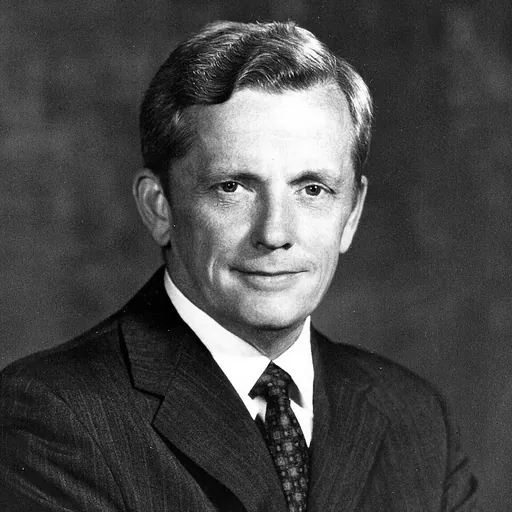
About Paul Findley
Lived 1921 – 2019 (aged 98). Paul Findley was an American politician.
Paul Augustus Findley (June 23, 1921 – August 9, 2019) was an American writer and politician. He served as United States Representative from Illinois, representing its 20th District. A Republican, he was first elected in 1960. A moderate Republican for most of his long political career, Findley was a supporter of civil rights and an early opponent of the U.S. war in Vietnam. He co-authored the War Powers Act in 1973, which aims to limit the ability of the president to go to war without congressional authorization. Findley lost his seat in 1982 to current United States Senator Dick Durbin. He was a cofounder of the Council for the National Interest, a Washington, D.C. advocacy group, and was a vocal critic of American policy towards Israel.
Early life Findley was born in Jacksonville, Illinois, the son of Florence Mary (Nichols) and Joseph S. Findley. He attended the Jacksonville public schools. He received his bachelor's degree from Illinois College, which is currently home to The Paul Findley Congressional Office Museum. The collection contains manuscripts and artifacts related to the life and political career of Paul Findley. It is one of the few congressional office museums in the United States. Findley served in the United States Navy during World War II and was commissioned a lieutenant (junior grade).
Career
Findley served 11 terms in Congress, finally losing to Dick Durbin, in his bid for reelection in 1982. He was known in Congress as an advocate for the farmers of his district, as an early opponent of the U.S. war in Vietnam, and as a strong proponent of the Palestinians and of opening up communication with the Palestine Liberation Organization
An early critic of U.S. military involvement in South East Asia, Findley and his staff pioneered what became a signature tactic of the peace movement: in 1969 Rep. Findley got the Congressional Record to publish the names of all Americans who had died in the Vietnam War, which then numbered over 31,000. Soon after, Quaker peace groups and other anti-war activists began reading those names aloud on the steps of the U.S. Capitol and at protests and vigils across the country.
Findley also co-authored the War Powers Act of 1973 which was passed by the House and Senate over President Nixon's veto. The measure was intended to prevent a president from committing the United States to war without the consent of Congress. Findley confirmed that his 1982 campaign raised "almost exactly the same sum" as that of his opponent. Following his defeat, he served on the Board for International Food and Agricultural Development (BIFAD) from 1983 to 1994.
In 1989, Findley, with former representative Pete McCloskey (R-CA), formed the Council for the National Interest. It is a 501(c)4 non-profit, non-partisan organization in the United States that works for "Middle East policies that serve the American national interest." Its first executive director was ten-term congressman John B. Anderson (R-IL), who ran as an independent candidate in the 1980 U.S. presidential election.
Criticism of Israel A year after the September 11 attacks in 2001, Findley published an article saying that this attack would never have occurred were it not for the United States' uncritical support of Israel. Findley claimed that the 2003 invasion of Iraq was launched primarily to benefit Israel, at the behest of the Israel lobby in the United States.
Findley was a frequent critic of U.S. foreign policy regarding Israel. Findley was the author of They Dare to Speak Out: People and Institutions Confront Israel's Lobby in which he stated that the pro-Israel lobby, notably AIPAC, has undue influence over the United States Congress. He referred to the lobby as "the 700-pound gorilla in Washington".
A review of the book in The Washington Post stated: "Stripped of all the maudlin martyrdom, former congressman Paul Findley's message is straightforward and valid: Israeli influence in the United States, including in the inner sanctums of government, is very strong." The New York Times review by Adam Clymer described the book as "an angry, one-sided book that seems often to be little more than a stringing together of stray incidents ... [it] does not really accept the idea that people of any political point of view are entitled to organize, support their friends and try to defeat the people they think are their enemies".
On the 24th anniversary of the 1967 USS Liberty incident (in 1991), he and fellow former Congressman Pete McCloskey set up a meeting at the White House that was attended by approximately 50 Liberty survivors. He has also authored several articles in support of Liberty survivors.
On the publication of Mearsheimer and Walt's 2006 working paper, The Israel Lobby and U.S. Foreign Policy, he wrote: "You can't imagine how pleased I was [...] I think I can pose as a foremost expert on the lobby for Israel, because I was the target the last three years I was in Congress."
Findley supported the efforts of the Council on American–Islamic Relations (CAIR) to improve the image of Muslims in America. In a conference in Riyadh, Saudi Arabia, Findley said that "the cancer of anti-Muslim and anti-Islamic sentiments was spreading in American society and requires corrective measures to stamp out this malaise." He was a board member of If Americans Knew and the Streit Council.
Findley endorsed the proposal for the United Nations Parliamentary Assembly (UNPA), one of only six persons who served in the United States Congress ever to do so.
Reactions The Anti-Defamation League (ADL) has criticized the Council for the National Interest (CNI), of which Findley was a founder, as an "anti-Israel organization" that "disseminates demonizing propaganda about Israel to academics, politicians, and other audiences." The ADL alleges that the CNI has disseminated cartoons with anti-Semitic based themes by Khalil Bendib. Additionally, it expressed concern about a 2003 article by Findley blamed U.S. support of Israel for the September 11 attacks: "Nine-eleven would not have occurred if the U.S. government had refused to help Israel humiliate and destroy Palestinian society." Findley continued in the same article that: "America suffered 9/11 and its aftermath and may soon be at war with Iraq, mainly because U.S. policy in the Middle East is made in Israel, not in Washington."
Death Findley died from heart failure on August 9, 2019, at Passavant Area Hospital in Jacksonville, Illinois, at the age of 98. He was buried in Arlington National Cemetery in June 2022.
His son Craig J. Findley served in the Illinois General Assembly.
Published works The Transparent Cabal: The Neoconservative Agenda, War in the Middle East, and the National Interest of Israel (Foreword). 2008. Ihs Press. Silent No More: Confronting America's False Images of Islam. 2001. Amana Publications. They Dare to Speak Out: People and Institutions Confront Israel's Lobby. 1985, 1989, 2003 editions. Lawrence Hill Books. Deliberate Deceptions: Facing the Facts About the U.S.–Israeli Relationship. 1993, 1995 editions. Lawrence Hill Books. Abraham Lincoln: The Crucible of Congress. 1979, 2004 editions. Crown. The Federal Farm Fable. 1968. Arlington House. ASIN B001UCDQQW Speaking Out: A Congressman's Lifelong Fight Against Bigotry, Famine, and War.2011. Chicago Review Press.
Don’t just read it —
keep it.
Full-length biographies made to live with: read them, listen on the way to work, watch them tonight.
- E-book
- Audio
- Video
Instant download · yours to keep · every purchase keeps this site free
Important facts
Family & relationships
People in Paul Findley's life
Named in this biography and alive at the same time




Related people
Same field, nearest in time





Contemporaries
People whose lives overlapped Paul Findley's




Frequently asked questions
Who was Paul Findley?
American politician (1921-2019)
When was Paul Findley born?
Paul Findley was born on 23 June 1921 in Jacksonville.
When did Paul Findley die?
Paul Findley died on 9 August 2019 in Jacksonville.
What was Paul Findley's occupation?
Paul Findley was a politician.
What nationality was Paul Findley?
Paul Findley was American.
Sources & further reading
Cite this page
APA: Biography.guide. (2026). Paul Findley. https://biography.guide/paul-findley/
MLA: "Paul Findley." Biography.guide, https://biography.guide/paul-findley/.
Chicago: "Paul Findley." Biography.guide. https://biography.guide/paul-findley/.
Data last updated: 2026-09-20 · Spot an error? Report a correction.
Portrait: Wikimedia Commons · author & licence
Page generated 2026-09-27 04:58 UTC