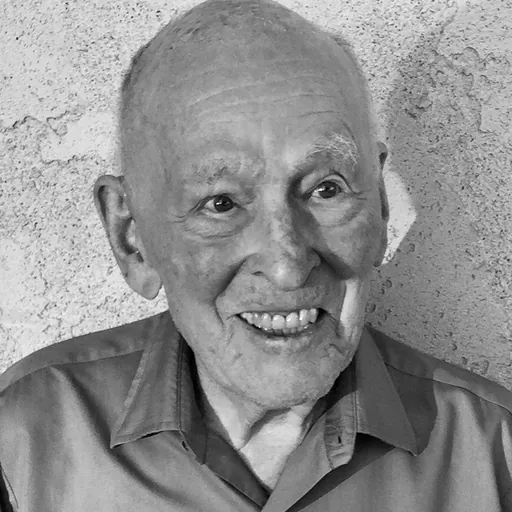
About Paul D. Boyer
Lived 1918 – 2018 (aged 99). Paul D. Boyer was an American biochemist, university teacher and chemist, known for Adenosine triphosphate.
Paul Delos Boyer (July 31, 1918 – June 2, 2018) was an American biochemist, analytical chemist, and a professor of chemistry at University of California, Los Angeles (UCLA). He shared the 1997 Nobel Prize in Chemistry for research on the "enzymatic mechanism underlying the biosynthesis of adenosine triphosphate (ATP)" (ATP synthase) with John E. Walker, making Boyer the first Utah-born Nobel laureate; the remainder of the Prize in that year was awarded to Danish chemist Jens Christian Skou for his discovery of the Na+/K+-ATPase. He was also his high schools valedictorian and played intramural basketball in high school and college. He received a B.S. in chemistry from Brigham Young University in 1939 and obtained a Wisconsin Alumni Research Foundation Scholarship for graduate studies. Five days before leaving for Wisconsin, Paul married Lyda Whicker in 1939, and they remained married for nearly eighty years until his death in 2018, making him the longest-married Nobel laureate. The Boyers had three children.
Though the Boyers connected with the Mormon community in Wisconsin, they considered themselves "on the wayward fringe" and doubted the doctrinal beliefs of the Church of Jesus Christ of Latter-day Saints (LDS Church). After experimenting with Unitarianism, Boyer eventually became an atheist. In 2003 he was one of 22 Nobel laureates who signed the Humanist Manifesto.
Academic career After Boyer received his Ph.D. degree in biochemistry from the University of Wisconsin–Madison in 1943, he spent years at Stanford University on a war-related research project dedicated to stabilization of serum albumin for transfusions. He began his independent research career at the University of Minnesota and introduced kinetic, isotopic, and chemical methods for investigating enzyme mechanisms. In 1955, he received a Guggenheim Fellowship and worked with Professor Hugo Theorell on the mechanism of alcohol dehydrogenase. In 1956, he accepted a Hill Foundation Professorship and moved to the medical campus of the University of Minnesota. In 1959–1960, he served as Chairman of the Biochemistry Section of the American Chemical Society (ACS) and in 1969–1970 as President of the American Society of Biological Chemists.
Since 1963, he had been a professor in the department of chemistry and biochemistry at University of California, Los Angeles. In 1965, he became the founding director of the Molecular Biology Institute and spearheaded the construction of the building and the organization of an interdepartmental Ph.D. program. This institutional service did not diminish the creativity and originality of his research program, which led to three postulates for the binding mechanism for ATP synthesis—that energy input was not used primarily to form ATP but to promote the binding of phosphate and mostly the release of tightly bound ATP; that three identical catalytic sites went through compulsory, sequential binding changes; and that the binding changes of the catalytic subunits, circularly arranged on the periphery of the enzyme, were driven by the rotation of a smaller internal subunit.
Paul Boyer was editor or associate editor of the Annual Review of Biochemistry from 1963 to 1989. He was editor of the classic series, "The Enzymes".
Publications Dahms, A. S. & P. D. Boyer. "Occurrence and Characteristics of 18O-exchange Reactions Catalyzed By Sodium- and Potassium-dependent Adenosine Triphosphatases", University of California Los Angeles (UCLA), United States Department of Energy (through predecessor agency the Atomic Energy Commission), (1972). Kanazawa, T. & P. D. Boyer. "Occurrence and Characteristics of a Rapid Exchange of Phosphate Oxygens Catalyzed by Sarcoplasmic Reticulum Vesicles", University of California Los Angeles (UCLA), United States Department of Energy (through predecessor agency the Atomic Energy Commission), (1972). Boyer, P. D. "Isotopic Studies on Structure-function Relationships of Nucleic Acids and Enzymes. Three Year Progress Report, May 1972 — October 1975", University of California Los Angeles (UCLA), United States Department of Energy (through predecessor agency the Energy Research and Development Administration), (1975). Boyer, P. D. "Energy Capture and Use in Plants and Bacteria. Final Technical Report", University of California Los Angeles (UCLA), United States Department of Energy, (December 31, 1993).
Awards and honors Year Organization Award title,Category Refs 1955 American Chemical Society Paul-Lewis Award in Enzyme Chemistry 1955 John Simon Guggenheim Memorial Foundation Guggenheim Fellowship,study in Sweden 1968 American Academy of Arts and Sciences Fellow 1970 National Academy of Sciences Member 1981 University of California, Los Angeles Faculty research lecturer 1989 American Society for Biochemistry and Molecular Biology William C. Rose Award 1996 University of Minnesota Honorary Doctorate 1997 Royal Swedish Academy of Sciences Nobel Prize in Chemistry 1998 University of California, Los AngelesDepartment of Chemistry and Biochemistry Glenn T. Seaborg Medal 1998 University of Wisconsin Honorary Doctorate 1998 American Academy of Achievement Golden Plate Award 1998American Philosophical SocietyMember
Don’t just read it —
keep it.
Full-length biographies made to live with: read them, listen on the way to work, watch them tonight.
- E-book
- Audio
- Video
Instant download · yours to keep · every purchase keeps this site free
Important facts
People in Paul D. Boyer's life
Named in this biography and alive at the same time




Related people
Same field, nearest in time




Contemporaries
People whose lives overlapped Paul D. Boyer's


Frequently asked questions
Who was Paul D. Boyer?
American biochemist (1918–2018)
When was Paul D. Boyer born?
Paul D. Boyer was born on 31 July 1918 in Provo.
When did Paul D. Boyer die?
Paul D. Boyer died on 2 June 2018 in Los Angeles.
What was Paul D. Boyer's occupation?
Paul D. Boyer was a biochemist, university teacher and chemist.
What was Paul D. Boyer known for?
Paul D. Boyer was known for Adenosine triphosphate.
What nationality was Paul D. Boyer?
Paul D. Boyer was American.
Sources & further reading
Cite this page
APA: Biography.guide. (2026). Paul D. Boyer. https://biography.guide/paul-d-boyer/
MLA: "Paul D. Boyer." Biography.guide, https://biography.guide/paul-d-boyer/.
Chicago: "Paul D. Boyer." Biography.guide. https://biography.guide/paul-d-boyer/.
Data last updated: 2026-09-22 · Spot an error? Report a correction.
Portrait: Wikimedia Commons · author & licence
Page generated 2026-09-27 05:02 UTC