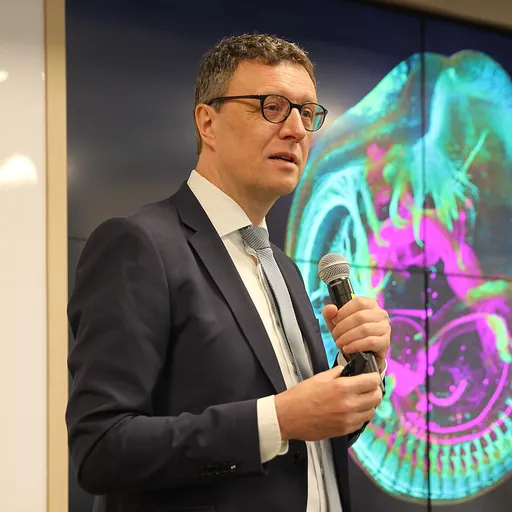
About Patrick Cramer
Born 1969. Patrick Cramer is a German biochemist, chemist, university teacher, scientist and manager.
Patrick Cramer (born 3 February 1969) is a German chemist, structural biologist, and molecular systems biologist. In 2020, he was elected an international member of the National Academy of Sciences. He became president of the Max Planck Society in June 2023.
Early life and education Cramer studied chemistry at the University of Stuttgart and Heidelberg University (Germany) from 1989 until 1995. He completed a part of his studies as ERASMUS scholar at the University of Bristol in the UK. As a research student, he also worked in the lab of Sir Alan Fersht in Cambridge, UK at the MRC Laboratory for Molecular Biology (LMB) site. In 1995 until 1998 he worked as a PhD student in laboratory of Christoph W. Müller at the European Molecular Biology Laboratory (EMBL) in Grenoble, France. He obtained his PhD in natural sciences (Dr. rer. nat.) from Heidelberg University in 1998.
LMU Munich, 2001–2013 In 2001, Cramer returned to Germany, where he obtained a tenure-track professorship for biochemistry at the Gene Center of LMU Munich where he was later, in 2004, appointed full professor of biochemistry. Patrick Cramer headed the LMU Gene Center for 10 years, from 2004 until 2013.
Max Planck Society, 2023–present Since 22 June 2023, Cramer has been serving as president of the Max Planck Society.
Achievements Cramer conducts basic research as the head of the Department of Molecular Biology
Cramer's laboratory investigates the molecular mechanisms and systemic principles of gene transcription in eukaryotic cells. The laboratory uses integrated structural biology methods, including X-ray crystallography, cryo-electron microscopy, and biochemical tools. The Cramer laboratory also uses functional genomics and computational biology approaches to study the principles of transcription in living cells.
Cramer's group created the first molecular movie of transcription initiation and elongation. Moreover, Patrick Cramer developed methods to analyze fundamental aspects of RNA metabolism in cells by integrating aspects of both molecular and systems biology. His long-term goal is to understand the expression and the regulation of the genome. The laboratory thus pioneers an approach that combines structural and genome-wide methods and may be referred to as molecular systems biology.
In April 2020, Cramer's team at the Max Planck Institute of Biophysical Chemistry created the first "3D structure of the corona polymerase" for the COVID-19 virus. Their model will allow researchers "to investigate how antiviral drugs such as remdesivir – which blocks the polymerase – work, and to search for new inhibitory substances." Non-profit organizations Robert Koch Foundation, Member of the Board of Trustees Bayer Foundation, Chair of the Board of Trustees (2020–2022) European Molecular Biology Laboratory (EMBL), Chair of the Council (2016–2019) Cell, Member of the Editorial Board (2016–2022)
Publications Original research articles (selection)
Review articles (selection)
Other publications (selection) Aufbruch in die molekulare Systembiology. - Essay for the anniversary edition "20 Jahre Laborjournal", Published in Laborjournal on 11 July 2014. Entwicklungen in der Biomedizin: Genom-Sequenzierung in Diagnose, Prävention und Therape; Systembiologie und Medizin. In: T. Rendtorff (Hrsg.): Zukunft der biomedizinischen Wissenschaften. Nomos, 2013. O. Primavesi, P. Cramer, R. Hickel, T. O. Höllmann; W. Schön: Lob der Promotion. Published in Frankfurter Allgemeine Zeitung on 19 July 2013. J. Hacker, T. Rendtorff, P. Cramer, M. Hallek, K. Hilpert, C. Kupatt, M. Lohse, A. Müller, U Schroth, F. Voigt, M. Zichy. Biomedizinische Eingriffe am Menschen – Ein Stufenmodell zur ethischen Bewertung von Gen- und Zelltherapie. Water de Gruyter, Berlin. (2009).
Awards and honours (selection)
2000 EMBO Young Investigator Award 2000 MSC Future Investigator Award 2002 GlaxoSmithKline Science Award 2004 10th Eppendorf Award for Young European Researchers 2006 Leibniz Prize 2008 Bijvoet Medal, Bijvoet Center for Biomolecular Research, Utrecht University 2009 Ernst Jung Prize for Medicine 2009 Hansen Family Award, Bayer Science & Education Foundation 2009 Member, German National Academy of Sciences Leopoldina 2009 Member, European Molecular Biology Laboratory (EMBL) 2010 Advanced Grant of the European Research Council ('TRANSIT') 2010 Medal of Honour, Robert Koch Institute 2011 Feldberg Foundation Prize 2012 Vallee Foundation Visiting Professorship 2012 Cross of Merit of the Federal Republic of Germany 2012 Paula und Richard von Hertwig Preis 2015 Arthur Burkhardt Preis 2015 Guest Professor, Karolinska Institutet, Stockholm, Sweden 2016 Advanced Grant of the European Research Council ('TRANSREGULON') 2016 Centenary Award of the British Biochemical Society 2017 Elected Member, Academia Europaea 2017 Honorary Professor, University of Göttingen 2017 Weigle Lectureship, University of Geneva 2018 Inaugural George William Jourdian Lectureship, University of Michigan 2019 Ernst Schering Prize 2020 Otto Warburg Medal 2021 Louis-Jeantet Prize for Medicine 2023 Shaw Prize in Life Sciences 2025 Honorary doctorate, Bar-Ilan University
Don’t just read it —
keep it.
Full-length biographies made to live with: read them, listen on the way to work, watch them tonight.
- E-book
- Audio
- Video
Instant download · yours to keep · every purchase keeps this site free
Important facts
People in Patrick Cramer's life
Named in this biography and alive at the same time


Related people
Same field, nearest in time



Contemporaries
People whose lives overlapped Patrick Cramer's




Frequently asked questions
Who is Patrick Cramer?
German biochemist
When was Patrick Cramer born?
Patrick Cramer was born on 3 February 1969 in Stuttgart.
What is Patrick Cramer's occupation?
Patrick Cramer is a biochemist, chemist, university teacher, scientist and manager.
What nationality is Patrick Cramer?
Patrick Cramer is German.
Sources & further reading
Cite this page
APA: Biography.guide. (2026). Patrick Cramer. https://biography.guide/patrick-cramer/
MLA: "Patrick Cramer." Biography.guide, https://biography.guide/patrick-cramer/.
Chicago: "Patrick Cramer." Biography.guide. https://biography.guide/patrick-cramer/.
Data last updated: 2026-09-20 · Spot an error? Report a correction.
Portrait: Wikimedia Commons · author & licence
Page generated 2026-09-27 04:58 UTC