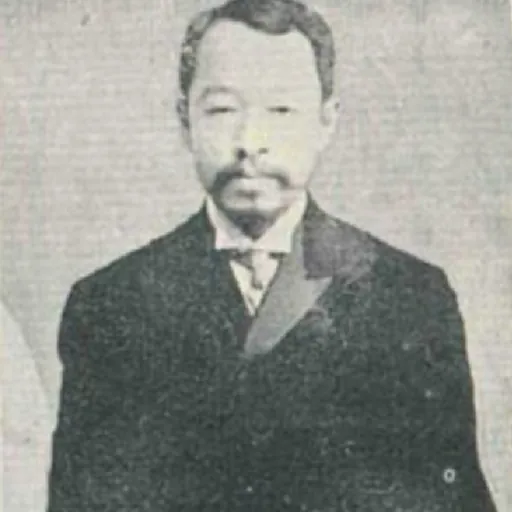
About Park Yeong-hyo
Lived 1861 – 1939 (aged 78). Park Yeong-hyo was a Japanese and Korean autobiographer and politician.
Pak Yŏnghyo (; 12 June 1861 – 21 September 1939) was a Korean politician from the Joseon period, an enlightenment activist, diplomat, and pro-Japanese collaborator. He was one of the organizers of the 1884 Kapsin Coup, in which progressive political elements attempted to overthrow the conservative Korean government. He become Prince Consort Geumneung through his marriage to Princess Yeonghye, King Cheoljong's daughter.
Early life and education Pak Yŏnghyo was born in Suwon, south of Hanseong. He was the third son of Pak Won-yang and his mother was Lady Yi of the Jeonui Yi clan.
By birth, he also had a distant connection with the Royal Family: his 7th great-grandfather was Pak Se-gyo (; 1611–1663), the only son of King Seonjo's 5th daughter, Princess Jeongan (; 1590–1660), and Pak Mi, Prince Consort Geumyang (; 1592–1645).
Pak Yŏnghyo was also an adoptive 16th great-grandson of Pak Eun (박은, 朴誾; 1370–1422) who was the great-great-grandfather of Queen Inseong, wife of King Injong, and the 4th great-grandfather of Queen Uiin, first wife of King Seonjo. Thus making him distant cousins with the queens.
On April 3, 1872, he was chosen to be the spouse of Princess Yeonghye, the only living daughter of King Cheoljong, the 25th King of Joseon. However, the princess died just three months after their wedding.
Together with Kim Okkyun, Pak was a strong supporter of the Dongnipdang, or "Enlightenment Party", which sought to reform the government, economy, and military by incorporating Western technology and methodology, so that Korea would become stable enough to withstand increasing foreign encroachment. He accompanied Kim on his visit to Tokyo, meeting with various influential Japanese politicians, including Fukuzawa Yukichi.
Career He is credited with creating the first Korean national flag, in 1882. Kapsin Coup Pak was one of the leaders of the 1884 Kapsin Coup that attempted to overthrow the government and institute Western-style reforms. The coup attempt lasted only three days before its suppression by Chinese troops. He was forced to flee to Japan, where he initially stayed with Fukuzawa Yukichi, before moving on to Kobe.
Subsequent career Following the Japanese Occupation of Gyeongbokgung Palace, Pak returned to Korea with some of his entourage, such as Lee Kyu-wan and Ryu Hyeok-ro. Arriving Seoul on 23 August 1894, Pak requested a discursive authority to reform the country to Gojong. But because public ideas about reforms remained so negative due to the Kapsin Coup, Pak was not able to gain great political power, and instead fled to Incheon. Following the Japanese victory of Battle of Pyongyang, the Korean public started to regard Japan as the new leading power in Asia. Finally on 9 December, Pak and his allies gained political independence. The Second Kim Hong-jip cabinet was established, and Pak was appointed as Minister of Interior. However, Pak once asked Gojong to replace his bodyguards with Hunryeondae, which was a Japanese-influenced organization. This proposal made the king furious; the Min regime identified Pak as an enemy, forcing Pak to flee to Japan again. After the removal of Pak, the new cabinet became pro-American, Russian, and English, consisting of Bak Jeongyang, Ye Wanyong, Yi Bum-jin, and Min Young-hwan.
Following the Japan-Korea Treaty of 1910, in which Korea was annexed to the Empire of Japan, Pak was awarded with the kazoku title of marquess (koshaku) in the Japanese peerage, and a seat in the House of Peers in the Diet of Japan. He served as Director of the Bank of Chōsen in 1918, Chairman of the Korean Economic Association in 1919, first president of The Dong-A Ilbo newspaper in 1920, president of the Kyungbang Corporation, chairman of the Korea Industrialization Bank in 1921, and advisor to the Government-General of Korea's Central Institute.
Family
Pak didn't remarry due to the connections he gained through his marriage to Princess Yeonghye.
Thus having him to take in 3 concubines which produced 3 illegitimate children; 1 daughter, Pak Myook, and 2 sons, Pak Chinsŏ and Pak Ilsŏ. Among Pak's granddaughters was Park Chan-ju, who was married to Prince Yi U, and was the mother of Yi Cheong.
Pak Chanju's younger brother, Pak Chanbŏm (박찬범, 朴贊汎; 17 August 1917 – 23 November 1986) eventually married, and later divorced, Yi Kang's third illegitimate daughter, Yi Haech'un (이해춘; 1921–2009), and had one son Pak Hyŏngu (박형우, 朴亨雨; 1937–2012).
Father – Pak Wŏnyang (; 1804–1884) Mother Biological – Lady Yi of the Jeonju Yi clan (; 1817–1884), Pak Won-yang's third wife Step – Lady Yi (; 1802–?) Step – Lady Song (; 1803–1822) Siblings Older sister – Lady Pak of the Bannam Park clan (; 1847–?) Older brother – Pak Yŏnggyo (; 1849–1884) Older brother – Pak Yŏngho (; 1852–1897) Older sister – Lady Pak of the Bannam Park clan (; 1858–?) Spouse Princess Yeonghye (1859 – 4 July 1872) – No issue. Concubines and their issue Sun Kiltang (; 1861–?) – No issue. Lady Pŏm (; 1865–?) Daughter – Pak Myook , Lady Pak of the Bannam Park clan (; 1884–?) Son – Pak Hŭngwŏn (; 1895–?) Pak Kyŏnghŭi (; 1870–?) Son – Pak Chinsŏ (; 1893–?) Son – Pak Ilsŏ (; 1897–1931) Unnamed concubine (1890–?) – No issue.
Writings Sahwa giryak
Don’t just read it —
keep it.
Full-length biographies made to live with: read them, listen on the way to work, watch them tonight.
- E-book
- Audio
- Video
Instant download · yours to keep · every purchase keeps this site free
Important facts
People in Park Yeong-hyo's life
Named in this biography and alive at the same time


Related people
Same field, nearest in time



Contemporaries
People whose lives overlapped Park Yeong-hyo's


Frequently asked questions
Who was Park Yeong-hyo?
Korean politician (1861-1939)
When was Park Yeong-hyo born?
Park Yeong-hyo was born on 19 July 1861 in Suwon.
When did Park Yeong-hyo die?
Park Yeong-hyo died on 21 September 1939 in Seoul.
What was Park Yeong-hyo's occupation?
Park Yeong-hyo was an autobiographer and politician.
What nationality was Park Yeong-hyo?
Park Yeong-hyo was Japanese and Korean.
Sources & further reading
Cite this page
APA: Biography.guide. (2026). Park Yeong-hyo. https://biography.guide/park-yeong-hyo/
MLA: "Park Yeong-hyo." Biography.guide, https://biography.guide/park-yeong-hyo/.
Chicago: "Park Yeong-hyo." Biography.guide. https://biography.guide/park-yeong-hyo/.
Data last updated: 2026-09-20 · Spot an error? Report a correction.
Page generated 2026-09-27 05:10 UTC