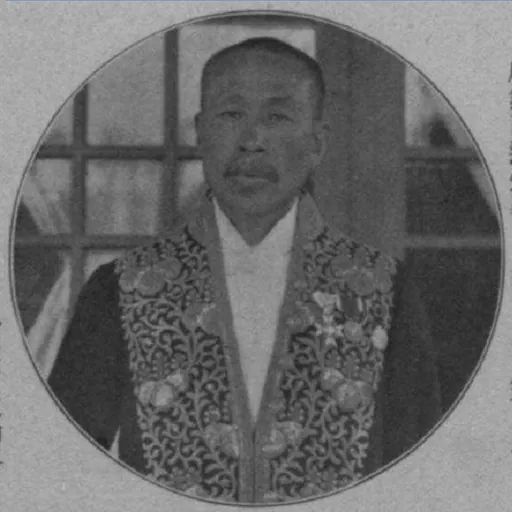
About Lee Kyu-wan
Lived 1862 – 1946 (aged 84). Lee Kyu-wan was a South Korean autobiographer, politician, philosopher and military personnel.
Yi Kyuwan (; November 15, 1862 – December 15, 1946) was a politician, philosopher, and revolutionist during Korea's Joseon period. His Japanese names were Asada Ryo and Asada Ryoichi . In 1884, he was one of several military leaders in the brief Gapsin Coup, a Japanese-supported attempt to overthrow the royal palace in Seoul.
Biography Yi was born in Gwangju, Gyeonggi Province, Joseon. He had ancestry in the royal family of the Joseon dynasty, descending from Prince Limyoung, the fifth son of Sejong the Great. Yi had a somewhat distant relationship with his family; his father was in the process of moving to Seoul from Guangzhou, and worked as a woodcutter, while his mother died early on in his life, which led his father to remarry. In Yi's youth, he came under the influence of reformist politicians Park Young-hyo and Seo Jae-pil, who arranged for him study in Japan in 1883. In 1884 he returned to Korea and was appointed to a junior military post.
In December 1884, he was one military leader of the short-lived Gapsin coup. When the coup failed, Yi escaped to Yamaguchi, Japan. He spent a long time wandering throughout areas near the southeastern tip of Honshu, such as Yamaguchi, Shimonoseki, and Fukuoka. During most of his time in Japan, he was an employee of a silk factory and rice mill, owned by the Nakamura family. One member of the family, Nakamura Ichi, was a diplomat for the United States in Japan at that time. The owner of the silk factory eventually paired Yi and Nakamura Umeko (中村梅子), Nakamura's daughter, whom Yi married on July 15, 1896.
In 1894, he was pardoned and returned to Korea, but the next year he was identified as being involved in Park Young-hyo's coup d'état. Both escaped. On May 11, 1907, while staying in Japan, Kojong was appointed deputy director of the Northwestern forestry service office (서북영림창;西北營林廠). In July 1907, he was again pardoned and returned to Korea, at which time he was appointed Jungchuwon Buchanui. In 1908, he became the governor of Gangwon Province. In 1910 he was reappointed to the post under the Japanese General Government, In 1918, he became governor of South Hamgyong Province, but resigned seven years later. In his later years he was active in farming and wasteland reclamation, as well as charitable work. He placed importance upon diligence and thrift, expressing disdain for idleness and laziness. In particular, he extremely disliked unemployed, idle peoples.
Family Yi's first son, Lee Sun-kil (이선길;李鮮吉), was a judoka and educator in Korea. His other son, Lee Young-il (이영일;李英一) was a painter and middle school teacher.
Don’t just read it —
keep it.
Full-length biographies made to live with: read them, listen on the way to work, watch them tonight.
- E-book
- Audio
- Video
Instant download · yours to keep · every purchase keeps this site free
Important facts
People in Lee Kyu-wan's life
Named in this biography and alive at the same time

Related people
Same field, nearest in time




Contemporaries
People whose lives overlapped Lee Kyu-wan's




Frequently asked questions
Who was Lee Kyu-wan?
Korean politician
When was Lee Kyu-wan born?
Lee Kyu-wan was born on 15 November 1862 in Gwangju.
When did Lee Kyu-wan die?
Lee Kyu-wan died on 15 December 1946.
What was Lee Kyu-wan's occupation?
Lee Kyu-wan was an autobiographer, politician, philosopher and military personnel.
What nationality was Lee Kyu-wan?
Lee Kyu-wan was South Korean.
Sources & further reading
Cite this page
APA: Biography.guide. (2026). Lee Kyu-wan. https://biography.guide/lee-kyu-wan/
MLA: "Lee Kyu-wan." Biography.guide, https://biography.guide/lee-kyu-wan/.
Chicago: "Lee Kyu-wan." Biography.guide. https://biography.guide/lee-kyu-wan/.
Data last updated: 2026-09-20 · Spot an error? Report a correction.
Portrait: Wikimedia Commons · author & licence
Page generated 2026-09-27 04:58 UTC