
About Otto Lancelle
Lived 1885 – 1941 (aged 56). Otto Lancelle was a military personnel and military officer.
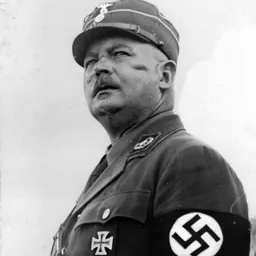
Otto Quirin Lancelle (27 March 1885 – 3 July 1941) was a German soldier who fought in both world wars and was awarded both the Pour le Mérite and the Knight's Cross of the Iron Cross, the highest military awards of the German Empire and Nazi Germany, respectively. During the interwar period, he joined Der Stalhelm and the Nazi Party, and participated in the failed Beer Hall Putsch that aimed to overthrow the Weimar Republic. He also was a member of the Supreme SA Leadership of the Nazi paramilitary organization, the Sturmabteilung (SA), in which he attained the rank of SA-Oberführer. Returning to military service, he became a general in command of an infantry division in the Wehrmacht during the Second World War and was killed in action in the first weeks of the invasion of the Soviet Union.
Early life and military service Lancelle was descended from a French Huguenot family that fled persecution in Catholic France and resettled in Germany in the seventeenth century. He was born in the Rhine Province, the son of a Royal Prussian Army officer who had fought in the Austro-Prussian War and the Franco-Prussian War. After earning his Abitur, Lancelle joined the Imperial German Navy as a midshipman on 1 April 1905. In December of the same year, he transferred to the Royal Prussian Army as a Fahnenjunker (officer cadet) with the 43rd (Kleve) Field Artillery Regiment, headquartered in Wesel. He was commissioned as a Leutnant on 27 January 1907, was attached to the (artillery school) at Jüterbog in March 1912 and was promoted to Oberleutnant on 8 July 1914.
At the outbreak of the First World War, Lancelle was attached to the 6th Guards Field Artillery Regiment as a platoon leader in the 5th and then the 2nd battery. He then advanced to the command of the 2nd battery in October 1914. He was promoted to Hauptmann on 2 April 1915, was twice wounded and moved to the eastern front in December 1915 as a battalion commander with the 5th Foot Guards Field Artillery Regiment. He returned to the western front as an artillery staff officer with the 1st Army from April 1917 to June 1918. He then returned to the role of battalion commander with the 2nd Guards Field Artillery Regiment until the end of the war. He distinguished himself several times, receiving both classes of the Iron Cross, the Knight's Cross of the Royal House Order of Hohenzollern with Swords and, on 9 October 1918, the highest Prussian award for bravery, the Pour le Mérite.
On 4 November 1931, Lancelle became a full-time employee on the staff of the Supreme SA Leadership (OSAF) in Munich with the rank of SA-Standartenführer. On 1 February 1932, he was promoted to SA-Oberführer. However, in April of that same year, he was removed from the OSAF after sharply criticizing SA-Stabschef Ernst Röhm for his homosexuality. In 1932, Lancelle also played a role in revealing the partial Jewish ancestry of the Stahlhelm deputy federal leader Theodor Duesterberg, which the Nazis used to damage Duesterberg's candidacy in the 1932 German presidential election and to attract Stahlhelm supporters to Hitler's candidacy. He was the first German general to be killed in Soviet territory. He was posthumously promoted to Generalleutnant on 21 July with an effective date of 1 July, and was awarded the Knight's Cross of the Iron Cross on 27 July. Lancelle was first buried next to the Krāslava Lutheran Church, and later reinterred in at Garmisch-Partenkirchen. The Polish town of Rzgów was renamed Lancellenstätt in his honor by the German occupiers from 1943 to 1945. A memorial marker on the site of his death was installed by his son Kraft in July 1994, but it was removed by authorities in November 2022.
Military ranks + Dates of rank Military rank Date 18 April 1906 27 January 1907 8 July 1914 3 April 1915 31 March 19201 October 1935 20 April 1936 1 January 1939 1 February 1941 (posthumous) 1 July 1941
Awards and decorations Iron Cross (1914) 2nd and 1st class Knight's Cross of the Royal House Order of Hohenzollern with Swords (14 August 1917) Pour le Mérite (9 October 1918) Wound Badge (1914) in silver Honour Cross of the World War 1914/1918 Clasp to the Iron Cross (1939) 2nd and 1st class Knight's Cross of the Iron Cross on 27 July 1941 (posthumous) Wound Badge (1939) in gold (posthumous)
Don’t just read it —
keep it.
Full-length biographies made to live with: read them, listen on the way to work, watch them tonight.
- E-book
- Audio
- Video
Instant download · yours to keep · every purchase keeps this site free
Important facts
People in Otto Lancelle's life
Named in this biography and alive at the same time

Related people
Same field, nearest in time




Contemporaries
People whose lives overlapped Otto Lancelle's

Frequently asked questions
Who was Otto Lancelle?
German Nazi and General (1885-1941)
When was Otto Lancelle born?
Otto Lancelle was born on 27 March 1885 in Xanten.
When did Otto Lancelle die?
Otto Lancelle died on 3 July 1941 in Krāslava.
What was Otto Lancelle's occupation?
Otto Lancelle was a military personnel and military officer.
What nationality was Otto Lancelle?
Otto Lancelle's recorded nationality: German Reich.
Sources & further reading
Cite this page
APA: Biography.guide. (2026). Otto Lancelle. https://biography.guide/otto-lancelle/
MLA: "Otto Lancelle." Biography.guide, https://biography.guide/otto-lancelle/.
Chicago: "Otto Lancelle." Biography.guide. https://biography.guide/otto-lancelle/.
Data last updated: 2026-09-20 · Spot an error? Report a correction.
Page generated 2026-09-27 05:27 UTC