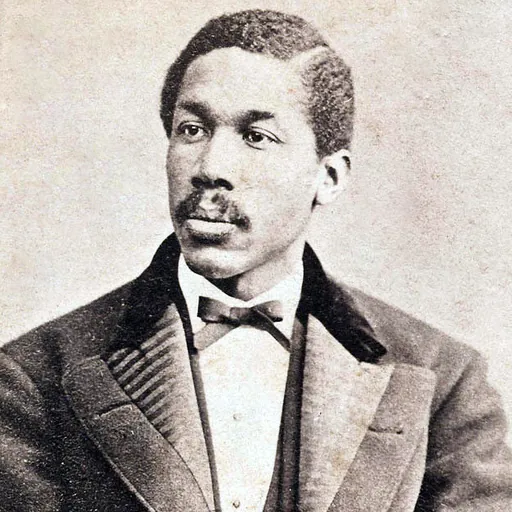
About Octavius Catto
Lived 1839 – 1871 (aged 32). Octavius Catto was an American activist, civil rights advocate, pedagogue and athlete.
Octavius Valentine Catto (February 22, 1839 – October 10, 1871) was an American educator, intellectual, and civil rights activist. He became principal of male students at the Institute for Colored Youth, where he had also been educated. Born free in Charleston, South Carolina, in a prominent mixed-race family, he moved north as a boy with his family. After completing his education, he went into teaching, and became active in civil rights. He also became known as a top cricket and baseball player in 19th-century Philadelphia, Pennsylvania. He helped organize and played for the Philadelphia Pythians baseball team. He was shot and killed on election-day in Philadelphia, where ethnic Irish of the Democratic Party, who were anti-Reconstruction and had opposed black suffrage, attacked black men to prevent their voting.
Early life Octavius Catto was born free. His mother Sarah Isabella Cain was a free member of the city's prominent mixed-race DeReef family, which had been free for decades and belonged to the Brown Fellowship Society, a mark of their status. His father, William T. Catto, had been an enslaved millwright in South Carolina who gained his freedom. He was ordained as a Presbyterian minister before taking his family north, first to Baltimore, and then to Philadelphia, where they settled in the free state of Pennsylvania. The state had gradually abolished slavery, beginning before the end of the Revolutionary War.
William T. Catto was a founding member of Philadelphia's Banneker Institute, an African-American intellectual and literary society. He wrote "A Semi-Centenary Discourse", a history of the First African Presbyterian Church in Philadelphia.
Catto began his education at Vaux Primary School and then Lombard Grammar School, institutions specifically for the education of African-Americans, in Philadelphia. In 1853, he entered the, otherwise, all-white Allentown Academy in Allentown, New Jersey, located across the Delaware River and 40 miles north. In 1854, when his family returned to Philadelphia, he became a student at that city's Institute for Colored Youth (ICY).
While a student at ICY, Catto presented papers and took part in scholarly discussions at "a young men's instruction society". Led by fellow ICY student Jacob C. White Jr., they met weekly at the ICY.
On May 10, 1864, Catto delivered ICY's commencement address, which gave a historical synopsis of the school.
In 1869, Bassett left ICY when he was appointed ambassador to Haiti. Catto lobbied to succeed Bassett as principal; however, the ICY board chose Catto's fellow teacher, Fanny Jackson Coppin, as head of the school. Catto was elected as the principal of the ICY's male department. In 1870, Catto joined the Franklin Institute, a center for science and education whose white leaders supported Catto's membership despite his race, in the face of some opposition.
Sportsman Catto was active not just in the public arenas of education and equal rights, but also on the sporting field. Like many other young men of Philadelphia, both white and black, Catto began playing cricket while in school, as it was a British tradition. The May 18, 1865, issue of the New York Times ran a story discussing the civil disobedience tactics employed by Catto as he fought for civil rights:
A meeting of the Union League of Philadelphia was held in Sansom Street Hall on Thursday, June 21, 1866, to protest and denounce the forcible ejection of several black women from Philadelphia's street cars. At this meeting, Catto presented the following resolutions:
Later enlisting the help of Congressmen Thaddeus Stevens and William D. Kelley, Catto was instrumental in the passage of a Pennsylvania bill that prohibited segregation on transit systems in the state. Publicity about a conductor's being fined who refused to admit Catto's fiancée to a Philadelphia streetcar helped establish the new law in practice. in which thousands of Black men marched by ward. Contemporary reporting and later historical analysis describe the parade as a deliberate demonstration of electoral readiness and political discipline, signaling that newly enfranchised Black voters would have a decisive impact on upcoming elections, including the 1871 mayoral race.
Assassination
By 1871, Black voters in Philadelphia overwhelmingly supported the Republican Party, threatening the control of the city’s Democratic political machine. The Democratic administration of Mayor Daniel M. Fox, working through ward organizations, responded with systematic efforts to suppress the Black vote. In the Fourth Ward, political power was controlled by Alderman William “Bull” McMullen, whose organization relied on patronage, police loyalty, and street violence to maintain electoral dominance. Historical research and trial records show that McMullen’s organization coordinated Election Day violence using both uniformed police officers and civilian enforcers.
On Election Day, October 10, 1871, McMullen’s Fourth Ward organization initiated a campaign of racially targeted political violence intended to intimidate Black voters and disrupt polling. Police officers aligned with the Fourth Ward machine illegally separated Black and white voters at polling places, assaulted Black men attempting to vote, and either participated in or enabled armed attacks in surrounding neighborhoods. The violence spread beyond the Fourth Ward into adjacent Black communities.
In the hours preceding Catto’s death, multiple Black men were shot or killed within the same area of the city. Within a two-block radius of the site where Catto was later attacked, Jacob Gordon, Levi Bolden, Moses Wright, and Isaac Chase were violently assaulted or killed between the night before and the afternoon of Election Day. Armed groups moved through Black residential streets, breaking into homes, attacking residents, and forcing the closure of polling places.
According to witness testimony and trial evidence, Frank Kelly, a Democratic partisan operating within McMullen’s Fourth Ward organization, recognized Catto on South Street between Eighth and Ninth Streets. Kelly had already participated in violent attacks earlier that day, including the fatal assault on Isaac Chase. After recognizing Catto, Kelly confronted and shot him multiple times.
Catto did not die immediately. Police testimony indicates that after the first shot, Catto sought protection from nearby officers and requested their assistance. Kelly fired additional shots moments later, resulting in fatal wounds. Kelly fled the scene. He was able to escape Philadelphia and lived for 7 years in Chicago. He was recognized and apprehended, tried, and acquitted. No police officers or political officials were convicted for their roles in the Election Day violence.
O. V. Catto Memorial On June 17, 1878, R. W. Wallace, a biographer of Catto, wrote to the Christian Recorder, questioning why no one was taking care of Catto's grave:
Can you inform me through your paper, why there is no care taken of Prof. O. V. Catto's grave? I have recently been down to the Cemetery and was surprised to see its condition. Thousands of people have asked me about the same thing, and, when I am compelled to say there is no sign of any stone to his grave, while both white and colored stand ready to help in the matter, it is not creditable to us. Something ought to be done in the matter. I believe almost everybody would give something toward getting a stone. I am the publisher of his life, and am prepared to speak in regard to the interest taken by all classes of people. (Wallace 1878)However, Catto's memory continued to be revered in the Black community. His fiance Carolyn LeCount influenced the City of Philadelphia schools to rename the Ohio Street School to the Octavius V. Catto school. Fraternal organizations named lodges after him.
Some twenty years later, the New York Times reported:
21st century memorial campaign
An annual remembrance ceremony was initiated in 1995.
On June 14, 2006, the Board of Trustees of the O. V. Catto Memorial announced the kickoff of a $1.5 million fundraising campaign to erect a memorial statue to Catto. The Abraham Lincoln Foundation made the first contribution of $25,000. On October 10, 2007, the 136th anniversary of Catto's death, the Octavius V. Catto Memorial Fund erected a headstone at Catto's burial site at Eden Cemetery in Collingdale, Pennsylvania.
On July 26, 2011, to commemorate his life, the General Meade Society of Philadelphia participated in a wreath-laying ceremony at 6th and Lombard Streets in Philadelphia, Pennsylvania. The first OV Catto award was presented that year.
To honor the man affectionately called the "19th century Martin Luther King", Mayor Jim Kenney announced on June 10, 2016, that a new sculpture to commemorate Catto and other leaders would be erected outside Philadelphia City Hall.
The sculptural group, A Quest for Parity, including a twelve-foot bronze statue of Catto, was installed at Philadelphia's City Hall on September 24, 2017, and dedicated on September 26, 2017. The sculptor is Branly Cadet. It is the first public monument in Philadelphia to honor a specific African American.
Don’t just read it —
keep it.
Full-length biographies made to live with: read them, listen on the way to work, watch them tonight.
- E-book
- Audio
- Video
Instant download · yours to keep · every purchase keeps this site free
Important facts
Family & relationships
People in Octavius Catto's life
Named in this biography and alive at the same time
Related people
Same field, nearest in time


Contemporaries
People whose lives overlapped Octavius Catto's


Frequently asked questions
Who was Octavius Catto?
American activist (1839–1871)
When was Octavius Catto born?
Octavius Catto was born on 22 February 1839 in Charleston.
When did Octavius Catto die?
Octavius Catto died on 10 October 1871 in Philadelphia.
What was Octavius Catto's occupation?
Octavius Catto was an activist, civil rights advocate, pedagogue and athlete.
What nationality was Octavius Catto?
Octavius Catto was American.
Sources & further reading
Cite this page
APA: Biography.guide. (2026). Octavius Catto. https://biography.guide/octavius-catto/
MLA: "Octavius Catto." Biography.guide, https://biography.guide/octavius-catto/.
Chicago: "Octavius Catto." Biography.guide. https://biography.guide/octavius-catto/.
Data last updated: 2026-09-24 · Spot an error? Report a correction.
Portrait: Wikimedia Commons · author & licence
Page generated 2026-09-27 05:09 UTC