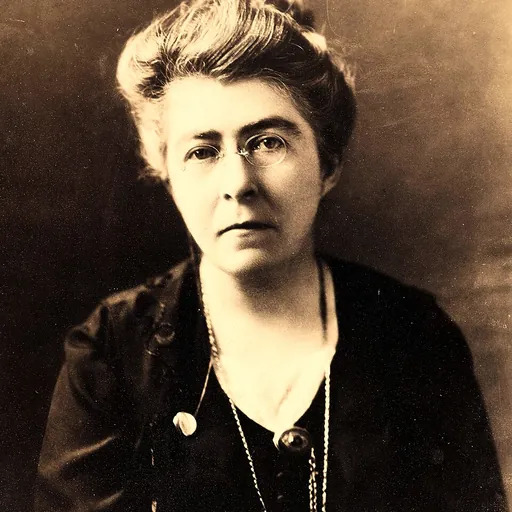
About Hanna Sheehy-Skeffington
Lived 1877 – 1946 (aged 68). Hanna Sheehy-Skeffington was a British and Irish activist, suffragist, humanist, teacher, editor and journalist, known for Suffragette.
Johanna Mary Sheehy-Skeffington (née Sheehy; 24 May 1877 – 20 April 1946) was a suffragette and Irish nationalist. Along with her husband Francis Sheehy-Skeffington, Margaret Cousins and James Cousins, she founded the Irish Women's Franchise League in 1908 with the aim of obtaining women's voting rights. She was later a founding member of the Irish Women Workers' Union. Her son Owen Sheehy-Skeffington became a politician and Irish senator.
Early life Hanna Sheehy was born in Kanturk, County Cork, the daughter of Elizabeth "Bessie" McCoy and David Sheehy, an ex-Fenian who later served as an MP for the Irish Parliamentary Party representing South Galway, and she spent her earliest years in the millhouse in which her father had also grown up before the family moved to Loughmore, County Tipperary when she was three years old. She had six siblings (one of whom died at an unknown age); her brothers and sisters included Margaret (born 1875), Eugene (born 1882), Richard (born 1884), Mary (born 1884) and Kathleen (born 1886). As a teenager the Sheehy household kept an open house on the second Sunday night of each month at 2 Belvedere Place near Mountjoy Square, and in 1896–1897 James Joyce and his brother Stanislaus were regular visitors; Joyce later depicted the family in Ulysses, describing Bessie in terms that she strongly objected to. She was sent to Germany for a short period at the age of eighteen for treatment of tuberculosis. By 1912, the IWFL reported having more than 1,000 members, making it Ireland's largest suffrage organisation. Although Hanna was a committed nationalist, she chose not to join Inghinidhe na hÉireann when it was founded in 1900, nor Cumann na mBan in 1914. She argued that women in nationalist groups were relegated to secondary roles behind men (a point of much debate at the time), and maintained that genuine citizenship could only be achieved through securing the right to vote.
The movement escalated in 1912. On 25 May of that year, Sheehy-Skeffington and Margaret Cousins launched The Irish Citizen, a feminist newspaper that within a month was selling about 3,000 copies and reaching up to 10,000 readers. On 13 June, she was arrested with seven other women for smashing the windows of Dublin Castle. Convicted a week later, she served a month in Mountjoy Prison and a further month after refusing to pay a fine, but was granted political prisoner privileges.
The socialist ideas of James Connolly had a strong influence on her, and during the Dublin lock-out of 1913, she worked in Liberty Hall with other suffragists to help feed the families of strikers. In the same year, she lost her post as a teacher at Rathmines School of Commerce because of her militancy.
She opposed Ireland's involvement in the First World War when it broke out in August 1914. In April 1915, the British government prevented her from attending the International Congress of Women at the Hague and in June, her husband was imprisoned for anti-recruitment activities.
Revolutionary era
In Easter 1916, Francis Sheehy-Skeffington was arrested and shot dead by British soldiers. She only discovered this two days later and refused all compensation for his killing. After his death, she assumed editorship of the Irish Citizen, a post she held intermittently until the paper ceased in 1920. In January 1918, she received a petition from Cumann na mBan urging President Woodrow Wilson to support Irish self-determination, and in May, she addressed Madison Square Garden. On 27 June 1918, she returned to Ireland with her son Owen.
In October 1917, she was the only Irish representative at the League of Small and Subject Nationalities and was accused of pro-German sympathies. Around the same time she became a Sinn Féin executive.
She published British Militarism as I Have Known It, which was banned in the United Kingdom until after the First World War. After her release, Sheehy-Skeffington attended the 1918 Irish Race Convention in New York City. In 1919, she stated that the Irish Citizen had been founded not only to promote feminism and suffrage but also to defend labour and Irish self-determination.
Between 1922 and 1923, she returned to the United States, this time alongside Kathleen Boland and Linda Kearns, replacing Muriel MacSwiney. Their tour raised $123,000 for Irish prisoners and their families. That same year, she attended the Women's International League for Peace and Freedom (WILPF) conference in Dublin, later travelling to Prague for its 1929 congress. A pacifist organisation of which she became vice-president, the WILPF remained central to her activism. Although politically unsettled by the character of the Irish government in the 1920s and 1930s, she continued to campaign as a feminist, while also sustaining herself and her son Owen through journalism for the Irish World and by delivering numerous public talks and lectures. At her trial she said: "I recognise no partition. I recognise it as no crime to be in my own country. I would be ashamed of my own name and my murdered husband's name if I did… Long live the Republic!" and was sentenced to a month's imprisonment.
In 1935, Sheehy-Skeffington spoke out on behalf of the Women Graduates' Association against the Conditions of Employment Bill, which sought to restrict women's access to work. She later opposed the 1937 Constitution and, through the Women Graduates' Association, campaigned publicly against its provisions. In November 1937, motivated by her concerns over the constitution, she helped found the Women's Social and Progressive League, a non-sectarian and non-party women's political organisation. At the 1943 general election, she stood as a candidate in Dublin South, receiving 917 votes (1.7 per cent) but failing to win a seat. and a colleague of Lillian Metge, who contributed to the Irish Citizen and wrote in sympathy after Francis Sheehy-Skeffington's death.
Personal life
Sheehy was introduced to Francis Skeffington, from County Down, by mutual friend James Joyce, who went to university with Skeffington. The couple would meet regularly in Bewley's Cafe to discuss politics, the arts and religion. In 2014, Owen's daughter, Dr Micheline Sheehy-Skeffington, won a gender discrimination case against NUI Galway.
Her sister Mary married the writer and politician Thomas Kettle. Another sister, Kathleen, married Frank Cruise O'Brien, and was the mother of Conor Cruise O'Brien. The fourth of the sisters, Margaret, married a solicitor, John Culhane, and later the poet Michael Casey. Their two brothers worked as lawyers.
Don’t just read it —
keep it.
Full-length biographies made to live with: read them, listen on the way to work, watch them tonight.
- E-book
- Audio
- Video
Instant download · yours to keep · every purchase keeps this site free
Important facts
Family & relationships
People in Hanna Sheehy-Skeffington's life
Named in this biography and alive at the same time




Related people
Same field, nearest in time


Contemporaries
People whose lives overlapped Hanna Sheehy-Skeffington's




Frequently asked questions
Who was Hanna Sheehy-Skeffington?
Irish feminist & nationalist (1877–1946)
When was Hanna Sheehy-Skeffington born?
Hanna Sheehy-Skeffington was born on 24 May 1877 in Kanturk.
When did Hanna Sheehy-Skeffington die?
Hanna Sheehy-Skeffington died on 20 April 1946 in Dublin.
What was Hanna Sheehy-Skeffington's occupation?
Hanna Sheehy-Skeffington was an activist, suffragist, humanist, teacher, editor and journalist.
What was Hanna Sheehy-Skeffington known for?
Hanna Sheehy-Skeffington was known for Suffragette.
What nationality was Hanna Sheehy-Skeffington?
Hanna Sheehy-Skeffington was British and Irish.
Sources & further reading
· Wikipedia: Hanna Sheehy-Skeffington
· DBpedia: Hanna Sheehy-Skeffington
Cite this page
APA: Biography.guide. (2026). Hanna Sheehy-Skeffington. https://biography.guide/hanna-sheehy-skeffington/
MLA: "Hanna Sheehy-Skeffington." Biography.guide, https://biography.guide/hanna-sheehy-skeffington/.
Chicago: "Hanna Sheehy-Skeffington." Biography.guide. https://biography.guide/hanna-sheehy-skeffington/.
Data last updated: 2026-09-22 · Spot an error? Report a correction.
Portrait: Wikimedia Commons · author & licence
Page generated 2026-09-27 05:03 UTC