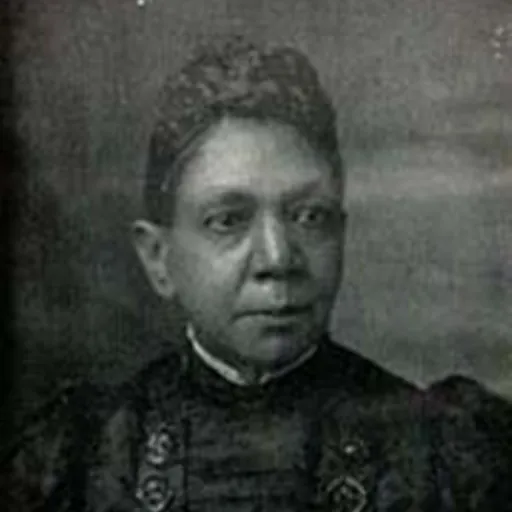
About Fanny Jackson Coppin
Lived 1837 – 1913 (aged 75). Fanny Jackson Coppin was an American teacher, missionary and pedagogue.
Fanny Jackson Coppin (October 15, 1837 – January 21, 1913) was an American educator, missionary and lifelong advocate for female higher education. One of the first Black alumnae of Oberlin College, she served as principal of the Institute for Colored Youth in Philadelphia and became the first African-American school superintendent in the United States.
Personal life Born into slavery, Fanny Jackson was 12 years old when her freedom was purchased by her aunt for $125. Fanny spent the rest of her youth in Newport, Rhode Island, working as a servant for author George Henry Calvert, studying at every opportunity.
On December 21, 1881, Fanny married Reverend Levi Jenkins Coppin, a minister of the African Methodist Episcopal Church and pastor of Bethel AME Church Baltimore. Following her three decades as an educator, Fanny Jackson Coppin became more involved with her husband's religious work. In 1902 the couple went to South Africa and performed a variety of missionary work, including the founding of the Bethel Institute, a missionary school with self-help programs. After almost a decade of missionary work, Fanny Jackson Coppin's declining health forced her to return to Philadelphia, and she died on January 21, 1913. Along with many other prominent Black Philadelphians, Jackson Coppin is buried at Merion Memorial Park in Bala Cynwyd, Pennsylvania.
Education Throughout her youth, she used her earnings from her servant work to hire a tutor who guided her studies for three hours a week. With the help of a scholarship from the African Methodist Church and financial support from her aunt, Coppin was able to enroll at Oberlin College, Ohio – the first college in the United States to accept both black and female students – in 1860. Initially enrolling for the "ladies' course", Coppin switched to the more rigorous "gentlemen's course" the following year.
She also recalled the pressure she felt under as a Black woman: "I never rose to recite in my classes at Oberlin but I felt that I had the honor of the whole African race upon my shoulders. I felt that, should I fail, it would be ascribed to the fact that I was colored. At one time, when I had quite a signal triumph in Greek, the Professor of Greek concluded to visit the class in mathematics and see how we were getting along. I was particularly anxious to show him that I was as safe in mathematics as in Greek. I, indeed, was more anxious, for I had always heard that my race was good in the languages, but stumbled when they came to mathematics. Now, I was always fond of a demonstration, and happened to get in the examination the very proposition that I was well acquainted with; and so went that day out of the class with flying colors." becoming one of only three black women to have done so by this time (the others were Mary Jane Patterson and Frances Josephine Norris).
Career Jackson Coppin was the first black teacher at the Oberlin Academy.
Legacy
In 1888, with a committee of women from Mother Bethel, she opened a home for destitute young women after other charities refused them admission.
In 1899, the Fannie Jackson Coppin Club was named in her honor for community oriented African-American women in Alameda County. This club played an important role in the California suffrage movement.
To illustrate her point on Black economic independence, Jackson organized an effort to save The Christian Recorder – official newspaper of the AME Church – from bankruptcy in 1879.
Jackson Coppin's Reminiscences of a School Life and Hints on Teaching – a combination of autobiography and an account of her teaching and administration at the ICY – was published in 1913. On February 12, 1986, the Pennsylvania Historical and Museum Commission dedicated a historical marker in honor of Coppin on the campus of Cheyney University of Pennsylvania.
On December 18, 1999, Coppin State University unveiled a bust in Jackson Coppin´s honor during their Centennial Celebration.
On June 24, 2021, the Philadelphia Board of Education voted unanimously to rename the former Andrew Jackson Elementary School in South Philadelphia after Jackson Coppin (no relation), effective July 1, 2021; the school is now named Fanny Jackson Coppin School. The formal renaming occurred on March 29, 2022. At that time, the president of Coppin State University announced the establishment of a "Philadelphia Pathway" scholarship, under which any graduate of Coppin Elementary may attend Coppin State tuition-free, upon completion of high school.
Don’t just read it —
keep it.
Full-length biographies made to live with: read them, listen on the way to work, watch them tonight.
- E-book
- Audio
- Video
Instant download · yours to keep · every purchase keeps this site free
Important facts
People in Fanny Jackson Coppin's life
Named in this biography and alive at the same time



Related people
Same field, nearest in time


Contemporaries
People whose lives overlapped Fanny Jackson Coppin's



Frequently asked questions
Who was Fanny Jackson Coppin?
American educator (1837–1913)
When was Fanny Jackson Coppin born?
Fanny Jackson Coppin was born on 15 October 1837 in Washington, D.C..
When did Fanny Jackson Coppin die?
Fanny Jackson Coppin died on 21 January 1913 in Philadelphia.
What was Fanny Jackson Coppin's occupation?
Fanny Jackson Coppin was a teacher, missionary and pedagogue.
What nationality was Fanny Jackson Coppin?
Fanny Jackson Coppin was American.
Sources & further reading
· Wikipedia: Fanny Jackson Coppin
· DBpedia: Fanny Jackson Coppin
Cite this page
APA: Biography.guide. (2026). Fanny Jackson Coppin. https://biography.guide/fanny-jackson-coppin/
MLA: "Fanny Jackson Coppin." Biography.guide, https://biography.guide/fanny-jackson-coppin/.
Chicago: "Fanny Jackson Coppin." Biography.guide. https://biography.guide/fanny-jackson-coppin/.
Data last updated: 2026-09-23 · Spot an error? Report a correction.
Portrait: Wikimedia Commons · author & licence
Page generated 2026-09-27 05:07 UTC