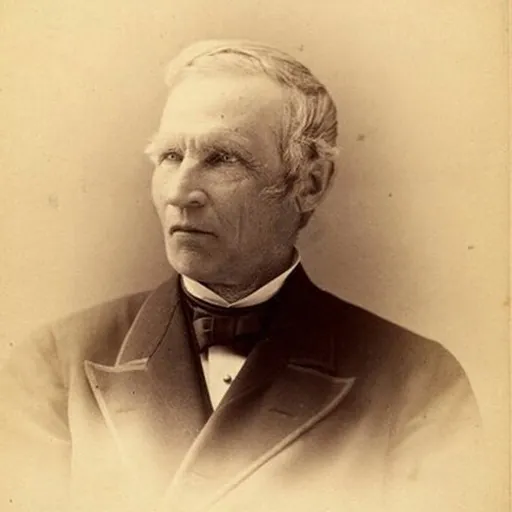
About Noah Porter
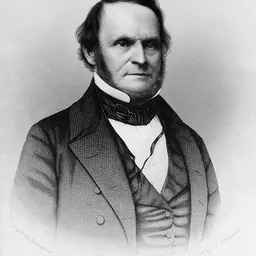
Lived 1811 – 1892 (aged 80). Noah Porter was an American lexicographer, linguist, philosopher, writer and theologian.
Noah Thomas Porter III (December 14, 1811 – March 4, 1892) was an American Congregational minister, academic, philosopher, author, lexicographer and an outspoken anti-slavery activist. Porter Mountain, of the Adirondack Mountains, was named for him after he was the first to climb it in 1875. He was President of Yale College (1871–1886).
Biography He was born to Noah Porter Jr. (1781–1866) (one of the first ministers of First Church of Christ, Congregational in Farmington, Connecticut) and his wife, born Mehitable Meigs, in Farmington, Connecticut, on December 14, 1811. His younger sister was Sarah Porter, founder of Miss Porter's School, a college preparatory school for girls. He graduated in 1831 from Yale College, where he was a member of the Linonian Society. On April 13, 1836, in New Haven, he married Mary Taylor, daughter of Nathaniel Taylor He was elected professor of moral philosophy and metaphysics at Yale in 1846.
Porter was inaugurated as President of Yale College on Wednesday, October 11, 1871. He continued to serve as head of the college until 1886.
Porter edited several editions of Webster's Dictionary, and wrote on education.
Influenced by the German refugee writer and philosopher Francis Lieber, Porter opposed slavery and integrated an antislavery position with religious liberalism.
He was a frequent visitor to the Adirondack Mountains of New York, and in 1875 was among the first recorded to make an ascent of the peak later named Porter Mountain in his honor.
His best-known work is The Human Intellect, with an Introduction upon Psychology and the Human Soul (1868), comprehending a general history of philosophy, and following in part the "common-sense" philosophy of the Scottish school, while accepting the Kantian doctrine of intuition, and declaring the notion of design to be a priori. Of great importance were two other works, Elements of Intellectual Science (1871) and Elements of Moral Science (1885).
He died on March 4, 1892, in New Haven, and was buried in the Grove Street Cemetery there.
Don’t just read it —
keep it.
Full-length biographies made to live with: read them, listen on the way to work, watch them tonight.
- E-book
- Audio
- Video
Instant download · yours to keep · every purchase keeps this site free
Important facts
People in Noah Porter's life
Named in this biography and alive at the same time



Related people
Same field, nearest in time



Contemporaries
People whose lives overlapped Noah Porter's





Frequently asked questions
Who was Noah Porter?
American academic (1811-1892)
When was Noah Porter born?
Noah Porter was born on 14 December 1811 in Farmington.
When did Noah Porter die?
Noah Porter died on 4 March 1892 in New Haven.
What was Noah Porter's occupation?
Noah Porter was a lexicographer, linguist, philosopher, writer and theologian.
What nationality was Noah Porter?
Noah Porter was American.
Sources & further reading
Cite this page
APA: Biography.guide. (2026). Noah Porter. https://biography.guide/noah-porter/
MLA: "Noah Porter." Biography.guide, https://biography.guide/noah-porter/.
Chicago: "Noah Porter." Biography.guide. https://biography.guide/noah-porter/.
Data last updated: 2026-09-23 · Spot an error? Report a correction.
Portrait: Wikimedia Commons · author & licence
Page generated 2026-09-27 05:07 UTC