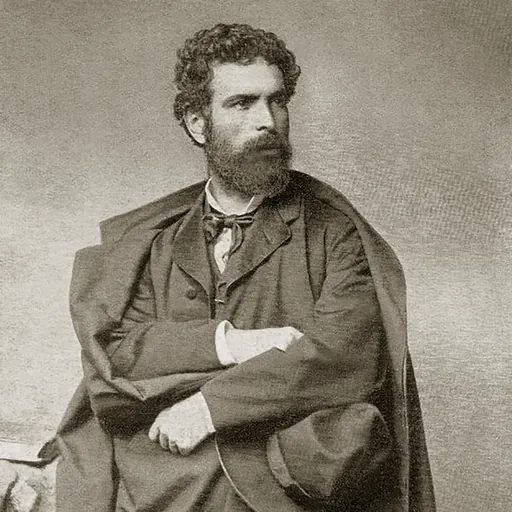
About Nikolaos Gyzis
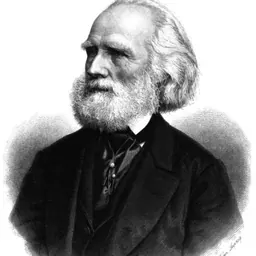
Lived 1842 – 1901 (aged 58). Nikolaos Gyzis was a Greek painter, university teacher, teacher, visual artist and art educator.
Nikolaos Gyzis ( ; ; 1 March 1842 – 4 January 1901) is considered one of Greece's most important 19th century painters. He was most famous for his work Eros and the Painter, his first genre painting. It was auctioned in May 2006 at Bonhams in London, being last exhibited in Greece in 1928. He was the major representative of the Munich School, the major 19th-century Greek art movement.
Life
Gyzis was born in the village of Sklavochori, on the island of Tinos which has a long artistic history. As his family settled in Athens in 1850, he soon embarked on a study at the Athens School of Fine Arts. His studies there formed the foundation of his artistic education and helped him to develop his natural skill in painting.
In 1865, having won a scholarship, he went to continue his studies at the Academy of Fine Arts, Munich, where he settled for the rest of his life. He was very soon incorporated into the German pictorial climate, and became one of its most characteristic representatives of the Greek artistic movement of the Munich School. This is expressed in the painting News of Victory of 1871, which deals with the Franco-Prussian War, and the painting Apotheosis i Thriamvos tis Vavarias (Apotheosis or Triumph of Bavaria).
From 1886 onward he was professor at the Academy of Fine Arts, Munich, and gradually turned from the detailed realistic depictions towards compositions of a singularly impressionistic character. His students included Jan Vochoc, Ernst Oppler, Fritz Osswald, Anna May-Rychter, Alfred Juergens and Stefan Popescu (Romanian painter).
At the beginning of the 1870s returned to Greece for a period of several years, after which he produced a sequence paintings with more avowedly Greek themes, such as the Carnival at Athens and the Arravoniasmata (Engagement Ceremony) and a little later the painting After the Destruction of Psara. Towards the end of his life, in the 1890s, he took a turn toward more religious themes, with his best known work of the later period being Triumph of Religion. Gyzis died in Munich.
Legacy His works are today exhibited at museums and private collections in Greece, Germany, and elsewhere.
Gyzis' painting The Secret School was depicted on the reverse of the Greek 200 drachmas banknote of 1996–2001.
The Athenian neighbourhood Gyzi is named for him.
Gallery
Don’t just read it —
keep it.
Full-length biographies made to live with: read them, listen on the way to work, watch them tonight.
- E-book
- Audio
- Video
Instant download · yours to keep · every purchase keeps this site free
Important facts
more
Gysis, Nikolaos Gyzes, nicoles gysis, nikolaus von gysis, N. Gysis, Nikolas GysisPeople in Nikolaos Gyzis's life
Named in this biography and alive at the same time


Related people
Same field, nearest in time
Contemporaries
People whose lives overlapped Nikolaos Gyzis's

Frequently asked questions
Who was Nikolaos Gyzis?
Greek artist (1842-1901)
When was Nikolaos Gyzis born?
Nikolaos Gyzis was born on 1 March 1842 in Tinos.
When did Nikolaos Gyzis die?
Nikolaos Gyzis died on 4 January 1901 in Munich.
What was Nikolaos Gyzis's occupation?
Nikolaos Gyzis was a painter, university teacher, teacher, visual artist and art educator.
What nationality was Nikolaos Gyzis?
Nikolaos Gyzis was Greek.
Sources & further reading
Cite this page
APA: Biography.guide. (2026). Nikolaos Gyzis. https://biography.guide/nikolaos-gyzis/
MLA: "Nikolaos Gyzis." Biography.guide, https://biography.guide/nikolaos-gyzis/.
Chicago: "Nikolaos Gyzis." Biography.guide. https://biography.guide/nikolaos-gyzis/.
Data last updated: 2026-09-21 · Spot an error? Report a correction.
Portrait: Wikimedia Commons · author & licence
Page generated 2026-09-27 05:00 UTC