
About Nikolai Kasterin
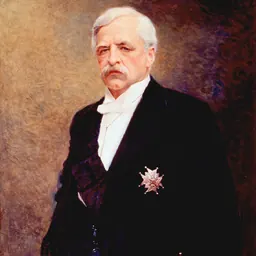
Lived 1869 – 1947 (aged 77). Nikolai Kasterin was a Russian physicist.
Nikolai Petrovich Kasterin (1869–1947) was a physicist and a student of Aleksandr Stoletov. His 1903 doctoral dissertation, portions of which were published in German in the Proceedings of the Royal Academy of Sciences in Amsterdam under the sponsorship of Heike Kamerlingh Onnes, is considered to be a pivotal contribution to multiple scattering theory (MST) by such experts as Paul Peter Ewald and Jan Korringa. The MST formalism is widely used for electronic structure calculations as well as diffraction theory, and is the subject of many books. He lived in the Russian Empire and later the Soviet Union.
Biography Kasterin studied at the Physical-Mathematical Faculty of Moscow University under the supervision of Aleksandr Stoletov. He graduated in 1892 and continued to work for Stoletov as a laboratory assistant. In 1896-1899, he trained abroad. In 1899, Kasterin returned to Moscow University where he became an assistant professor and taught theoretical physics. In 1905, Kasterin defended his doctoral dissertation "On the propagation of waves in non-uniform medium".
In 1906, Kasterin became a professor at the Department of Physics of Novorossiyskii University in Odessa. He also headed the Institute of Physics. From 1906 to 1922, he was the Chairman of the Department of Physics at Novorossiyskii University.
In 1922, Kasterin moved to the Biophysics Institute in Moscow.
Since 1930, he was a consultant for various scientific institutions including CAGI, Angarsrtoy and the National Institute of Building Materials.
Kasterin authored more than forty scientific publications in theoretical physics. He was also known for his works opposing special relativity.
In the summer of 1944, N. P. Kasterin’s work was criticized by the physics community of the USSR Academy of Sciences. On July 11, a letter from four academicians was sent to V. M. Molotov on behalf of A. F. Ioffe. In this letter, the work of N. P. Kasterin and A. K. Timiryazev was presented as a textbook example of pseudoscience.
Don’t just read it —
keep it.
Full-length biographies made to live with: read them, listen on the way to work, watch them tonight.
- E-book
- Audio
- Video
Instant download · yours to keep · every purchase keeps this site free
Important facts
People in Nikolai Kasterin's life
Named in this biography and alive at the same time



Related people
Same field, nearest in time


Contemporaries
People whose lives overlapped Nikolai Kasterin's



Frequently asked questions
Who was Nikolai Kasterin?
Russian physicist (1869-1947)
When was Nikolai Kasterin born?
Nikolai Kasterin was born on 1 December 1869 in Kaluga Governorate.
When did Nikolai Kasterin die?
Nikolai Kasterin died on 10 March 1947 in Moscow.
What was Nikolai Kasterin's occupation?
Nikolai Kasterin was a physicist.
What nationality was Nikolai Kasterin?
Nikolai Kasterin was Russian.
Sources & further reading
Cite this page
APA: Biography.guide. (2026). Nikolai Kasterin. https://biography.guide/nikolai-kasterin/
MLA: "Nikolai Kasterin." Biography.guide, https://biography.guide/nikolai-kasterin/.
Chicago: "Nikolai Kasterin." Biography.guide. https://biography.guide/nikolai-kasterin/.
Data last updated: 2026-09-20 · Spot an error? Report a correction.
Page generated 2026-09-27 05:16 UTC