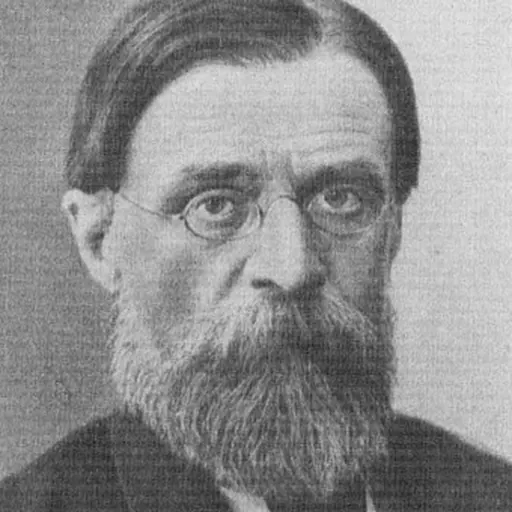
About Aleksandr Stoletov
Lived 1839 – 1896 (aged 56). Aleksandr Stoletov was a Russian physicist, engineer and university teacher, known for Photoelectric effect.
Alexander Grigorievich Stoletov (; 10 August 1839 – 27 May 1896) was a Russian physicist, founder of electrical engineering, and professor in Moscow University. He was the brother of general Nikolai Stoletov.
Biography
Alexander Stoletov defended his doctoral dissertation in 1872 and became professor at Moscow University a year later.
After defending his dissertation he became a renowned scientist worldwide. He attended the opening ceremony of the physical laboratory in Cambridge in 1874, and represented Russia at the first World Congress of Electricity in Paris in 1881, where he presented his work on links between electrostatic and electromagnetic values.
Contribution to science
His major contributions include pioneer work in the field of ferromagnetism and discovery of the laws and principles of the outer photoelectric effect.
Achievements of Alexander Stoletov include:
Magnetism (1871–1872) Stoletov was the first to show that with the increase of the magnetic field the magnetic susceptibility of iron grows, but then begins to decrease. Built the curve of the magnetic permeability of ferromagnetics, known as the Stoletov curve. Developed two new methods for measuring magnetic properties of various materials.
Photoelectric effect (1888–1891) Studied the outer photoelectric effect, discovered by Hertz in 1887. Published the results in six works. Developed quantitative methods for the study of the photoelectric effect. Discovered the direct proportionality between the intensity of light and the corresponding photo induced current (Stoletov's law) Discovered the Stoletov constant which defines the ratio between the intensity of the electric current and the gas pressure under the maximum current. Built the first solar cell based on the outer photoelectric effect and estimated the response time of the photoelectric current. Discovered the decrease of the solar cell's sensitivity with time (fatigue of solar cells).
Other Calculated the proportion between electrodynamic and electrostatic units, producing a value very close to the speed of light.
Don’t just read it —
keep it.
Full-length biographies made to live with: read them, listen on the way to work, watch them tonight.
- E-book
- Audio
- Video
Instant download · yours to keep · every purchase keeps this site free
Important facts
People in Aleksandr Stoletov's life
Named in this biography and alive at the same time

Related people
Same field, nearest in time




Contemporaries
People whose lives overlapped Aleksandr Stoletov's


Frequently asked questions
Who was Aleksandr Stoletov?
Russian physicist (1839–1896)
When was Aleksandr Stoletov born?
Aleksandr Stoletov was born on 29 July 1839 in Vladimir.
When did Aleksandr Stoletov die?
Aleksandr Stoletov died on 16 May 1896 in Moscow.
What was Aleksandr Stoletov's occupation?
Aleksandr Stoletov was a physicist, engineer and university teacher.
What was Aleksandr Stoletov known for?
Aleksandr Stoletov was known for Photoelectric effect.
What nationality was Aleksandr Stoletov?
Aleksandr Stoletov was Russian.
Sources & further reading
· Wikipedia: Aleksandr Stoletov
Cite this page
APA: Biography.guide. (2026). Aleksandr Stoletov. https://biography.guide/aleksandr-stoletov/
MLA: "Aleksandr Stoletov." Biography.guide, https://biography.guide/aleksandr-stoletov/.
Chicago: "Aleksandr Stoletov." Biography.guide. https://biography.guide/aleksandr-stoletov/.
Data last updated: 2026-09-21 · Spot an error? Report a correction.
Portrait: Wikimedia Commons · author & licence
Page generated 2026-09-27 05:00 UTC