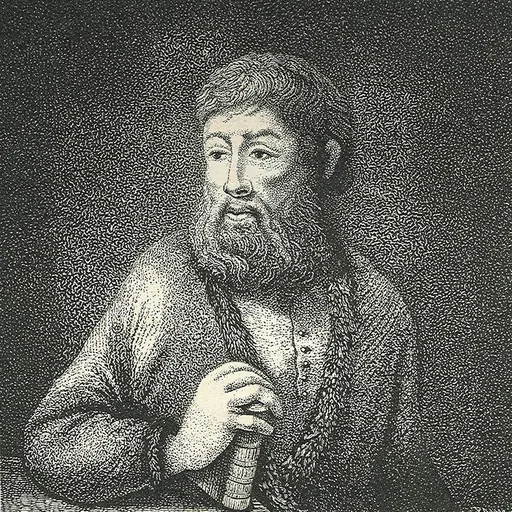
About Nikita Zotov
Lived 1644 – 1717 (aged 72–73). Nikita Zotov was a Russian diplomat.
alt=An elderly man sitting by a table and looking left. His right arm rests on the table and holds a book
Count Nikita Moiseevich Zotov (1644 – December 1717 ) was a childhood tutor and lifelong friend of Russian Tsar Peter the Great. Historians disagree on the quality of Zotov's tutoring. Robert K. Massie, for example, praises his efforts, but Lindsey Hughes criticizes the education that he gave to the future tsar.
Not much is known about Zotov's life aside from his connection to Peter. Zotov left Moscow for a diplomatic mission to Crimea in 1680 and returned to Moscow before 1683. He became part of the "Jolly Company", a group of several dozen of Peter's friends that eventually became The All-Joking, All-Drunken Synod of Fools and Jesters. Zotov was mockingly appointed "Prince-Pope" of the Synod, and regularly led them in games and celebrations. He accompanied Peter on many important occasions, such as the Azov campaigns and the torture of the Streltsy after their uprising. Zotov held a number of state posts, including from 1701 a leading position in the Tsar's personal secretariat. Three years before his death, Zotov married a woman 50 years his junior. He died in December 1717 of unknown causes.
Tutelage of Peter I
Background alt=A boy is sitting at a table and is looking at a large open book held by a bearded standing man. The table is covered with books and papers. A woman is sitting by the wall and looking at the man Tsar Alexis of Russia, father to Peter I, was married twice. His first wife, Maria Miloslavskaya, bore him Feodor, who would later become Tsar despite his frail health. Following Maria's death, Alexis married Natalia Naryshkina, mother to Peter. Upon Alexis's death in 1676, Feodor ascended the throne, and his uncle Ivan Miloslavsky, previously exiled as the Governor of Astrakhan, returned to Moscow to serve as Chief Minister. The Miloslavsky family, having lost their influence due to Alexis's remarriage, harbored animosity towards the Naryshkin family, which included Peter, Natalia, and Natalia's foster father, Artamon Matveyev. Despite attempts by Miloslavsky to arrest the Naryshkins, Feodor intervened, allowing only for Matveyev's exile. Feodor permitted Peter and Natalia to live in private apartments within the Kremlin, despite the political unrest.
Education in 17th-century Moscow was minimal, with low literacy rates even among the nobility. The curriculum typically included basic reading, writing, and rudimentary history and geography. Religious scholars, however, often received instruction in grammar, mathematics, and foreign languages. Feodor and his half-sister, Tsarevna Sophia, were among those who received comprehensive education from Kiev’s religious scholars, gaining proficiency in Latin and Polish.
Peter began his education at a young age. Around 1674 or 1675, when he was three, Tsar Alexis provided him with a primer to learn the alphabet. Two years later, Tsar Feodor recommended that Peter commence his studies. The exact year of the start of Peter’s tutoring is disputed, with some sources suggesting as early as 1677 and others as late as 1683. However, many references pinpoint 12 March 1677 as the commencement date. Nikita Zotov, a former church clerk or “Duma secretary” from the tax-collection department of the government bureaucracy, was selected to instruct Peter in reading and writing.
Peter's education began the day after Zotov's appointment. The books were first sanctified with holy water, after which Zotov initiated his instruction with the alphabet and the Prayer Book. He taught Peter the Bible, from which Peter memorized extensive passages that he could recite even four decades later. Zotov also taught Peter to sing, a skill Peter often utilized to accompany church choirs in his later years. To keep Peter engaged, Zotov, with the Tsaritsa's approval, introduced engravings of foreign cities, palaces, sailing ships, weapons, and historical events into the study room. These, along with a relatively accurate globe, served to divert Peter when he grew tired of his studies. Robert K. Massie defended him for providing Peter with a stimulating and diverse education that suited his curiosity and self-reliance. Peter moved to Preobrazhenskoye two years later, where he distanced himself from the traditional subjects taught by his siblings’ tutors. He resumed his studies with Afanassyi Nesterov and Zotov when the latter returned from Crimea. Peter focused on natural and military sciences, Zotov, and later his sons, helped Peter translate books on fortification from Western European languages into Russian. Peter lacked or forgot much of the mathematical knowledge he needed for siege warfare and fortification, and he later regretted not having a more comprehensive education. He tried to give his daughters Anne and Elizabeth the same level of education as European princesses.
Prince-Pope of Drunken Synod In 1692, Peter, who had by then become Tsar of Russia, formed a group known as The All-Joking, All-Drunken Synod of Fools and Jesters. This assembly was a satirical imitation of religious gatherings. Zotov, known for his sobriety and fasting, of the Synod, earning him the occasional title of Patriarch Bacchus. Despite Zotov's claims of illness and fatigue, Peter insisted on his participation in the group's festivities. During holidays, the group's games spilled onto the streets of Moscow. At Christmas, the Jolly Company, led by Zotov, would traverse the city on sleighs, singing songs. Zotov, seated on a sleigh drawn by twelve bald men, donned an eccentric costume embellished with playing cards, a tin hat, and a barrel for a seat. In the first week of Lent, a procession of “penitents” followed Zotov through the city, riding on donkeys, oxen, and sleighs pulled by various animals, including goats, pigs, and bears. The Russian forces surrounded the city by land and sea, breached the walls, and compelled the Pasha of Azov to surrender honorably. This victory, the first since the reign of Peter's father Alexis, astounded the people of Moscow. Peter delayed his return to allow Andrew Vinius, a fellow member of the All-Joking Company, to organize a victory parade in the capital. The triumphant return on October 10 was marked not by a traditional Orthodox reception, but by a procession through an arch symbolically supported by Hercules and Mars.
During a European tour in 1698, Peter learned of a rebellion by the Streltsy and immediately returned from Vienna. After quelling the rebellion, he ordered the secret torture of the instigators, a task carried out by members of his Jolly Company, including Fyodor Romodanovsky, Boris Golitsyn, and himself.
In 1701, Zotov was appointed head of the newly established Privy Council, a body similar to the now-defunct Duma. Peter elevated Zotov to the rank of count in 1710, and when the Governing Senate was established a year later, Zotov was appointed to oversee it.
Personal life alt=A primitive illustration of a processing group of people involved in some form of festivity. People are throwing their hats in the air, playing musical instruments and cheering up the event
Nikita Zotov was married twice and fathered three sons from his first marriage. His eldest son, Vasily Zotov , received his education abroad and was appointed Revisor-General of Ukazes (Inspector General of Decrees) in November 1715. Despite his official role of overseeing the Senate and enforcing its decrees, Vasily held little political power. The second son, Ivan Zotov (1687–1723), resided and studied in France, where he worked as a translator. The youngest, Konon Zotov (1690–30 December 1742), pursued his studies in England and held various positions in the Russian Navy and judicial system.
According to Robert K. Massie and Lindsey Hughes, in October 1713, Peter expressed his intention for Zotov to remarry, specifically to Anna Pashkova, a widow fifty years Zotov's junior. This was despite Zotov's desire to retire to a monastery. However, other sources, including the Brockhaus and Efron Encyclopedic Dictionary and Sergey Solovyov, suggest that Zotov himself proposed the marriage in 1714 and that his monastic aspirations were merely a jest.
Zotov's wedding, described by Friedrich Christian Weber, the ambassador of Hanover, as “solemnized by the court in masks,” The Jolly Company donned absurd attire, and many attendees behaved contrary to convention. The wedding procession included stammering invitation deliverers, crippled bridesmen, gout-ridden runners, and a purportedly centenarian (and blind) priest. Lindsey Hughes suggests that the event may have been a variation on the Western charivari or shaming ceremonies, demonstrating the Tsar's control over his subjects’ lives. In the autumn of 1721, Peter arranged for Zotov's widow to marry Buturlin. A dispute arose between Konon Zotov and his stepmother over the distribution of Nikita Zotov's estate. To avoid sharing the inheritance with his stepmother's family, Konon attempted to invalidate Nikita's second marriage.
Don’t just read it —
keep it.
Full-length biographies made to live with: read them, listen on the way to work, watch them tonight.
- E-book
- Audio
- Video
Instant download · yours to keep · every purchase keeps this site free
Important facts
People in Nikita Zotov's life
Named in this biography and alive at the same time




Related people
Same field, nearest in time



Contemporaries
People whose lives overlapped Nikita Zotov's




Frequently asked questions
Who was Nikita Zotov?
Tutor, friend to Peter I of Russia
When was Nikita Zotov born?
Nikita Zotov was born in 1644 in Moscow.
When did Nikita Zotov die?
Nikita Zotov died on 1 December 1717.
What was Nikita Zotov's occupation?
Nikita Zotov was a diplomat.
What nationality was Nikita Zotov?
Nikita Zotov was Russian.
Sources & further reading
Cite this page
APA: Biography.guide. (2026). Nikita Zotov. https://biography.guide/nikita-zotov/
MLA: "Nikita Zotov." Biography.guide, https://biography.guide/nikita-zotov/.
Chicago: "Nikita Zotov." Biography.guide. https://biography.guide/nikita-zotov/.
Data last updated: 2026-09-20 · Spot an error? Report a correction.
Page generated 2026-09-27 05:10 UTC