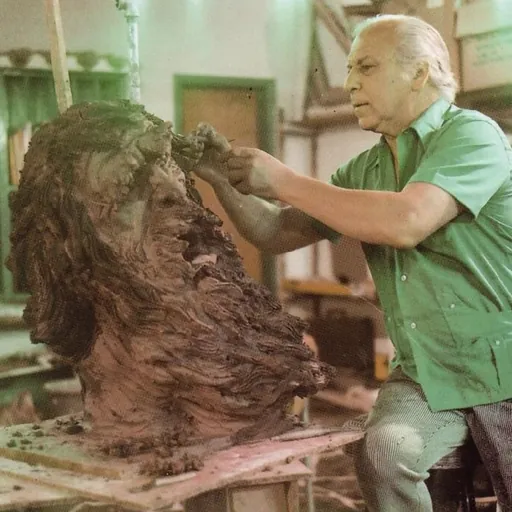
About Nicky Imber
Lived 1920 – 1996 (aged 75–76). Nicky Imber was an Israeli artist and sculptor.
Nicky Imberman (born Ignatz Imberman, Vienna 1920 – 1996) was an Austrian-born multidisciplinary Jewish artist best known for his sculptures on Jewish themes. Grand-nephew of Naftali Herz Imber, whose poem became the text of the Israeli national anthem “Hatikva”.
After escaping the Nazi concentration camp in Dachau, he pledged to dedicate his art to perpetuating the memory of the Holocaust. Among his more famous works are "The Hope" and "The Love of Torah". His work can be seen around the world, in Northern Israel, the United States, and the Venezuelan Museum of Natural History in Caracas.
Biography Nicky Imber was born in Vienna, Austria. During his studies at the Academy of Arts in Vienna, he drew anti-Nazi caricatures for Jewish student publications. After several thwarted attempts by the family to leave Vienna, in 1938, in the wake of the 'Anschluss', Imber was deported to Dachau. During this period he got married and had a daughter Raquel, who accompanied and assisted him.
In 1959, Imber was commissioned to create sculptures and dioramas for the Haifa Prehistory Museum at Gan Ha-em in Haifa, Israel. In 1960 he returned to Venezuela to restore the Phelps series of Dioramas for the Museum in Caracas.
Between 1961 and 1971 he travelled extensively around Europe and after establishing an international name for himself, returned to the United States. In New York he became famous for his realistic oil paintings of portraits of Aga Khan, Tyrone Power, Ava Gardner, David Ben-Gurion, Golda Meir, Sir Richard Burton and Simon Bolivar.
Returning to Venezuela in 1976, Imber created huge sculptures of prehistoric animals, forming one of the world's largest historical animal parks. During this period he also created realistic sculptures of famous Venezuelans for the country's National Hall of Fame.
In 1978, Imber spent three years designing and building a Holocaust memorial park at the entrance to the city of Karmiel located in the Galilee, entitled 'From Holocaust to Resurrection.' Imber also established animal theme playgrounds around the city. thumb
In the 1980s, Imber established residence in Karmiel, Israel. In Israel he was inspired to create highly emotional, life like collections.
Nicky Imber died in 1996 in Vienna, Austria.
Don’t just read it —
keep it.
Full-length biographies made to live with: read them, listen on the way to work, watch them tonight.
- E-book
- Audio
- Video
Instant download · yours to keep · every purchase keeps this site free
Important facts
People in Nicky Imber's life
Named in this biography and alive at the same time

Related people
Same field, nearest in time




Contemporaries
People whose lives overlapped Nicky Imber's


Frequently asked questions
Who was Nicky Imber?
Austrian-born Israeli sculptor
When was Nicky Imber born?
Nicky Imber was born on 20 October 1920 in Vienna.
When did Nicky Imber die?
Nicky Imber died in 1996 in Vienna.
What was Nicky Imber's occupation?
Nicky Imber was an artist and sculptor.
What nationality was Nicky Imber?
Nicky Imber was Israeli.
Sources & further reading
Cite this page
APA: Biography.guide. (2026). Nicky Imber. https://biography.guide/nicky-imber/
MLA: "Nicky Imber." Biography.guide, https://biography.guide/nicky-imber/.
Chicago: "Nicky Imber." Biography.guide. https://biography.guide/nicky-imber/.
Data last updated: 2026-09-22 · Spot an error? Report a correction.
Portrait: Wikimedia Commons · author & licence
Page generated 2026-09-27 05:01 UTC