
About Avard Fairbanks
Lived 1897 – 1987 (aged 89). Avard Fairbanks was an American artist and sculptor.
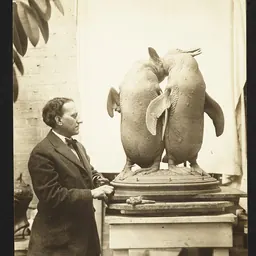
Avard Tennyson Fairbanks (March 2, 1897 – January 1, 1987) was a 20th-century American sculptor. Over his eighty-year career, he sculpted over 100 public monuments and hundreds of artworks. Fairbanks is known for his religious-themed commissions for the Church of Jesus Christ of Latter-day Saints (LDS Church) including the Three Witnesses, Tragedy of Winter Quarters, and several Angel Moroni sculptures on spires of the church's temples.
From a young age, Fairbanks was a talented artist. At 13 years old, he attended the Art Students League of New York on scholarship and his work was displayed at the National Academy of Design a year later. In 1913, he studied abroad in Paris at the École nationale supérieure des Beaux-Arts where he was the youngest student admitted to the French salons. He taught sculpture at several universities and attended medical school at the University of Michigan where he earned a doctorate in anatomical studies in order to better represent the human body in his art.
Life Early life and education Avard Tennyson Fairbanks was born on March 2, 1897, in Provo, Utah. Fairbanks was introduced to art by his father and his brother, John Leo Fairbanks. His first piece of art was a small, clay rabbit that won first prize in the 1909 Utah State Fair. Fairbanks joined his father in New York City to copy art pieces at the Metropolitan Museum, where he was reluctantly received by the curators due to his inexperience. However, he showed great skill and was called a "young Michelangelo" by the New York Herald, which led to other commissions such as animal models for the Bronx Zoological Gardens. After the project was finished in 1918, Fairbanks and Fox returned to Utah, where he enrolled at the University of Utah (U of U). Fairbanks took a sabbatical to study at Yale University, earning a Bachelor of Fine Arts degree and returned to instruct at University of Oregon. at Seattle Art Museum. While Fairbanks was living in Ann Arbor, he served for a time as the president of the branch of the LDS Church there. At the U of U, his conservative philosophy was that "modern abstraction was part of an international communist conspiracy." In 1965, he became a resident sculptor, fine arts consultant, and lecturer at the University of North Dakota (UND). Fairbanks also sculpted Tragedy of Winter Quarters in the Mormon Pioneer Cemetery at the Winter Quarters Historical Site. This project was particularly meaningful to him because his ancestors suffered at Winter Quarters when it was an encampment.
Many of the sculptures on Temple Square in Salt Lake City are by Fairbanks, including the Three Witnesses Monument. In 1957, his work Restoration of the Aaronic Priesthood was added to Temple Square; a relief version of this sculpture was added to the Priesthood Restoration Site in 1960. A companion piece, Restoration of the Melchizedek Priesthood, was also created for Temple Square and was displayed in the Mormon Pavilion at the 1964 New York World's Fair.
Although most of his later work was free-standing sculptures, Fairbanks did create several friezes for the Harold B. Lee Library on the Brigham Young University campus. While Fairbanks was a member of the faculty of the University of Oregon, he created his Oregon Trail sculpture. Around 1925–26, he designed several bas relief panels, cast in bronze, for large doors of the United States National Bank Building in Portland. The door's panels represent ideals of American life such as "Knowledge and Service", "Domestic Welfare", and "Progress through Direction". thumb upright|Two of several bronze-relief panels Fairbanks designed for the doors of the United States National Bank Building, in Portland, OregonFairbanks made a statue of Lycurgus and was consequently knighted by King Paul of Greece. Other monuments he created include the Pony Express, Pioneer family (at the Bismarck State Capitol), Daniel Jackling (at the Utah State Capitol), and Prime Minister of Canada McKenzie King (at Ottawa Parliament buildings).
Additionally, he designed and sculpted a George Washington statue at the Washington State Capitol Building. He also created an Ezra Meeker bust for the University of Oregon and a tabernacle door for the Altar of St. Mary's Cathedral in Eugene, Oregon. Additionally, Fairbanks constructed a 200-pound bronze medallion to commemorate the Oregon Trail. He also created a bust of Roscoe Pound in 1981 for the Nebraska Hall of Fame.
Three of his sculptures are in the United States Capitol, two of them in National Statuary Hall and one in a corridor; seven other statues are placed in Washington, D.C. The state capitols in Washington, North Dakota, Utah and Wyoming, as well as numerous other locations, also have his works. Possibly his most widely distributed artistic contribution was the charging ram symbol of the Dodge automobile.
Family Avard Fairbanks was a son of John B. Fairbanks, an artist who also had studied in Paris art academies and was briefly an art professor at Brigham Young Academy. His mother, Lilly Annetta Huish, died on May 12, 1898, about a year after he was born as a result of an injury related to a fall she had while she was carrying the fourteen-month-old Fairbanks.
Fairbanks had eight biological sons. Justin served as director of the art department at Eastern Arizona University. Elliot was a dean at the College of Eastern Utah. Eugene, Virgil, David, and Grant became physicians. His second eldest son, Eugene F. Fairbanks, compiled 10 books using archival material to illustrate his father's sculpture career. According to Abbott's book, My Return, Fairbanks also briefly served as a foster parent to Jack Henry Abbott. In 1956, after completing the Lycurgus in Sparta, Fairbanks and his wife adopted two young Greek sisters.
Awards and honors Fairbanks was a member of many organizations and societies, including National Sculpture Society, the Architectural League of New York, the International Institute of Arts and Letters, the Protetore Della Contrada Della Torre da Siena, Italy, and the Circolo Delgi Artisti di Firenzi. He was also an honorary member of the Society of Oregon Artists. Fairbanks was awarded Herbert Adams Memorial Medal by the National Sculpture Society for his contributions to American sculpture. Additionally, Paul of Greece awarded Fairbanks a medal of the Knights of Thermopylae. Fairbanks received an honorary doctorate of fine arts from Lincoln College and the Lincoln Diploma of Honor from Lincoln Memorial University. Moreover, he received the Sesquicentennial Commission of the Congress of the United States.
Don’t just read it —
keep it.
Full-length biographies made to live with: read them, listen on the way to work, watch them tonight.
- E-book
- Audio
- Video
Instant download · yours to keep · every purchase keeps this site free
Important facts
Family & relationships
People in Avard Fairbanks's life
Named in this biography and alive at the same time






Related people
Same field, nearest in time



Contemporaries
People whose lives overlapped Avard Fairbanks's

Frequently asked questions
Who was Avard Fairbanks?
American artist (1897-1987)
When was Avard Fairbanks born?
Avard Fairbanks was born on 2 March 1897 in Provo.
When did Avard Fairbanks die?
Avard Fairbanks died on 1 January 1987 in Salt Lake City.
What was Avard Fairbanks's occupation?
Avard Fairbanks was an artist and sculptor.
What nationality was Avard Fairbanks?
Avard Fairbanks was American.
Sources & further reading
Cite this page
APA: Biography.guide. (2026). Avard Fairbanks. https://biography.guide/avard-fairbanks/
MLA: "Avard Fairbanks." Biography.guide, https://biography.guide/avard-fairbanks/.
Chicago: "Avard Fairbanks." Biography.guide. https://biography.guide/avard-fairbanks/.
Data last updated: 2026-09-22 · Spot an error? Report a correction.
Page generated 2026-09-27 05:26 UTC