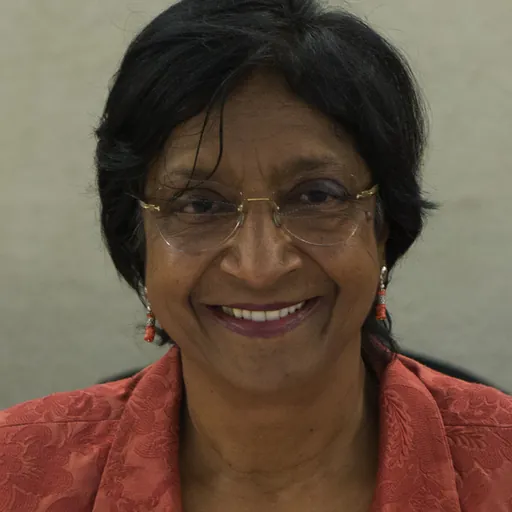
About Navanethem Pillay
Born 1941. Navanethem Pillay is a South African judge, lawyer and jurist.
Navanethem "Navi" Pillay (; born 23 September 1941) is a South African jurist who served as the United Nations High Commissioner for Human Rights from 2008 to 2014. She has also served as a judge of the International Criminal Court and President of the International Criminal Tribunal for Rwanda. and was extended an additional two years in 2012. In September 2014 Prince Zeid bin Ra'ad succeeded her in her position as High Commissioner for Human Rights. In April 2015, Pillay became the 16th Commissioner of the International Commission Against the Death Penalty. She is also one of the 25 leading figures on the Information and Democracy Commission launched by Reporters Without Borders.
Pillay was born and raised in Durban, South Africa where she later attended the University of Natal, receiving her Bachelor of Arts in 1963 and her Bachelor of Law in 1965. In 1967, Pillay started her own law firm and became the first woman to do so in her home province of Natal.
Pillay was nominated and confirmed to the High Court of South Africa by the Judicial Service Commission under supervision of the bar association in 1995. Towards the end of her term, the Minister of Justice Abdullah Omar and President Mandela submitted her name as a nominee for the U.N. Security Council and a judge on the U.N. International Criminal Tribunal for Rwanda (ICTR) in 1995. In 2008, the Secretary General Ban Ki Moon appointed Pillay and the General Assembly of the U.N. approved her position as the U.N. High Commissioner for Human Rights. In addition, she is the Chair of the U.N. Independent International Commission of Inquiry on the Occupied Palestinian Territory, President of the International Commission Against the Death Penalty in Madrid, the President of the Advisory Council of the International Nuremberg Principles Academy, and the Chair of the Quasi-Judicial Inquiry into Detention in the Democratic People's Republic of Korea.
She met her husband Paranjothee “Gaby” Anthony Pillay in 1962 as the first lawyer she offered a contract of articles to. woman to open her own law practice in Natal Province. As a non-white lawyer under the Apartheid regime, she was not allowed to enter a judge's chambers. of the African National Congress, the Unity Movement, the Black Consciousness Movement, and Azapo. In 1973, she won the right for political prisoners on Robben Island, including Nelson Mandela, to have access to lawyers in State v Kader Hassim and 9 others and State v Harry Gwala and 9 others. While providing legal counsel, her clients recommended she consult judges with expertise in international law and humanitarian law on their cases.
High Court of South Africa
In 1995, the year after the African National Congress came to power, Pillay was nominated and confirmed to the High Court of South Africa by the President Nelson Mandela and the Judicial Service Commission under supervision of the bar association, becoming the first non-white woman to serve on the court. Pillay's connection with Nelson Mandela during their work against apartheid made her a familiar name to Mandela during his presidency, putting her on the short-list for the nomination to the court.
International Criminal Tribunal for Rwanda (1995-2003) In 1995, the Minister of Justice Abdullah Omar and President Mandela submitted Pillay's name as a nominee for the U.N. Security Council and a judge on the U.N. International Criminal Tribunal for Rwanda (ICTR). Her tenure on the ICTR is best remembered for her role in the landmark trial of Jean-Paul Akayesu, which established that rape and sexual assault could constitute acts of genocide. Pillay said in an interview, "From time immemorial, rape has been regarded as spoils of war. Now it will be considered a war crime. We want to send out a strong signal that rape is no longer a trophy of war." It was during the case that Pillay was able to set an international legal precedent which considered rape as a form of genocide and a crime against humanity. Rather, an act is considered a crime against humanity if it "part of a widespread or systematic attack against any civilian population".
The role of media in inciting violence Pillay also served on the Prosecutor v Ferdinand Nahimana, Jean-Bosco Barayagwiza, Hassan Ngeze trial regarding the role the Radio Television Libre des Mille Collins (RTLM) and the Kangura magazine in spreading hate propaganda against the Tutsis. Jean-Bosco Barayagwiza was also indicted for the direct and public incitement to commit genocide at the RTLM and for his work with the Coalition for the Defence of the Republic.
International Criminal Court (2003-2008) Pillay garnered international recognition for her work as a judge on the ICTR and caught the attention of the members of the Women's Caucus for Gender Justice during the late 1990s. Impressed by her work, women's advocates wanted to ensure the protection of women's rights during the establishment of the International Criminal Court. The Women's Caucus gained enough momentum to attend PrepCom and the Rome Diplomatic Conference where they codified women's rights into the ICC statue, advocating that there be quota for the number of women judges on the bench and the use of "gender" instead of "sex" in the ICC provisions of the Rome Statue.
Pillay was nominated to serve on the International Criminal Court's Appeal Chambers by the Assembly of State Parties to the Rome Statute on 7 February 2003. She was elected to a six-year term that March, but resigned in July 2008, effective 31 August 2008, in order to take up her position with the UN.
One of the first cases to appear in the International Criminal Court was The Prosecutor v Thomas Lubanga Dyilo for enlisting children under 15 years old to the armed militias inciting violence between the Hema and Lendu ethnic groups in the Ituri, north-eastern region of the Democratic Republic of the Congo. While Dyilo was convicted for his war crimes in 2012, Pillay served on the appeals chamber during the pre-trial phase of the case from 2006 to the end of her term in 2008.
High Commissioner for Human Rights (2008-2014) Navi Pillay Speaking as High Commissioner for Human Rights in the U.N. On 24 July 2008, UN Secretary-General Ban Ki-moon nominated Pillay to succeed Louise Arbour as High Commissioner for Human Rights. The United States reportedly resisted her appointment at first, because of her views on abortion and other issues, but eventually dropped its opposition. She also signed a document "BORN FREE AND EQUAL", a document on sexual orientation and gender identity in international human rights law as High Commissioner.
Pillay expressed concern about pressure being placed on private companies to enact a financial blockade against WikiLeaks in 2010. She said such action was a violation of WikiLeaks' right to freedom of expression. At a news conference in July 2014, she referred to Edward Snowden as a "human rights defender" and said, "I am raising right here some very important arguments that could be raised on his behalf so that these criminal proceedings are averted."
In a speech on 8 June 2012, Pillay blacklisted the provincial government of Quebec in Canada for human rights violations concerning the rights to peaceful protest and free expression for its student protesters, specifically in Canada. The bill in question, Bill 78, required that protest groups over 50 must gain approval from authorities at least 8 hours before the planned start of the protest.
Her 2013 criticism of the Sri Lankan government being an authoritarian state, in alleging human rights violations and atrocities committed by them against Tamil civilians at the end of the Sri Lankan civil war, led the government and its supporters to apportion her own Tamil descent as the only reason for her criticism, a claim she strongly denies. thumb Aftermath of Sri Lankan Civil WarDuring the 2014 Gaza war, Pillay stated that both Israel and Hamas had likely violated international law. Her statement that Israel had engaged in the "apparent targeting... of seven children playing on a Gaza beach" during the 2014 Gaza war beach bombings was criticized in a Fox News op-ed by Anne Bayefsky as "incitement to hate". Pillay also criticized US funding of the Iron Dome program, noting that "no such protection has been provided to Gazans against the shelling". Tablet described the statement as a "hilariously delicious absurdity". On 25 July 2014, the United States Congress published a letter addressed to Pillay by over 100 members in which the signatories asserted that the Human Rights Council "cannot be taken seriously as a human rights organisation" because of their investigation of Israel's conduct during the war.
In August 2014, she criticized the international community over its "paralysis" in dealing with the more than three-year old Syrian Civil War, which by 30 April 2014 had resulted in 191,369 deaths.
International Court of Justice The composition of the bench of the International Court of Justice varies from case to case, and will choose a judge ad hoc to serve on the bench if there are no judges of the nationality of one or both of the parties. The party of Gambia designated her as judge ad hoc and she has been serving on the bench since 2019. The case was brought by Gambia against Myanmar for violating the Genocide Convention against the ethnic group Rohingya. Despite pushback from Myanmar, the court approved Gambia's case as admissible in court and continues to hold hearings. The U.S. and Europe have been vocal about their disapproval of the establishment of the commission because it has no formal end date, to which she has responded that "the occupation [of Israel] does not have end date either and you tend to support that occupation".
In June 2024, the commission determined that war crimes have been committed both by Hamas and Israel in the wake of the 7 October attacks. The three members of the commission announced that they were planning to resign in July 2025.
In September 2025, the Commission of Inquiry determined that Israel had committed genocide during the Gaza war.
Awards In 2003, Pillay received the inaugural Gruber Prize for Women's Rights.
She has been awarded honorary degrees by Durban University of Technology - based in her hometown of Durban, South Africa Durham University, England City University of New York School of Law, USA London School of Economics, Rhodes University, South Africa Catholic University of Leuven, Belgium Erasmus University Rotterdam, Netherlands
In 2009, Forbes ranked her as the 64th most powerful woman in the world.
In 2009, she received the Golden Plate Award of the American Academy of Achievement presented by Awards Council member Archbishop Desmond Tutu at an awards ceremony at St. George's Cathedral in Cape Town, South Africa.
In 2025, she won the Sydney Peace Prize and in 2026, she won the Olof Palme Prize.
Don’t just read it —
keep it.
Full-length biographies made to live with: read them, listen on the way to work, watch them tonight.
- E-book
- Audio
- Video
Instant download · yours to keep · every purchase keeps this site free
Important facts
People in Navanethem Pillay's life
Named in this biography and alive at the same time








Related people
Same field, nearest in time





Contemporaries
People whose lives overlapped Navanethem Pillay's

Frequently asked questions
Who is Navanethem Pillay?
South African lawyer, judge and human rights activist
When was Navanethem Pillay born?
Navanethem Pillay was born on 23 September 1941 in Durban.
What is Navanethem Pillay's occupation?
Navanethem Pillay is a judge, lawyer and jurist.
What nationality is Navanethem Pillay?
Navanethem Pillay is South African.
Sources & further reading
· Wikipedia: Navanethem Pillay
Cite this page
APA: Biography.guide. (2026). Navanethem Pillay. https://biography.guide/navanethem-pillay/
MLA: "Navanethem Pillay." Biography.guide, https://biography.guide/navanethem-pillay/.
Chicago: "Navanethem Pillay." Biography.guide. https://biography.guide/navanethem-pillay/.
Data last updated: 2026-09-21 · Spot an error? Report a correction.
Portrait: Wikimedia Commons · author & licence
Page generated 2026-09-27 05:00 UTC