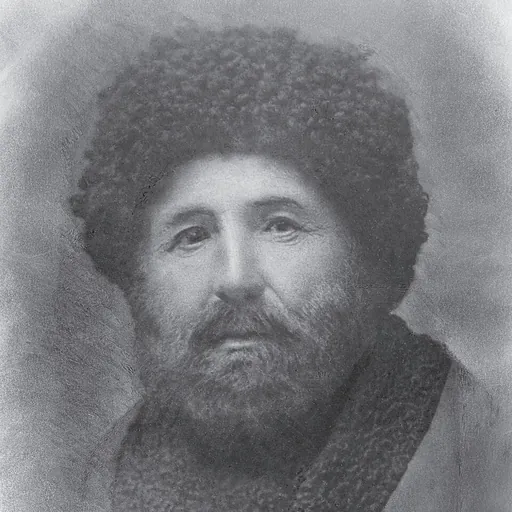
About Najmuddin of Gotzo
Lived 1859 – 1925 (aged 65–66). Najmuddin of Gotzo was a politician.
Najmuddin of Gotzo (1859 – October 1925) was a North Caucasian religious, military, and political leader who led multiple uprisings against the Bolsheviks during and after the Russian Civil War. A poet and teacher of Arabic prior to the Russian Revolution, Najmuddin first served as Mufti of the Mountainous Republic of the Northern Caucasus.
Najmuddin was born into a family of landowning nobles who had defected from the Caucasian Imamate of Imam Shamil. Prior to the Russian Revolution, he was part of both the ulama and the Russian government, and he was briefly a bureaucrat for the Russian Provisional Government following the February Revolution. Najmuddin led a series of rebellions in both Dagestan and Chechnya against Russian authorities, seeking to establish an independent Islamic theocracy in the North Caucasus under his leadership. Following the failure of a led by Najmuddin, he was captured by the Red Army in September 1925. He was then executed by the Soviet government.
Early life and career Najmuddin was born in 1859 in the village of Gotsob, in the Russian Empire's Dagestan Oblast to an aristocratic family. His Avar father, , had been a naib under Imam Shamil that defected to the Russian government, becoming a high-ranking military officer and significant landowner as a result of his defection. Najmuddin's mother was an ethnic Kumyk from the village of Nizhny Dzhengutay. Najmuddin's elder brother, , was a teacher of Islamic theology. Najmuddin followed his brother into a religious career, joining the ulama after receiving a religious education.
Following the deaths of his father and brother, Najmuddin inherited large tracts of land, including 10,000 sheep across both mountainous and lowland pastures. He defended his inheritance, saying that if claims were filed in sharia court against the argument that his father had honourably obtained the land, he would voluntarily surrender it.
Najmuddin travelled to the Ottoman Empire on the permission of the Russian government briefly in 1903. There, he engaged in writing literature, particularly poetry.
Revolution and the Mountainous Republic Najmuddin supported the 1917 February Revolution, Soon after the revolution, two mutually-hostile political groups formed, each vying for power: the Dagestan Socialist Group, which claimed to speak "in the interests of the workers", and the , which was led by Najmuddin. Najmuddin sharply criticised the Bolsheviks, whose ideology he felt was antithetical to Islamic values. At the same time, he distanced himself politically from the nobility, particularly in matters of land, urging adherence to Islamic courts in order to solve land disputes. Najmuddin had confidence that supporters of the now-deposed Empire would come to his side, believing that they would need his support more than he needed theirs. Magomed Dzhafarov, a colonel of the Imperial Russian Army and the military of the Mountainous Republic of the Northern Caucasus, remarked that Najmuddin was intelligent, proud and arrogant, and that he was well-connected to the working class despite his wealth. Dzhafarov noted that none of the many aalimath of the Caucasus had a level of fame equivalent to Najmuddin, particularly in highland regions.
Najmuddin attended the , which took place in May 1917 in Vladikavkaz. There, he was appointed as mufti of the North Caucasus and as a member of the Central Committee of the Union of Highlanders of the North Caucasus. Alibek Ṭahaq̇adiqala, a member of the Central Committee from the Socialist Group, assessed Najmuddin's move not as one of a religious fanatic, but as a carefully-calculated step performed to achieve support from the people. Najmuddin secured another victory at the congress's conclusion by successfully lobbying for the next such meeting to be held in the highland village of Andi. He argued that such a location would be fitting for the movement to deliberate, but ulterior motives also played a role: Andi was located in Avar territory, where his influence was stronger than anywhere else in the Caucasus.
Among Najmuddin's closest political allies was sheikh Uzun-Hajji, who travelled across the North Caucasus spreading propaganda in favour of a theocracy. Uzun-Hajji's vision was the establishment of a sharia state with Najmuddin as leader, similar to Imam Shamil's Caucasian Imamate. Dzhafarov wrote that Najmuddin had initially been slow to act politically, before being forced into doing so by the more enthusiastic Uzun-Hajji. Further impetuses emerged from the victory of the Socialist Group in the local elections, which had alarmed supporters of sharia into forming militias. Uzun-Hajji gathered five thousand Najmuddin loyalists in Andi from the Dagestani highlands and Chechnya prior to the beginning of the . Presented with what seemed to be a fait accompli, the liberal intellectuals among the Union of Highlanders of the North Caucasus agreed to attend, while scheduling another conference for a later date.
On 17 August 1917, Najmuddin was formally appointed as at a ceremony on Lake Kezenoyam during the congress. Upon his accession to the role, Najmuddin stated in a message to the people: Beware of crimes prohibited by Allah: murder, theft, robbery, plunder. Obey your aalimath, gather soldiers capable of defending freedom and sharia. Give freedom of religion to Christians and other non-believers, and do not cause harm to the Russian soldiers who gave us this freedom. and to replace him with Uzun-Hajji. This move was not recognised by Najmuddin or his supporters as legitimate. Uzun-Hajji's resistance against White rule soon led Najmuddin and other pro-Denikin aalimath to condemn Uzun-Hajji and urge Muslims to capture and kill him. According to Dagestani historian Murtazali Dugrichilov, both the Red and White armies sought to divide Najmuddin and Uzun-Hajji in an effort to ensure that both would be defeated. Ali-Hajji of Akusha also led an anti-Denikin movement of his own, eventually succeeding in expelling the Whites from the North Caucasus. Uzun-Haji died in combat in March 1920, and Najmuddin left the North Caucasus for Georgia after the Red Army conquered the region. Najmuddin returned to Dagestan ahead of Said, leading an uprising in the Avar District in September 1920. The uprising soon spread across Dagestan, growing to include the Andi and Gunib districts. Both Gunib and Khunzakh, strategically-important villages held by the Bolsheviks, were also captured.
Said arrived in Dagestan on 29 October 1920, and, in spite of his protestations that he was too young to be a monarch, he was crowned in a ceremony overseen by Najmuddin in the village of . Contemporary analyses argued that the uprising amounted to a civil war in Dagestan. Residents of smaller villages were quick to join Najmuddin's forces, while those in larger settlements were subject to a massive propaganda campaign. In one instance, leading Bolshevik revolutionary Joseph Stalin proclaimed, "...If you drive out Gotsinsky, the enemy of the workers of Dagestan, then you will thereby justify the trust that the highest Soviet powers have placed in granting autonomy to Dagestan." The uprising was eventually defeated in May 1921, largely as a result of poor discipline among rebel ranks. Said fled to the mountains after being injured, while Najmuddin left for Chechnya, where he was in contact with British intelligence. This, along with other measures taken by security forces, pushed him to give up his plans for an uprising. In 1923, he contacted the head of the local branch of the Joint State Political Directorate via a relative, expressing his desire to end the conflict.
Najmuddin soon changed his mind once again, however, after a February 1924 visit by two British agents, who assured him of their country's support for his struggle. He delivered a note to the Soviet government, in which he demanded that they withdraw from all territory south of Rostov-on-Don. On 12 May 1924, the Soviets moved a military presence to Dylym and other nearby villages, taking prisoners and hostages. 370 people were killed, and Mitayev was arrested.On 19 May Najmuddin again proposed a meeting, but this time, he was outright refused by the Soviets. In September, he began receiving weapons and textiles from the British government. The British wanted Najmuddin to seize the villages of Botlikh, Vedeno, and Shatoy, believing that it would cause an uprising.
The Soviets launched a military operation in Chechnya the same year,
Capture and execution
Soviet security services undertook significant efforts to capture Najmuddin, who was hiding in the highlands of Dagestan. Prior to his capture, Najmuddin had personally captured and killed around twenty would-be assassins, and multiple attempted pushes by the Red Army had failed due to both unfavourable weather conditions and stiff resistance by rebels. The Red Army dispatched a cavalry detachment to Zumsoy in February 1924, expecting to find Najmuddin, but were instead encircled by rebels. Najmuddin allowed the cavalry detachment to escape unharmed, as he feared that a battle would cause civilian casualties.
He briefly resided in from April 1924 until he was forced to retreat to the Vedeno District by the Red Army advance. In June of that year he fell ill, and he disbanded his military detachment, instead travelling from village to village. A decisive Red Army offensive in August 1925, during which 20,000 soldiers were deployed, led to Najmuddin evacuating to the forest. As his illness prevented him from staying outside for several days at a time, he instead began searching for a hamlet where he could remain. During interrogation, Najmuddin was defiant, saying that those interrogating him would soon "fall victim" to their own ideology.
On 15 October 1925, Najmuddin was sentenced to execution by shooting in Rostov-on-Don. He was executed later that month.
Don’t just read it —
keep it.
Full-length biographies made to live with: read them, listen on the way to work, watch them tonight.
- E-book
- Audio
- Video
Instant download · yours to keep · every purchase keeps this site free
Important facts
People in Najmuddin of Gotzo's life
Named in this biography and alive at the same time



Related people
Same field, nearest in time




Contemporaries
People whose lives overlapped Najmuddin of Gotzo's


Frequently asked questions
Who was Najmuddin of Gotzo?
North Caucasian religious, military, and political leader (1859–1925)
When was Najmuddin of Gotzo born?
Najmuddin of Gotzo was born in 1859 in Gotsob.
When did Najmuddin of Gotzo die?
Najmuddin of Gotzo died on 28 September 1925 in Rostov-on-Don.
What was Najmuddin of Gotzo's occupation?
Najmuddin of Gotzo was a politician.
Sources & further reading
· Wikipedia: Najmuddin of Gotzo
Cite this page
APA: Biography.guide. (2026). Najmuddin of Gotzo. https://biography.guide/najmuddin-of-gotzo/
MLA: "Najmuddin of Gotzo." Biography.guide, https://biography.guide/najmuddin-of-gotzo/.
Chicago: "Najmuddin of Gotzo." Biography.guide. https://biography.guide/najmuddin-of-gotzo/.
Data last updated: 2026-09-20 · Spot an error? Report a correction.
Page generated 2026-09-27 05:10 UTC