
About Munif al-Razzaz
Lived 1919 – 1984 (aged 64). Munif al-Razzaz was a Syrian and Jordanian politician.
Munif al-Razzaz (; 19 December 1919 – 16 September 1984) was a Jordanian-Syrian physician and politician who was the second, and last, Secretary General of the (unified) National Command of the Arab Socialist Ba'ath Party, having been elected to the post at the 8th National Congress held in April 1965.
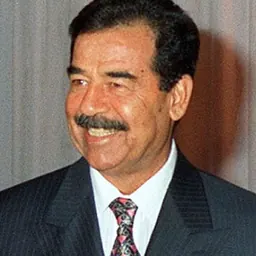
Munif relocated to Iraq in 1977 and became a leading member of the Iraqi Ba'ath. Munif was among dozens of dissidents accused of plotting against then new Iraqi President Saddam Hussein in the 1979 Ba'ath Party Purge. King Hussein had advocated for Munif's release so he can return safely to Jordan, but President Saddam Hussein adamantly refused. Munif died in 1984 during his house arrest in Baghdad. His wife and doctor claimed that he was poisoned after his medication for high blood pressure medicine was replaced. He was buried in Amman according to his only will.
Thought
In the article "Ba'ath Socialism" in the Iraqi newspaper Iraq Today Razzaz stated that Ba'athist socialism was scientific socialism, and that it "was the natural and inevitable response to the contradictions between the Arab nation and home land, with colonialism, imperialism and backwardness, both inherited and recent. It is a natural response to natural struggle blended with class struggle." Razzaz laid emphasis on the fact that Ba'athist socialism was both scientific and moral, and that Ba'athist socialism was a form of Third World Socialism and not the form of socialism of the First, Second, Third or Fourth Internationals. These forms of socialism derived "their character from pure class contradictions inside imperialist industrialized societies. It is a socialism which draws its basic properties from the contradictions of the Third World with imperialism on the one hand, and backwardness on the other". Ba'athist socialism, in his mind, opposed full state ownership of the economy, but supported state ownership over the heights of the economy. In his influential 1957 article "Why Socialism Now?" Razzaz states; "Socialism is a way of life, not just an economic order. It extends to all aspects of life – economics, politics, training, education, social life, health, morals, literature, science, history, and others both great and small. Socialism, freedom and unity are not different names for different things … but different facets of one basic law from which they spring." Together with Aflaq and Jamal al-Atassi, Razzaz wrote Articles on Socialism in 1974.
In a paper entitled "Arab nationalism" Razzaz asserts that Arab nationalist ideology is "the driving force behind the Arabs in their struggle to create a progressive nation that can hold on its own with the nations of the world." Razzaz believed that the Arabs had a sense of belonging to an Arab identity which could be traced back to pre-Islamic days. He believed that the Arab world was first confronted by Western colonialism at the beginning of the 16th century in the Persian Gulf and the Indian Ocean. The 1948 Arab–Israeli War "which brought the humiliating defeat of the Arabs by a handful of Jews, was the last straw that destroyed any remnants of confidence between the ruling classes on one side and the masses on the other." Resentments towards the Western powers for creating Israel could never be forgotten Razzaz believed, and the creation of Israel led to the popular demand of an end to all Western tutelage in the Arab world. Razzaz claimed that Arab nationalism was the conflict between two forces; the reactionary classes and the masses. The reactionary classes were inefficient vassals of Western capitalist imperialism who had betrayed the nation, while the masses were "anti-imperialist, anti-capitalist and anti-Zionist, and in favor of unity, freedom, socialism and neutralism."
Personal life In 1949, he married Lam'a Bseisso, who was born in Hama, Syria in 1923, with whom he had two sons and one daughter. His son Omar Razzaz was the Prime Minister of Jordan from 2018 to 2020.
Don’t just read it —
keep it.
Full-length biographies made to live with: read them, listen on the way to work, watch them tonight.
- E-book
- Audio
- Video
Instant download · yours to keep · every purchase keeps this site free
Important facts
People in Munif al-Razzaz's life
Named in this biography and alive at the same time


Related people
Same field, nearest in time






Contemporaries
People whose lives overlapped Munif al-Razzaz's


Frequently asked questions
Who was Munif al-Razzaz?
Syrian politician (1919–1984)
When was Munif al-Razzaz born?
Munif al-Razzaz was born on 19 December 1919 in Syria.
When did Munif al-Razzaz die?
Munif al-Razzaz died on 16 September 1984 in Baghdad.
What was Munif al-Razzaz's occupation?
Munif al-Razzaz was a politician.
What nationality was Munif al-Razzaz?
Munif al-Razzaz was Syrian and Jordanian.
Sources & further reading
Cite this page
APA: Biography.guide. (2026). Munif al-Razzaz. https://biography.guide/munif-al-razzaz/
MLA: "Munif al-Razzaz." Biography.guide, https://biography.guide/munif-al-razzaz/.
Chicago: "Munif al-Razzaz." Biography.guide. https://biography.guide/munif-al-razzaz/.
Data last updated: 2026-09-20 · Spot an error? Report a correction.
Page generated 2026-09-27 05:25 UTC