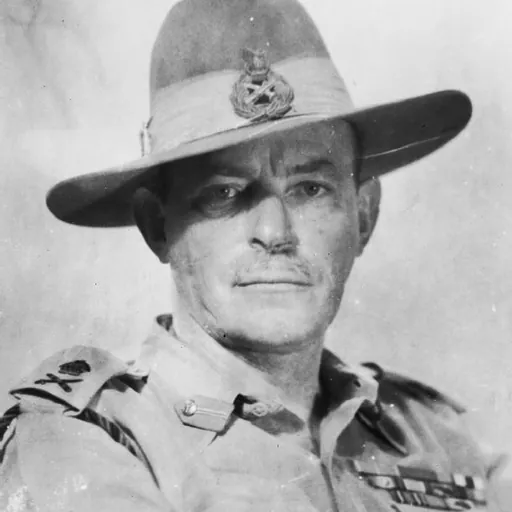
About Montagu Stopford
Lived 1892 – 1971 (aged 78). Montagu Stopford was a British military personnel.
General Sir Montagu George North Stopford, (16 November 1892 – 10 March 1971) was a senior British Army officer who fought during both the First and Second World Wars. The latter he served in with distinction, commanding XXXIII Indian Corps in the Far East, where he served under General Sir William Slim, and played a significant role in the Burma Campaign, specifically during the Battle of Kohima in mid-1944.
Early life and First World War Born on 16 November 1892 in Hanover Square, London, Montagu Stopford was the son of Colonel Sir Lionel Stopford, and the great-grandson of James Stopford, 3rd Earl of Courtown. His mother was Mabel Georgina Emily, daughter of George Alexander Mackenzie. He was educated at Wellington College, Berkshire and the Royal Military College, Sandhurst. He was commissioned as a second lieutenant into the Rifle Brigade (The Prince Consort's Own) on 20 September 1911, His fellow graduates included Edward Williams, also of the Rifle Brigade, John Fullerton Evetts, Leslie Gordon Phillips, Eric Paytherus Nares, and Kenneth Anderson, all of whom would, like Stopford himself, become general officers. until shortly after the outbreak of the First World War in August 1914.
In late October Stopford, by now a lieutenant, arrived with his battalion in Liverpool, having left India the month before. The battalion, now serving as part of the 25th Brigade of the 8th Division, arrived on the Western Front in early November. After serving with his battalion throughout some of the most intense battles of 1915, including the Battle of Neuve Chapelle, Stopford, promoted on 5 July 1915 to captain, became a General Staff Officer Grade 3 (GSO3) with the 56th (1st London) Division, a Territorial Force (TF) formation, on 10 June 1916. On 6 December 1916 he became the brigade major of the 56th Division's 167th (1st London) Brigade, a post which he held throughout 1917 until 25 March 1918. He ended the war with the substantive rank of major, and had been twice mentioned in despatches and awarded the Military Cross. On 1 July 1929 he was promoted to brevet rank of major.
In February 1930 Stopford relinquished his assignment as brigade major with the 11th Infantry Brigade. In May 1932 he was made a GSO2 to the Inspector General of the King's African Rifles. Promoted to permanent major in January 1933, he was a brevet lieutenant colonel two years later. In January 1938, towards the end of the interwar period, Stopford returned to the Staff College, Camberley, this time with the role of Senior Instructor, and was promoted to colonel on 25 July (with seniority backdating to 12 January). In this position he came into contact with numerous other members of the Directing Staff who were to achieve high rank in the war which was believed to be inevitable. They were John Swayne, Brian Horrocks, Alexander Galloway, Charles Allfrey, Francis Festing, Charles Keightley, Charles Loewen and Cameron Nicholson, along with the Commandant, Major General Sir Ronald Adam.
Second World War France and Belgium Stopford was still there by the outbreak of the Second World War in September 1939. However, just over a month later he was selected to command the 17th Infantry Brigade, then being formed in Aldershot, Hampshire for service overseas, and was promoted to the temporary rank of brigadier. Stopford's brigade came under a succession of determined attacks from 26 to 28 May, suffering many losses but managing to retain its position. By the time the 17th Brigade fell back towards Dunkirk, from where it was evacuated to England on the night of 31 May/1 June, the brigade was reduced from a strength of over 2,500 officers and men, at the beginning of the campaign, to less than that of a battalion and Brigadier Dempsey's 13th Brigade was in a similarly depleted state. Stopford remained with his brigade for the next seven months, in June moving to Scotland with the rest of the division, now reunited with all three brigades and commanded from mid-July by Major General Horatio Berney-Ficklin, formerly the 15th Brigade commander, after Major General Franklyn was promoted to command VIII Corps, to reform after its severe casualties. Most of the rest of 1940 was spent in Scottish Command and was devoted to training to repel a German invasion of Britain, then, in the aftermath of Dunkirk, thought to be imminent, although in Scotland it was considered less likely, yet still a distinct possibility. By late October, with the threat of invasion now much receded, the division moved to North West England. Montgomery, already well known for his tendency to dismiss senior officers who failed to live up to his standards, appears to have formed a high opinion of Stopford, as the latter was not sacked, and may well have secured for him his next appointment, as Commandant of the Staff College, Camberley, handing over command of the 56th Division to Major General Eric Miles in early October.
Stopford took over as Commandant from Major General Robert Collins, who ironically had been one of his instructors there when he was attending as a student in the 1920s. was there for just over a year, where many important lessons were learnt from the fighting in North Africa, until, in November 1942 Stopford handed over to Major General Sir Alan Cunningham. Taking over from Lieutenant General James Gammell, who had briefly been a fellow brigade commander in the 5th Division shortly after Dunkirk, XII Corps was still serving in Kent, although the emphasis was now slowly changing from being on the defensive to taking the offensive. The corps, then comprising Major General William Ramsden's 3rd (replaced by Major General William Bradshaw's 59th Division in late March), Major General Ivor Thomas's 43rd (Wessex) and Major General Robert Ross's 53rd (Welsh) Infantry Divisions, along with several independent brigades, had been selected for participation in Operation Overlord, the Allied invasion of Normandy. Throughout 1943 the corps, aided by its Brigadier General Staff (BGS), Dudley Ward, participated in several large-scale exercises, most notably in Exercise SPARTAN in March. in early November, Stopford handed over XII Corps to Lieutenant General Neil Ritchie later in the month.
Burma and India Stopford was sent to India to become GOC of XXXIII Indian Corps, in succession to Lieutenant General Philip Christison, who was posted to XV Corps as its GOC. Slim had failed to estimate the arrival of the Japanese 31st Division (Lieutenant General Kōtoku Satō), which headed for Kohima, north of Imphal. If the 31st Division were able to take the small town of Kohima, they would be almost unopposed and be able to march into Assam, cutting land communications to Ledo, at the Indian end of the Ledo Road, then being built to China. The fighting was relentless as the Japanese remained in two strong defensive preparations, on the Aradura Ridge and around Naga Village. The 2nd Division, which by now was severely depleted but pushed them off Aradura Ridge in early June, the 7th Indian Division pushing them out of Naga Village around the same time. The Japanese retreated to the Chindwin River and, on 22 June, XXXIII Corps met IV Corps. Given Lieutenant General Messervy's IV Corps, with three divisions under command, the Twelfth Army inflicted severe losses upon the Japanese troops, a significant number of whom were suffering from starvation or otherwise ill. As it turned out, this was to be the last major land action fought by the Western Allies during the Second World War as, in mid-August, the Japanese surrendered in Tokyo. Stopford gave orders for all offensive operations to cease, and soon began negotiations with the Japanese, which culminated in their surrender at Rangoon in mid-September. The following month, at another ceremony, General Heitarō Kimura, commander of the Japanese Burma Area Army, handed over to Stopford his sword. He was also appointed Colonel-in-Chief of the Rifle Brigade. and lived at Rock Hill House in Chipping Norton. He married Dorothy Deare, daughter of Lieutenant Colonel Henry Foulkes Deare, on 12 April 1921. They had no children. His wife died on 4 October 1982.
Don’t just read it —
keep it.
Full-length biographies made to live with: read them, listen on the way to work, watch them tonight.
- E-book
- Audio
- Video
Instant download · yours to keep · every purchase keeps this site free
Important facts
People in Montagu Stopford's life
Named in this biography and alive at the same time




Related people
Same field, nearest in time





Contemporaries
People whose lives overlapped Montagu Stopford's

Frequently asked questions
Who was Montagu Stopford?
British Army general (1892-1971)
When was Montagu Stopford born?
Montagu Stopford was born on 16 November 1892 in Hanover Square.
When did Montagu Stopford die?
Montagu Stopford died on 10 March 1971 in Chipping Norton.
What was Montagu Stopford's occupation?
Montagu Stopford was a military personnel.
What nationality was Montagu Stopford?
Montagu Stopford was British.
Sources & further reading
Cite this page
APA: Biography.guide. (2026). Montagu Stopford. https://biography.guide/montagu-stopford/
MLA: "Montagu Stopford." Biography.guide, https://biography.guide/montagu-stopford/.
Chicago: "Montagu Stopford." Biography.guide. https://biography.guide/montagu-stopford/.
Data last updated: 2026-09-22 · Spot an error? Report a correction.
Portrait: Wikimedia Commons · author & licence
Page generated 2026-09-27 05:02 UTC