About Mokujiki
Lived 1718 – 1810 (aged 91–92). Mokujiki was a Japanese painter, waka poet and busshi.
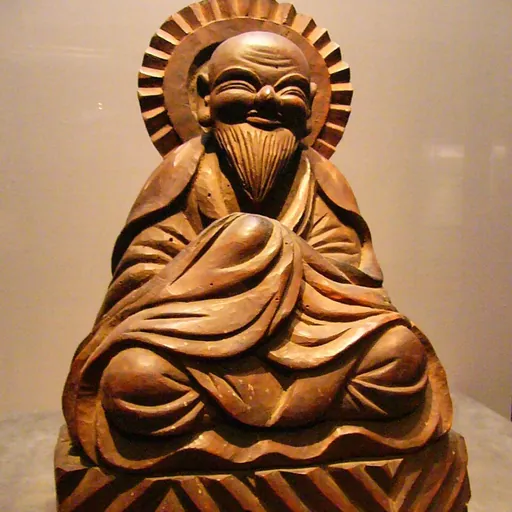
Mokujiki Shōnin (, 1718 – 6 July 1810), also recorded as Mokujiki Gogyō Myōman , was a Japanese Buddhist monk, itinerant sculptor, calligrapher, painter, and poet of the late Edo period. Beginning in his early sixties, he carved more than a thousand wooden Buddhist statues—each inscribed on the reverse with the date of completion and his religious name—which he left at temples, shrines, and villages across Japan during four decades of nationwide pilgrimage.
His mature works are characterized by rounded forms, smiling expressions (bishō-butsu, ), and the deliberate retention of chisel marks on unvarnished single-block wood. This late style—most fully developed after age eighty—is regularly contrasted with the vigorous, angular carving of the earlier itinerant monk-sculptor Enkū (1632–1695), with whom Mokujiki is habitually paired in Japanese art scholarship and exhibition.
Largely forgotten after his death, his works were rediscovered in the early 1920s by the philosopher and art critic Yanagi Sōetsu, whose research directly inspired the coinage of the term mingei (, "people's craft") in 1925 and the subsequent Mingei movement.
Biography
Early life and ordination Mokujiki was born in 1718 in Marubatake, Koseki, Kai Province (today Minobu, Yamanashi), the second son of the village head of the Itō family. At the age of fourteen (1731) he left home without permission for Edo. After years of secular life in the capital, he was ordained at age twenty-one (1739) at (Daizan-ji), a Shingon temple in Sagami Province.
The mokujiki-kai vow In 1762, at the age of forty-four, Mokujiki formally adopted the mokujiki-kai precepts at Rakan-ji in Mito, receiving them under the monk Mokujiki Kankai. This vow required lifelong abstinence from the five grains, cooked food, salt, and fish; subsistence consisted solely of wild plants, tree nuts, and mountain herbs. The name mokujiki (literally "eating wood") derives from this practice, which has roots in Chinese Taoist grain-avoidance and was incorporated into Japanese Shugendō and Shingon esotericism. Mokujiki maintained the vow unbroken until his death. After receiving it, he adopted the religious name "Mokujiki"; over his lifetime he also used variant names such as Mokujiki Gogyō and Mokujiki Myōman in his inscriptions. Around 1778, at age sixty-one, he arrived in Hokkaido and—upon encountering sculptures attributed to Enkū at Kumaishi—began carving Buddhist images. His earliest securely dated surviving work is a standing Jizō Bosatsu at Hōzōji in present-day Yakumo, Hokkaido, inscribed on the reverse with the completion date of 24 April 1780 (Anei 9); it measures 206 cm and is designated a Hokkaido tangible cultural property.
Mokujiki vowed to carve one thousand Buddha images (sentaibutsu, ); by age eighty he had fulfilled this vow, after which he extended his ambition to two thousand. On the reverse of each statue he inscribed in black ink the date of completion, his religious name, and the statue's sequential number within his vow.
Mokujiki died on 6 July 1810 (Bunka 7, 5th day of the 6th month in the lunar calendar), aged ninety-three, in Kai Province.
Chronology
Year Age Event 1718 0 Born in Marubatake, Koseki, Kai Province. 1731 14 Leaves home for Edo. 1739 21 Ordained at Ōyama Fudō (Daizan-ji), Sagami Province. 1762 44 Receives the mokujiki-kai precepts at Rakan-ji, Mito; adopts the religious name "Mokujiki". 1773 56 Begins nationwide kaikoku pilgrimage. c. 1778 61 Arrives in Hokkaido; encounters works attributed to Enkū at Kumaishi; begins carving Buddhist statues. 1780 63 Earliest securely dated surviving work: standing Jizō Bosatsu at Hōzōji, Yakumo, Hokkaido (24 April; 206 cm; Hokkaido designated cultural property). 1781–1785 63–67 Active on Sado Island; produces statues and calligraphic scrolls. c. 1780s — Extended encounter with works by Enkū; decisive influence on sculptural style. c. 1790s — Resides at Hyūga Kokubun-ji, Kyūshū. 1800 83 Stays nearly two months in Fujieda and Yaizu (Shizuoka); produces 13 statues and 8 calligraphic/painting works. 1801–1802 83–84 Completes the Shikokudō complex (~90 images) in Marubatake. 1804 86–87 Creates self-portrait (Tokyo National Museum, inv. C-1825), donated by Masaichirō Yoshizawa. 1805 87–88 Carves Fudō Myōō (Metropolitan Museum of Art, 2016.363.1) and calligraphic scroll Sacred Names of Shinto Deities (Metropolitan Museum of Art, 2016.364). 1807 89–90 Visits Inagawa-chō (Hyogo); carves 26 statues, including the Tachiki Koyasu Kannon in a living tree. Carves Tamatsushima Daimyōjin (Kawai Kanjirō's House, Kyoto). 1810 93 Dies in Kai Province on 6 July.
Sculptural work and style
Technique Mokujiki carved from a single block of wood (ichiboku-zukuri, ), without hollowing, lacquering, or painting, leaving the surfaces with visible marks from round-headed chisels. His approach is often described by the term natabori (, "hatchet-carved"), though the Metropolitan Museum of Art notes that he used round-headed chisels rather than a true hatchet. Japanese art scholarship emphasizes the deliberate retention of tool traces and bold simplification as expressive qualities that later critics compared to aspects of modern sculpture. His poems return repeatedly to the image of the circle (maru, ) as a symbol of spiritual completeness, and to the ajikan meditative practice of Shingon Buddhism, in which the Sanskrit syllable A represents the primordial ground of all phenomena.
The most celebrated poem, quoted by Yanagi and widely reprinted, expresses the aspiration to inner roundness: The Met notes that his brush-writing "exhibits the same energy and heartfelt piety that appear in his sculptural works."
Works and cataloguing
Scholarly compilations estimate approximately 700 or more works attributed to Mokujiki, of which over 600 are extant. A 2007 catalogue counted 617 extant, 56 of unknown location, and 31 destroyed by fire (total 710). A 2015 exhibition tally reported 626 extant, plus 95 missing, relocated, or lost examples (total 721).
The iconographic repertoire of Mokujiki's sculpture spans Amida Nyorai (Amitābha), Jizō Bosatsu (Kṣitigarbha), various forms of Kannon (Avalokiteśvara), Fudō Myōō (Acala), Bishamonten (Vaiśravaṇa), Kōbō Daishi, and Prince Shōtoku, as well as Shinto deities (kami). The encounter prompted Yanagi to formulate his concept of "beauty of health" (, kenkō no bi)—the spontaneous, egoless creativity he identified as the aesthetic ideal of folk craftspeople working in a state of mushin (, "no-mind"). He published his findings in 1925 as a seven-volume study, c. 130 works drawn from Niigata, Shizuoka, Kyoto, Hyogo, and Yamaguchi; record attendance and catalogue sales for the museum
Legacy
Mokujiki is recognized, alongside Enkū, as one of the most significant itinerant monk-sculptors of the Edo period. His sculpture is preserved in temples, public museums, and private collections throughout Japan.
Don’t just read it —
keep it.
Full-length biographies made to live with: read them, listen on the way to work, watch them tonight.
- E-book
- Audio
- Video
Instant download · yours to keep · every purchase keeps this site free
Important facts
more
Mokujiki Myoman, Mokujiki ShōninRelated people
Same field, nearest in time



Contemporaries
People whose lives overlapped Mokujiki's




Frequently asked questions
Who was Mokujiki?
Japanese painter (1718-1810)
When was Mokujiki born?
Mokujiki was born in 1718 in Furuseki.
When did Mokujiki die?
Mokujiki died on 6 July 1810 in Japan.
What was Mokujiki's occupation?
Mokujiki was a painter, waka poet and busshi.
What nationality was Mokujiki?
Mokujiki was Japanese.
Sources & further reading
Cite this page
APA: Biography.guide. (2026). Mokujiki. https://biography.guide/mokujiki/
MLA: "Mokujiki." Biography.guide, https://biography.guide/mokujiki/.
Chicago: "Mokujiki." Biography.guide. https://biography.guide/mokujiki/.
Data last updated: 2026-09-20 · Spot an error? Report a correction.
Portrait: Wikimedia Commons · author & licence
Page generated 2026-09-27 04:57 UTC