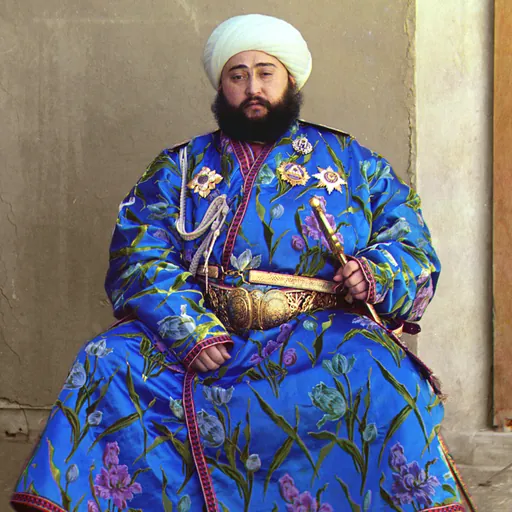
About Mohammed Alim Khan
Lived 1880 – 1944 (aged 64). Mohammed Alim Khan was a Russian sovereign and politician.
Emir Sayyid Mir Muhammad Alim Khan (Chagatai and , 3 January 1880 – 28 April 1944) was the last emir of the Uzbek Manghit dynasty, rulers of the Emirate of Bukhara in Central Asia. Although Bukhara was a protectorate of the Russian Empire from 1873, the Emir presided over the internal affairs of his emirate as an absolute monarch and reigned from 3 January 1911 to 30 August 1920.
Early life At the age of thirteen, Alim Khan was sent by his father Emir Abdulahad Khan to Saint Petersburg for three years to study government and modern military techniques. In 1896, having received formal confirmation as Crown Prince of Bukhara by the Russian government, he returned home.
After two years in Bukhara assisting in his father's administration, he was appointed governor of the Nasef region for the next twelve years. He was then transferred to the northern province of Karmana, which he ruled for another two years, until receiving word in 1910 of his father's death.
Reign At the beginning of Alim Khan's rule, there were promising signs of reform. He initially announced a rejection of personal gifts and prohibited officials from soliciting bribes or imposing unauthorized taxes. However, over time, there was a shift in the Emir's approach to issues like bribes, taxes, and state salaries. The power struggle between traditionalists and reformists concluded with the traditionalists gaining control, and the reformist faction finding refuge in Moscow or Kazan. Some historians suggest that Alim Khan, who initially supported modernization and reforms, may have realized that the reformists' ultimate objectives excluded him and his descendants from future rule. Like his predecessors, Alim Khan was a traditional ruler. He toyed with the idea of reform as a tool to keep the clergy in line, but only as long as he saw the possibility of using it to strengthen Manghud rule.
One of the most important Tajik writers, Sadriddin Ayniy, wrote vivid accounts of life under the Emir. He was whipped for speaking Tajik and later wrote about the life under the Emirs in The Bukhara Executioners ("Jallodon-i Bukhara").
Alim Khan was the only Manghud ruler to add the title of Caliph to his name, and was the last direct descendant of the Manghit dynasty to serve as a national ruler. In 1914-1916 - Nodir Devonbegi Khanaka was repaired by Olim Khan.
In March 1918, activists of the Young Bukharan Movement (Yosh Buxoroliklar) informed the Bolsheviks that the Bukharians were ready for the revolution and that the people were awaiting liberation. The Red Army marched to the gates of Bukhara and demanded that the emir surrender the city to the Young Bukharans. As Russian sources report, the emir responded by killing the Bolshevik delegation, along with several hundred Russian supporters of the Bolsheviks in Bukhara and the surrounding territories. The majority of Bukharans did not support an invasion and the ill-equipped and ill-disciplined Bolshevik army fled back to the Soviet stronghold at Tashkent.
Deposition and death However, the emir had won only a temporary respite. As the civil war in Russia wound down, Moscow sent reinforcements to Central Asia. On 2 September 1920, an army of well-disciplined and well-equipped Red Army troops under the command of general Mikhail Frunze attacked the city. After four days of fighting, the Ark of Bukhara was destroyed, the red flag was raised from the top of Kalyan Minaret, and the Emir Alim Khan fled, first to his base at Dushanbe (in present-day Tajikistan), and then finally to Kabul, Afghanistan, where he died in 1944. He is buried at the Shuadoi Solehin cemetery.
He was awarded the Order of Prince Danilo I and a number of decorations.
Family
Although the emir had several children, the exact number of offspring the emir had is unknown. Emir Alim Khan had three official wives in Bukhara, but after settling in Afghanistan, people there sympathized with him and many gave their daughters to him as wives. Therefore, he had several more wives in Afghanistan.
Alim Khan's daughter, Shukria Alimi Raad, worked as a broadcaster for Radio Afghanistan. Shukria Raad left Afghanistan with her family three months after Soviet troops invaded the country in December 1979. With her husband, also a journalist, and two children, she fled to Pakistan, and then through Germany to the United States. In 1982, she joined the Voice of America, working for many years as a broadcaster for VOA's Dari Service, editor, program host and producer.
During his governance in Bukhara, Alim Khan also had a son named Qasem, who was killed by the Bolshevik revolutionaries. Qasem had only one son who, when he was 13 years old, escaped from Bukhara to Mashhad, Iran, with his stepfather. When he arrived in Iran, he took the name Husein Bukharaei. He married Bibimeymanat Mohsenolhoseini in Mashhad. They had 6 sons and 4 daughters. Husein Bukharaei died in 1993. Their children live in Mashhad.
In 2020, the BBC World Service made a documentary, called Bukhara, which discusses Emir Alim Khan and the fate of his family.
Alim Khan's descendants include his granddaughter Nailaj Naebzadeh from his daughter Razia Alimi; his great-granddaughter Kadeij Naebzadeh; They also include Nailaj Naebzadeh, who was born in United States. Just like her aunt, Shukria Alimi Raad, her mother Razia Alimi also escaped from Afghanistan during the invasion of the Soviet Army in 1979.
Don’t just read it —
keep it.
Full-length biographies made to live with: read them, listen on the way to work, watch them tonight.
- E-book
- Audio
- Video
Instant download · yours to keep · every purchase keeps this site free
Important facts
Family & relationships
People in Mohammed Alim Khan's life
Named in this biography and alive at the same time

Related people
Same field, nearest in time




Contemporaries
People whose lives overlapped Mohammed Alim Khan's



Frequently asked questions
Who was Mohammed Alim Khan?
The last Amir of Emirate of Bukhara (1911–1920)
When was Mohammed Alim Khan born?
Mohammed Alim Khan was born on 3 January 1880 in Bukhara.
When did Mohammed Alim Khan die?
Mohammed Alim Khan died on 28 April 1944 in Kabul.
What was Mohammed Alim Khan's occupation?
Mohammed Alim Khan was a sovereign and politician.
What nationality was Mohammed Alim Khan?
Mohammed Alim Khan was Russian.
Sources & further reading
· Wikipedia: Mohammed Alim Khan
· DBpedia: Sayyid Mir Muhammad Alim Khan
Cite this page
APA: Biography.guide. (2026). Mohammed Alim Khan. https://biography.guide/mohammed-alim-khan/
MLA: "Mohammed Alim Khan." Biography.guide, https://biography.guide/mohammed-alim-khan/.
Chicago: "Mohammed Alim Khan." Biography.guide. https://biography.guide/mohammed-alim-khan/.
Data last updated: 2026-09-23 · Spot an error? Report a correction.
Portrait: Wikimedia Commons · author & licence
Page generated 2026-09-27 05:07 UTC