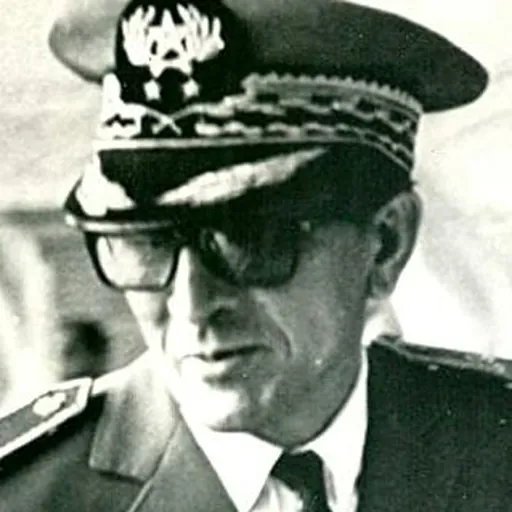
About Mohamed Oufkir
Lived 1920 – 1972 (aged 52). Mohamed Oufkir was a Moroccan politician and military personnel, known for 1972 Moroccan coup attempt and Forced disappearance.
General Mohamed Oufkir (; 16 August 1920 − 16 August 1972) was a Moroccan senior military officer who held many important governmental posts like the minister of interior and minister of defense. Throughout the 60s, he rose to become the regime's strongman having a close relationship with Hassan II of Morocco and was partly responsible for the suppression of political opposition and riots. It is believed that he was involved in the Ben Barka affair and that he was assassinated for his alleged role in the failed 1972 Moroccan coup attempt.
Early life and military career Mohamed Oufkir was born on 16 August 1920 or the Berber-speaking village of Boudenib. The name Oufkir means "the impoverished" according to his daughter Malika. According to Malika Oufkir, his name was Ahmed.
Political career
After World War II, in 1949, Oufkir joined the military cabinet of Raymond Duval and interpreter. After independence, he was appointed a high-ranking officer in the Royal Moroccan Armed Forces.
Oufkir became the right-hand man of Hassan II during the 1960s and regime strongman "willing and able to employ all means necessary to repress dissent and ensure the stability and supremacy of the regime" according to historian Bruce Maddy-Weitzman. In the early years of Morocco's independence, his nominal boss was the interior minister. He was appointed the director of the Sûreté Nationale in 1960 to control dissidents and reorganise the military. He had a close relationship with the CIA during this period and was the main architect for relations with French intelligence and for the forging of ties between Israel and Morocco. He visited Israel in 1964 to observe the security arrangements of a papal visit which convinced him that Israel could assist him with palace security in Rabat.
During the late 50s and throughout the 60s, Oufkir was involved in the systematic and brutal repression of political opponents like the leaders of the armed resistance and Moroccan Liberation Army along with prominent leftists. He did so through killing, arbitrary detainment and forced disappearances. His main torture centre was in the former palace of Moqri. He oversaw the repression of the 1965 Casablanca riots. Under him, army and police were sent to take action against the rioters which led to 400 deaths. From his helicopter, he directed the suppression and allegedly personally machine-gunned rioters in Casablanca. These riots ended up in a state of emergency with a 5-year suspension of the constitution and subsequent rule by decree. The French government issued arrest warrants for him and in 1967 a French court sentenced Oufkir to life imprisonment in absentia. French president Charles de Gaulle also accused Oufkir of being responsible which led to tensions straining between Morocco and France until De Gaulle left the French presidency. Initially, Hassan defended Oufkir and called De Gaulle's position "intolerable". However, after the 1972 coup, Hassan claimed, in his memoirs, he had no involvement in Ben Barka's disappearance and that it was a fait accompli by Oufkir.
After the failed 1971 military coup, Hassan II appointed Oufkir as defense minister and chief of staff of the Royal Armed Forces. Oufkir associates where appointed minister of interior and minister of agriculture and development. Oufkir was granted full military and civilian powers by Hassan and tasked with reorganising the army and securing their loyalty by safeguarding against further coup attempts. There were also suspicions that Oufkir even had connections with the coup plotters.
1972 Moroccan coup attempt and death
Oufkir was accused of plotting the 1972 Moroccan coup attempt against King Hassan II alongside two other high ranking air forces, one of whom being Mohamed Amekrane. The USFP were also said to be involved with Fqih Basri fleeing to Algeria. The official narrative, first given by the interior minister Mohamed Benhima and later Hassan II, claimed that the general had committed suicide first "out of shame of his failure to protect the king" and later because his complicity was revealed. However, his daughter, Malika Oufkir, writing in her book Stolen Lives: Twenty Years in a Desert Jail, claimed to have seen five bullet wounds in her father's body, all in positions not consistent with suicide. These bullets at the back of his head made this alleged suicide come to be known as an "acrobatic suicide". One version of his death claims that Oufkir returned to the palace to reported to the king that he put down the rebellion, arresting most of the culprits. However, after being informed by Ahmed Dlimi and that the king suspected him of being the chief instigator of the coup attempt, he exploded in a fury, pulled out his gun and then was shot dead in the struggle. Hassan II, during a press conference held on 21 August, described Oufkir as a scheming traitor which helped to create the black legend around him. He died on 16 August 1972 He is buried in Ain Chair. According to Amekrane, Oufkir, in a meeting in late November 1971, spoke about "the physical elimination of the sovereign" expressing concern about contacts between the palace and the political opposition warning how "uncontrolled elements" could seize power with the help of outside forces and stressing how the armed forces were the guarantee of stability.
The orientalist Robin Bidwell points out how it is strange how Oufkir wasn't involved with the 1971 coup in hindsight. Furthermore, Oufkir was already very powerful unlikely to have cared about the trappings of the King and if he was involved in the coup, it would be unlikely for him to fail. Bidwell argues that it is probable that the Court seized the opportunity to get rid of an over-mighty servant whose continuance in office led to loss in foreign aid.
Views Oufkir was part of the French-speaking Westernized elite who supported capitalist regimes and was a staunch anti-communist He had a disdain for the urban Arab political and cultural elites in Morocco and would have preferred Morocco to not be part of the Arab League.
Legacy
On orders of the king, Oufkir's entire family, his wife and their six children with the youngest being 3 years old, and two family friends were sent to secret desert prison camps after the 1972 coup attempt. They spent 15 years in those secret prisons usually under solitary confinement. When they escaped by tunnelling out in 1987, they had 5 days of freedom where they revisited their old family home in Rabat only to find it razed to the ground by Hassan II. They were kept again in house arrest. They were not released until 1991. Partly because of pressure from French public opinion, they fled to France in 1996, a story that was detailed by Oufkir's daughter Malika in her autobiographical book Stolen Lives. Oufkir's wife Fatima and his son Raouf also published their own accounts.
Soldiers suspected to have been involved in the 1972 coup were put on trial with many receiving lengthy prison sentences and being sent to secret detention camps. Few of these soldiers survived. Furthermore, the regime isolated the military from the political sphere by removing the ranks of defense minister, major general, and deputy major general.
Oufkir is a controversial figure in both Morocco and the Amazigh movement. For most contemporary Berber activists, Oufkir represents the quintessential Berbère de service meaning a Berber who instead of looking to the Berber community's needs, did the bidding of the king to advance and serve his own interests. However, some privately see Oufkir in a positive light justifying his attempted coup. Oufkir had a similar worldview to many of the intellectuals of the Amazigh movement like his disdain for the urban Arab elite. When the Oufkir family was released, Malika reports that junior policemen they encountered said to them "you have restored the Berbers’ pride. You have brought your father back to life" indicating that among Berbers serving in the security forces Oufkir's image is popular.
Personal life He married his wife Fatima Chenna who came from a wealthy Berber family on 29 June 1952.
Honours Order of Military Merit – July 13, 1949 Order of Ouissam Alaouite, Officer – October 3, 1949 Order of the Throne
Order of Glory, Officer (Tunisia) – December 3, 1953
Oufkir also had about 20 foreign decorations.
Don’t just read it —
keep it.
Full-length biographies made to live with: read them, listen on the way to work, watch them tonight.
- E-book
- Audio
- Video
Instant download · yours to keep · every purchase keeps this site free
Important facts
Family & relationships
People in Mohamed Oufkir's life
Named in this biography and alive at the same time





Related people
Same field, nearest in time




Contemporaries
People whose lives overlapped Mohamed Oufkir's





Frequently asked questions
Who was Mohamed Oufkir?
Moroccan politician and officer (1920-1972)
When was Mohamed Oufkir born?
Mohamed Oufkir was born on 14 May 1920 in Aïn Chaïr.
When did Mohamed Oufkir die?
Mohamed Oufkir died on 16 August 1972 in Rabat.
What was Mohamed Oufkir's occupation?
Mohamed Oufkir was a politician and military personnel.
What was Mohamed Oufkir known for?
Mohamed Oufkir was known for 1972 Moroccan coup attempt and Forced disappearance.
What nationality was Mohamed Oufkir?
Mohamed Oufkir was Moroccan.
Sources & further reading
Cite this page
APA: Biography.guide. (2026). Mohamed Oufkir. https://biography.guide/mohamed-oufkir/
MLA: "Mohamed Oufkir." Biography.guide, https://biography.guide/mohamed-oufkir/.
Chicago: "Mohamed Oufkir." Biography.guide. https://biography.guide/mohamed-oufkir/.
Data last updated: 2026-09-21 · Spot an error? Report a correction.
Portrait: Wikimedia Commons · author & licence
Page generated 2026-09-27 04:58 UTC