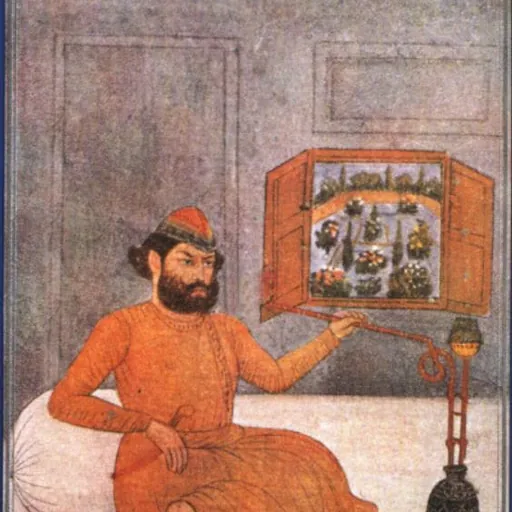
About Mir Taqi Mir
Lived 1723 – 1810 (aged 87). Mir Taqi Mir was an Indian poet, prose writer and writer.
Mir Muhammad Taqi (February 1723 – 20 September 1810), known as Mir Taqi Mir , was an Urdu poet of the 18th-century Mughal India and one of the pioneers who gave shape to the Urdu language itself. He was one of the principal poets of the Delhi School of the Urdu ghazal and is often remembered as one of the best poets of the Urdu language. His pen name (takhallus) was Mir. He spent the latter part of his life in the court of Asaf-ud-Daulah in Lucknow.
His father's name was Meer Muttaqi. Following his father's death, his step-brothers seized control of his inheritance. His (paternal) step-uncle took care of him after he was orphaned, and after the death of his step-uncle, his maternal step-uncle took care of him. The signature of his poetry is the grief he expresses. His poetry expresses much grief and distress over the downfall of his city, Delhi.
Life The main source of information on Mir's life is his autobiography Zikr-e-Mir, which covers the period from his childhood to the beginning of his sojourn in Lucknow. However, it is said to conceal more than it reveals, with material that is undated or presented in no chronological sequence. Therefore, many of the 'true details' of Mir's life remain a matter of speculation.
Early life and background Mir was born in Agra, India (then called Akbarabad and ruled by the Mughals) in August or February 1723. He was given a daily allowance by the Mughal Amir-ul-Umara and Mir Bakhshi, Khan-i Dauran, who was another native of Agra.
Some scholars consider two of Mir's masnavis (long narrative poems rhymed in couplets), Mu'amlat-e-ishq (The Stages of Love) and Khwab o Khyal-e Mir ("Mir's Vision"), written in the first person, as inspired by Mir's early love affairs, but it is by no means clear how autobiographical these accounts of a poet's passionate love affair and descent into madness are. Especially, as Frances W. Pritchett points out, the austere portrait of Mir from these masnavis must be juxtaposed against the picture drawn by Andalib Shadani, whose inquiry suggests a very different poet, given to unabashed eroticism in his verse.
Life in Lucknow
Mir lived much of his life in Mughal Delhi. Kuchha Chelan, in Old Delhi was his address at that time. However, after Ahmad Shah Abdali's sack of Delhi each year starting 1748, he eventually moved to the court of Asaf-ud-Daulah in Lucknow, at the ruler's invitation. Distressed to witness the plundering of his beloved Delhi, he gave vent to his feelings through some of his couplets. In the 1970s, a cenotaph was built in the vicinity of his actual burial place, helped by Maqbool Ahmed Lari, the founder of Mir Academy in Lucknow.
Literary life His complete works, Kulliaat, consist of six Diwans containing 13,585 couplets, comprising a variety of poetic forms: ghazal, masnavi, qasida, rubai, mustezaad, satire, etc.
"A Sayyid from Amroha took the trouble to put me on to writing poetry in the Urdu medium, the verse which resembled Persian poetry. Urdu was the language of Hindustan by the authority of the king and presently it was gaining currency. I worked at it very hard and practised this art to such a degree that I came to be acknowledged by the literari of the city. My verse became well known in the city and reached the ears of the young and old."
Mir and Mirza Ghalib Mir's famous contemporary, also an Urdu poet of no inconsiderable repute, was Mirza Rafi Sauda. Mir Taqi Mir was often compared with the later day Urdu poet, Mirza Ghalib. Lovers of Urdu poetry often debate Mir's supremacy over Ghalib or vice versa. It may be noted that Ghalib himself acknowledged, through some of his couplets, that Mir was indeed a genius who deserved respect. Here are two couplets by Mirza Ghalib on this matter. He that vows not on Mir, is himself unlearned!
Ghalib and Zauq were contemporary rivals but both of them believed in the greatness of Mir and also acknowledged Mir's greatness in their poetry. My life is like a bubble This world is like a mirage
At a higher spiritual level, the subject of Mir's poem is not a woman but God. Mir speaks of man's interaction with the Divine. He reflects upon the impact on man when God reveals Himself to the man. So the same sher can be interpreted in this way as well:
Other shers:
Mir Taqi Mir in fiction Khushwant Singh's famous novel Delhi: A Novel gives very interesting details about the life and adventures of the great poet. Mah e Mir is a 2016 Pakistani biographical film directed by Anjum Shahzad in which Fahad Mustafa played Mir Taqi Mir.
Major works Nikat-us-Shura, a biographical dictionary of Urdu poets of his time, written in Persian. Zikr-e-Mir, an autobiography written in Persian. Kulliyat-e-Farsi, a collection of poems in Persian Kulliyat-e-Mir, a collection of Urdu poetry consisting of six diwans (volumes). Mir Taqi Mir Ki Rubaiyat
Don’t just read it —
keep it.
Full-length biographies made to live with: read them, listen on the way to work, watch them tonight.
- E-book
- Audio
- Video
Instant download · yours to keep · every purchase keeps this site free
Important facts
People in Mir Taqi Mir's life
Named in this biography and alive at the same time
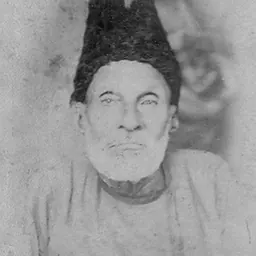
Related people
Same field, nearest in time

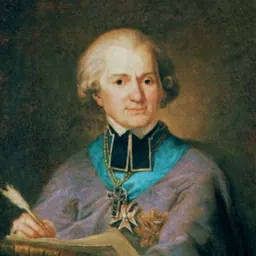

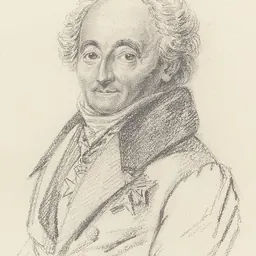
Contemporaries
People whose lives overlapped Mir Taqi Mir's




Frequently asked questions
Who was Mir Taqi Mir?
Indian Urdu language poet (1723-1810)
When was Mir Taqi Mir born?
Mir Taqi Mir was born on 28 May 1723 in Baggrave Hall.
When did Mir Taqi Mir die?
Mir Taqi Mir died on 20 September 1810 in United Kingdom, Awadh.
What was Mir Taqi Mir's occupation?
Mir Taqi Mir was a poet, prose writer and writer.
What nationality was Mir Taqi Mir?
Mir Taqi Mir was Indian.
Sources & further reading
Cite this page
APA: Biography.guide. (2026). Mir Taqi Mir. https://biography.guide/mir-taqi-mir/
MLA: "Mir Taqi Mir." Biography.guide, https://biography.guide/mir-taqi-mir/.
Chicago: "Mir Taqi Mir." Biography.guide. https://biography.guide/mir-taqi-mir/.
Data last updated: 2026-09-23 · Spot an error? Report a correction.
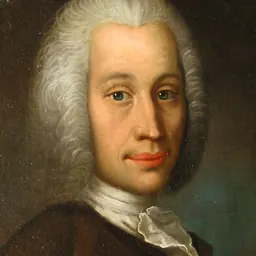
Portrait: Wikimedia Commons · author & licence
Page generated 2026-09-27 05:08 UTC