
About Mikhail Artemyevich Muravyov
Lived 1880 – 1918 (aged 37). Mikhail Artemyevich Muravyov was a Russian revolutionary and military personnel.
Mikhail Artemyevich Muravyov ( ( – July 11, 1918) was a Russian officer who changed sides during the time of the Civil War in Russia and the Soviet-Ukrainian war.
He was born in Burdukovo, a village near Vetluga in the Kostroma Governorate, to a peasant family. In 1898 he entered the army, serving in the Russo-Japanese War and World War I, in which he was a lieutenant colonel on the Southwestern Front.
After the February Revolution he organized volunteer units to continue the war, but he became disaffected with the Provisional Government and joined the Left Socialist-Revolutionaries. During the October Revolution he defended Petrograd against the forces of Alexander Kerensky.
In January 1918 he led Red Guard units against the Central Rada of Ukraine and after the Battle of Kruty his forces took Kyiv, where they carried out mass terror against the officers of the imperial army and pro-Ukrainian elements. Then his forces fought for the Odessa Soviet Republic against the Romanians and Austro-Hungarians, and in spring 1918 against the Don Cossack forces of General Kaledin.
However, after he had been named commander of the Eastern Front, fighting the Czechoslovak Legion, he heard of the Left SR uprising against the Bolsheviks in early July and rebelled, sailing down the Volga with a thousand men, hoping to take Simbirsk . He was captured by the Bolsheviks, resisted arrest, and was shot while trying to draw a gun.
Biography Early years Mikhail Muravyov was born into a peasant family. He studied at the Kostroma seminary. In 1898 he enlisted as a volunteer in the army. In 1901 he graduated from the two-year Kazan infantry cadet school, and after which he was sent to the city of Roslavl in the province of Smolensk. In that same year he distinguished himself in training exercises by capturing Aleksey Kuropatkin, the mock enemy commander.
Russo-Japanese War In 1904, he commanded a company of the 122nd Tambov Regiment in the Russo-Japanese War. In February 1905, he was seriously wounded in the head.
He spent about five years abroad, primarily in France, where he attended the Paris Military Academy. In 1907, Muravyov fell under the influence of revolutionary ideas and joined Boris Savinkov's Socialist Revolutionary group.
On January 1, 1909 he served in the 1st Nevsky Infantry Regiment in the Caucasus. For seven years he served as a teacher at the Kazan Military School and married the daughter of the commander of the reserve Skopinsky infantry regiment.
World War I At the beginning of World War I, after receiving a number of serious wounds at the front, he was transferred by a tactics teacher to the ensign school in Odessa. In March, he tried to oust the Governor of Odessa Ebelov for being "insufficiently revolutionary and a cadet." ), and led the formation of volunteer shock battalions. In this field, Muravyov managed to form up to one hundred "death battalions" and several women's battalions. He was spotted by Alexander Kerensky, who appointed him chief of security of the Provisional Government, and promoted him to lieutenant colonel.
October Revolution Following the October Revolution, he offered his services to the Soviet government. Two days after the uprising in Petrograd, Muravyov met with Yakov Sverdlov and Lenin, after which he was authorized to organize a fight against marauders who had plundered the Petrograd wine shops. Muravyov was appointed as Antonov-Ovseenko's chief of staff.
Muravyov himself imposed an indemnity of five million rubles on the Kievan "bourgeoisie" for the maintenance of Soviet troops. According to the Ukrainian Red Cross, in the first days after the establishment of Muravyov’s power in Kyiv, up to five thousand people were killed, of which up to three thousand were officers. It was one of the largest, if not the largest, massacres of Russian officers in the entire Civil War.
On January 27, Muravyov sent a report to Antonov-Ovseenko and Lenin on the capture of Kiev:
He opposed the conclusion of the Brest-Litovsk Treaty with Germany, declared himself "commander in chief of the army operating against Germany", and sent a telegraph to the Council of People's Commissars of the RSFSR, the German embassy in Moscow and the command of the Czechoslovak Legion, declaring war on Germany. The troops of the front and the Czechoslovak Legion (with which he had to fight before the rebellion) were ordered to move to the Volga and further west to repulse the German invasion.
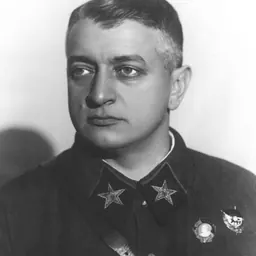
On July 11, Muravyov, with a detachment of a thousand people, arrived at Simbirsk, occupied strategic points of the city and arrested leading Bolsheviks, including the commander of the 1st Army Mikhail Tukhachevsky. Muravyov appeared at a meeting of the executive committee of the provincial Council, together with representatives of the Left Socialist Revolutionaries. At that time, the local Left SRs were not yet removed from power and held the posts of military, land and food provincial commissars. By this time, the chairman of the local Bolshevik party committee had managed to secretly place Latvian Riflemen, an armored squad and a special detachment of the Cheka around the building. During the meeting, the Red Guards and the Cheka came out from the ambush and announced the arrest of everyone in the building. Muravyov put up armed resistance and was killed in the fighting.
Don’t just read it —
keep it.
Full-length biographies made to live with: read them, listen on the way to work, watch them tonight.
- E-book
- Audio
- Video
Instant download · yours to keep · every purchase keeps this site free
Important facts
People in Mikhail Artemyevich Muravyov's life
Named in this biography and alive at the same time



Related people
Same field, nearest in time

Contemporaries
People whose lives overlapped Mikhail Artemyevich Muravyov's






Frequently asked questions
Who was Mikhail Artemyevich Muravyov?
Russian general (1880-1918)
When was Mikhail Artemyevich Muravyov born?
Mikhail Artemyevich Muravyov was born on 13 September 1880.
When did Mikhail Artemyevich Muravyov die?
Mikhail Artemyevich Muravyov died on 11 July 1918 in Ulyanovsk.
What was Mikhail Artemyevich Muravyov's occupation?
Mikhail Artemyevich Muravyov was a revolutionary and military personnel.
What nationality was Mikhail Artemyevich Muravyov?
Mikhail Artemyevich Muravyov was Russian.
Sources & further reading
· Wikipedia: Mikhail Artemyevich Muravyov
· DBpedia: Mikhail Artemyevich Muravyov
Cite this page
APA: Biography.guide. (2026). Mikhail Artemyevich Muravyov. https://biography.guide/mikhail-artemyevich-muravyov/
MLA: "Mikhail Artemyevich Muravyov." Biography.guide, https://biography.guide/mikhail-artemyevich-muravyov/.
Chicago: "Mikhail Artemyevich Muravyov." Biography.guide. https://biography.guide/mikhail-artemyevich-muravyov/.
Data last updated: 2026-09-20 · Spot an error? Report a correction.
Page generated 2026-09-27 05:20 UTC