
About Michel Sarrazin
Lived 1659 – 1734 (aged 75). Michel Sarrazin was a French naturalist, botanist, surgeon, physician and botanical collector.
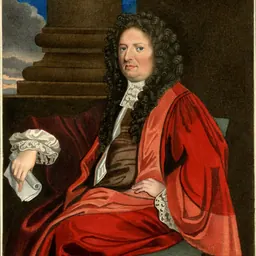
This painting is usually thought to be of Michel Sarrazin, however there is some debate as to whether or not this is true.
Michel Sarrazin (5 September 1659 – 8 September 1734), was a surgeon, physician, scientist and naturalist from New France. Born in Nuits-sous-Beaune in the Province of Burgundy, he immigrated at age 25 to the colony of New France as a surgeon. He remained in the colony for the rest of his life, returning to France only during two brief periods. While in New France, his medical skills were constantly in demand, and he quickly rose in the ranks, becoming one of the colonial elite.
He was both a seigneur and a member of the Conseil Superieur, and held considerable influence in the colony. He had a great interest in botany, and kept up a frequent correspondence with the Académie Royale des Sciences in France, sending fellow scientists numerous specimens of North American plants, as well as detailed descriptions of dissections of animals.
Sarrazin developed a vast knowledge of both the cultural and natural world of New France, and is credited being one of the first scientists to systematically catalogue ecosystems and samples found in New France, resulting in many important botanical discoveries.
Despite his high ranking position as one of the few colonial intellectuals, Sarrazin faced chronic financial struggles, and died in poverty at age seventy-five, leaving a widow and four children.
He was not paid for his work directly by his patients, but instead received a yearly sum from the King of France, Louis XIV, of around 300 livres. Sarrazin would later become a "correspondant" to Tournefort, and their relationship provided Sarrazin with an important link to the Académie Royale des Sciences. Sarrazin grew ginseng in his garden for future study, and sent the first sample of the specimen back to the Jardin du Roi in 1701.
The most interesting specimen discovered by Sarrazin is likely Sarracenia purpurea, the pitcher plant, a plant which was previously unknown in France. Linnaeus would name the genus Sarracenia in his honor. He maintained that this plant caught insects and ate them, a theory which was dismissed by the academic community. It was only later, when Charles Darwin published his dissertation in 1875, Insectivorous Plants, that this was validated. This plant, found mainly in bogs and marshes around Québec, proved to be an effective treatment for smallpox, a disease which plagued Europe and America at the time.
Other discoveries included l'Arum Canadense, which could treat tumours, l'Aralia canadensis, which treats ulcers, , for epileptic seizures, and l'Angelica Canadensis tenufolia asphodeli radice which can be used as a sedative. Moreover, the native people of New France taught Sarrazin that the sap from Arbor acadiensis could be used to treat sores.
As a correspondent of the Académie Royale des Sciences, Sarrazin consistently sent samples back to Paris, with no expectation of recognition. New France's uncharted lands proved challenging to botanists, as Sarrazin stated in his correspondence, "I could cross all of Europe more easily, and with less danger, than I could cross 100 leagues in Canada". The operation was a resounding success, and the nun lived for another 39 years, dying at the age of 77.
Sarrazin's specimens can now be found in the Muséum National d'Histoire Naturelle, in Paris; including a specimen of Sarracenia purpurea.
Maison Michel-Sarrazin The Maison Michel-Sarrazin is a private palliative care, non-profit hospital. The House opened its doors in 1985 and since then has treated over 7,000 patients. In 2010, the House celebrated its 25th anniversary.
Le Prix Michel Sarrazin The Michel Sarrazin Award recognizes the scientific career and outstanding contribution of an experienced Québécois scientist. It is awarded annually to a scientist who, through innovation and productivity, has contributed in vital ways to the advancement of biomedical research.
Don’t just read it —
keep it.
Full-length biographies made to live with: read them, listen on the way to work, watch them tonight.
- E-book
- Audio
- Video
Instant download · yours to keep · every purchase keeps this site free
Important facts
Related people
Same field, nearest in time




Contemporaries
People whose lives overlapped Michel Sarrazin's



Frequently asked questions
Who was Michel Sarrazin?
French physician and naturalist (1659-1734)
When was Michel Sarrazin born?
Michel Sarrazin was born on 5 September 1659 in Nuits-Saint-Georges.
When did Michel Sarrazin die?
Michel Sarrazin died on 8 September 1734 in Quebec City.
What was Michel Sarrazin's occupation?
Michel Sarrazin was a naturalist, botanist, surgeon, physician and botanical collector.
What nationality was Michel Sarrazin?
Michel Sarrazin was French.
Sources & further reading
Cite this page
APA: Biography.guide. (2026). Michel Sarrazin. https://biography.guide/michel-sarrazin/
MLA: "Michel Sarrazin." Biography.guide, https://biography.guide/michel-sarrazin/.
Chicago: "Michel Sarrazin." Biography.guide. https://biography.guide/michel-sarrazin/.
Data last updated: 2026-09-20 · Spot an error? Report a correction.
Page generated 2026-09-27 05:32 UTC