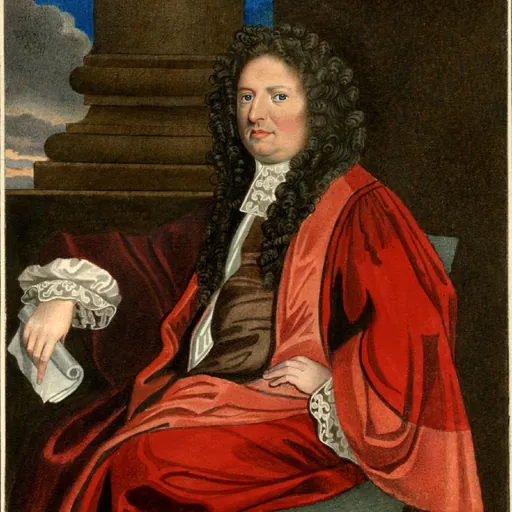
About Robert Plot
Lived 1640 – 1696 (aged 55). Robert Plot was an English naturalist, archaeologist, chemist, university teacher and historian.
Robert Plot (13 December 1640 – 30 April 1696) was an English naturalist and antiquarian who was the first professor of chemistry at the University of Oxford and the first keeper of the Ashmolean Museum.
Early life and education Born in Borden, Kent to parents Robert Plot and Elisabeth Patenden, and baptised on 13 December 1640, Robert Plot was educated at the Wye Free School in Kent. He entered Magdalen Hall, Oxford in 1658 where he graduated with a BA in 1661 and an MA in 1664. Plot subsequently taught and served as dean and vice principal at Magdalen Hall while preparing for his BCL and DCL, which he received in 1671 before moving to University College in 1676.
Natural history and chemistry By this time, Plot had already developed an interest in the systematic study of natural history and antiquities. In June 1674, with patronage from John Fell, the bishop of Oxford, and Ralph Bathurst, vice-chancellor of the university, Plot began studying and collecting artefacts throughout the nearby countryside, publishing his findings three years later in The Natural History of Oxford-shire.
In the field of chemistry, he searched for a universal solvent that could be obtained from wine spirits, and believed that alchemy was necessary for medicine. In 1684, Plot published De origine fontium, a treatise on the source of springs, which he attributed to underground channels originating from the sea. Plot shifted his focus towards archaeology in the 1686 publication of his second book, The Natural History of Staffordshire, but misinterpreted Roman remains as Saxon. and, for the first time, the Polish swan, a pale morph of the mute swan.
Later life and death In 1687, Plot was made a notary public by the Archbishop of Canterbury as well as appointed the registrar to the Norfolk Court of Chivalry. Plot resigned from his posts at Oxford in 1690, thereafter marrying Rebecca Burman of London and retiring to his property of Sutton Barne in his hometown of Borden, where he worked on The Natural History of Middlesex and Kent but never completed. The office of Mowbray Herald Extraordinary was created in January 1695 for Plot, who was made registrar of the College of Heralds just two days later. Although able to go on an archaeological tour of Anglia in September 1695, Plot was greatly suffering from urinary calculi (kidney stones), and succumbed to his illness on 30 April 1696 aged 55. He was buried at Borden Church, where a plaque memorialises him.
Don’t just read it —
keep it.
Full-length biographies made to live with: read them, listen on the way to work, watch them tonight.
- E-book
- Audio
- Video
Instant download · yours to keep · every purchase keeps this site free
Important facts
People in Robert Plot's life
Named in this biography and alive at the same time

Related people
Same field, nearest in time




Contemporaries
People whose lives overlapped Robert Plot's




Frequently asked questions
Who was Robert Plot?
English scientist
When was Robert Plot born?
Robert Plot was born on 13 December 1640 in Sutton Baron And Sutton Baron Hall.
When did Robert Plot die?
Robert Plot died on 30 April 1696 in Kent.
What was Robert Plot's occupation?
Robert Plot was a naturalist, archaeologist, chemist, university teacher and historian.
What nationality was Robert Plot?
Robert Plot was English.
Sources & further reading
Cite this page
APA: Biography.guide. (2026). Robert Plot. https://biography.guide/robert-plot/
MLA: "Robert Plot." Biography.guide, https://biography.guide/robert-plot/.
Chicago: "Robert Plot." Biography.guide. https://biography.guide/robert-plot/.
Data last updated: 2026-09-23 · Spot an error? Report a correction.
Portrait: Wikimedia Commons · author & licence
Page generated 2026-09-27 05:05 UTC