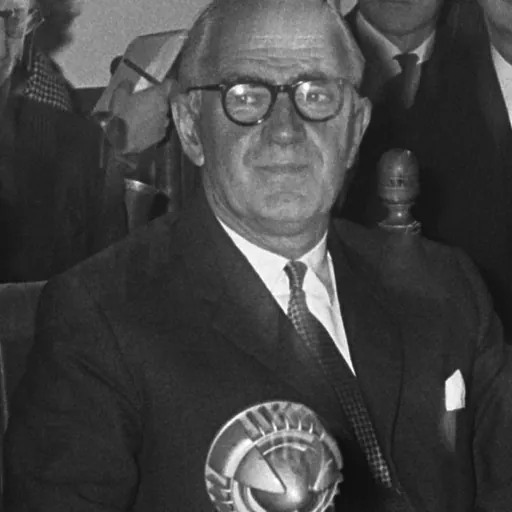
About Michael Stewart, Baron Stewart of Fulham
Lived 1906 – 1990 (aged 83). Michael Stewart, Baron Stewart of Fulham was a British and American politician and teacher.
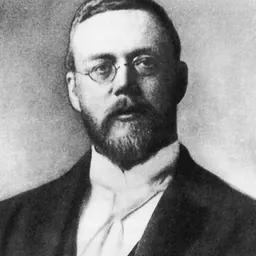
Robert Michael Maitland Stewart, Baron Stewart of Fulham, (6 November 1906 – 10 March 1990) was a British Labour Party politician, life peer and Fabian Socialist who was a Member of Parliament for 34 years, and served twice as Foreign Secretary in the first cabinet of Harold Wilson.
Early life The son of Robert Wallace Stewart, author and lecturer, and Eva Stewart née Blaxley, Robert Michael Maitland Stewart was born in Bromley. He was educated at Brownhill Road Elementary School, Catford, Christ's Hospital and St. John's College, Oxford, where he graduated with a first class BA in Philosophy, Politics and Economics in 1929. Whilst at Oxford he was involved in student politics and was elected as President of the Oxford Union for Michaelmas Term 1929. He was also the president of St John's Labour Club that same year. They were one of the few couples who both held titles in their own right.
Political career Stewart had contested the Lewisham West constituency in 1931 and 1935. In 1936 he was selected for Fulham East, though due to the outbreak of war there was no election until 1945. Granted leave from the army to contest the seat, Stewart became MP for Fulham East 1945–55, then for Fulham 1955–74, and Hammersmith, Fulham 1974–79. Soon after his initial election, he was made one of the Lords Commissioners of the Treasury (more commonly known as a junior whip), then a junior minister, as Under-Secretary of State for War (1947–51) and later as Parliamentary Secretary to the Ministry of Supply (May–October 1951), filling the vacancy caused by the resignation of John Freeman. Following Labour's defeat in the 1951 election, Stewart was a rising figure on the shadow front bench, first assisting Chuter Ede, the party's main spokesman on education, and then himself serving as Shadow Minister of Education (1955–59) and then as Shadow Minister of Housing and Local Government (1959–64).
Stewart first contested the Labour Party Shadow Cabinet elections in 1955. In 1959, as runner up, he joined the Shadow Cabinet following the resignation of Alf Robens; he was then elected in his own right for the remainder of Labour's period in opposition, topping the poll in 1963. His performance was boosted by his high profile in opposing the government's 1963 Local Government Act and in criticising predatory landlords.
On May 21, 1952 during the British Malayan headhunting scandal, Stewart asked Henry Hopkinson in the House of Commons if the government intended to punish British soldiers caught posing with decapitated human heads in images taken during the Malayan Emergency and leaked by the Daily Worker. Hopkinson confirmed to Stewart that none of the British soldiers would be punished, claiming that said soldiers had never explicitly been forbidden from mutilating corpses.
Stewart was Fabian Summer School director in 1952 and lecturer in 1954. He was Fabian New Year School lecturer in 1954–55 and publicist in 1956. He is listed as a member of the Fabian Society International Bureau Committee during 1957–58 and was mentioned in Fabian News November – December 1964 as a former member of the Fabian Executive Committee. He was described by the press as relatively unknown to the public but was extremely well known within Fabian socialist circles.
The most significant international issue during the period was the Vietnam War, which escalated in the years immediately after 1964. The government's stance, in avoiding active entanglement, providing vocal support for the Americans, and involvement in diplomatic initiatives, was driven directly by the Prime Minister. Stewart, a committed Atlanticist, played a supporting role. Nor was Stewart and the Foreign Office the lead for the government over Rhodesia, which declared UDI in 1965: that fell to the Colonial Office. Stewart - and his Foreign Office officials - was in favour of a renewed application to join the EEC, though Wilson was very reluctant to bring the issue to Cabinet because he saw it as divisive. Progress only really began in 1966 and gathered pace under Stewart's successor. The Nuclear Non-Proliferation Treaty was signed in 1967, where Lord Chalfont had been responsible for negotiations on behalf of Britain. There was also success in ending the 'Confrontation' with Indonesia.
In 1966, Stewart swapped jobs with George Brown and became Secretary of State for Economic Affairs and First Secretary of State. He returned to the Foreign Office from 1968 to 1970. As Foreign Secretary, he was instrumental in supplying arms to support the Nigerian military dictatorship's crushing of the secessionist Republic of Biafra in the Nigerian Civil War (when up to one million people died), later saying "It would have been quite easy for me to say: This is going to be difficult – let's cut off all connexion with the Nigerian Government. If I'd done that I should have known that I was encouraging in Africa the principle of tribal secession – with all the misery that could bring to Africa in the future."
Post-Government Stewart remained foreign affairs spokesman after the 1970 General Election, but only until the Shadow Cabinet elections a month later. His stance on both Vietnam and Biafra had been unpopular with the Parliamentary Labour Party and this resulted in his fall to eighteenth place in the poll. At the age of sixty-three, this was the end of his front bench career.
A committed pro-European, Stewart was leader of the Labour Delegation to the Council of Europe in June 1970, and joint president of the Labour Committee for Europe with George Brown and Roy Jenkins. He served as a member of the European Parliament from 1975 to 1976.
Stewart was made a member of the Privy Council in 1964. He was appointed a Member of the Order of the Companions of Honour (CH) in the 1969 New Year Honours. He retired from the House of Commons in 1979. He was elevated to the House of Lords, being created a life peer with the title Baron Stewart of Fulham, of Fulham in Greater London, on 5 July 1979.
Brian Harrison recorded an oral history interview with Stewart, in March 1978, as part of the Suffrage Interviews project, titled Oral evidence on the suffragette and suffragist movements: the Brian Harrison interviews. Stewart discusses his teaching career and his connection with the Association for Education in Citizenship.
He died at a hospital in London on 10 March 1990, at the age of 83.
Don’t just read it —
keep it.
Full-length biographies made to live with: read them, listen on the way to work, watch them tonight.
- E-book
- Audio
- Video
Instant download · yours to keep · every purchase keeps this site free
Important facts
Family & relationships
People in Michael Stewart, Baron Stewart of Fulham's life
Named in this biography and alive at the same time


Related people
Same field, nearest in time
Contemporaries
People whose lives overlapped Michael Stewart, Baron Stewart of Fulham's


Frequently asked questions
Who was Michael Stewart, Baron Stewart of Fulham?
British politician (1906–1990)
When was Michael Stewart, Baron Stewart of Fulham born?
Michael Stewart, Baron Stewart of Fulham was born on 6 November 1906 in Bromley.
When did Michael Stewart, Baron Stewart of Fulham die?
Michael Stewart, Baron Stewart of Fulham died on 10 March 1990 in London.
What was Michael Stewart, Baron Stewart of Fulham's occupation?
Michael Stewart, Baron Stewart of Fulham was a politician and teacher.
What nationality was Michael Stewart, Baron Stewart of Fulham?
Michael Stewart, Baron Stewart of Fulham was British and American.
Sources & further reading
· Wikipedia: Michael Stewart, Baron Stewart of Fulham
· DBpedia: Michael Stewart, Baron Stewart of Fulham
Cite this page
APA: Biography.guide. (2026). Michael Stewart, Baron Stewart of Fulham. https://biography.guide/michael-stewart-baron-stewart-of-fulham/
MLA: "Michael Stewart, Baron Stewart of Fulham." Biography.guide, https://biography.guide/michael-stewart-baron-stewart-of-fulham/.
Chicago: "Michael Stewart, Baron Stewart of Fulham." Biography.guide. https://biography.guide/michael-stewart-baron-stewart-of-fulham/.
Data last updated: 2026-09-28 · Spot an error? Report a correction.
Portrait: Wikimedia Commons · author & licence
Page generated 2026-10-04 12:44 UTC