
About Michael Dahl
Lived 1659 – 1743 (aged 84). Michael Dahl was a Swedish painter.
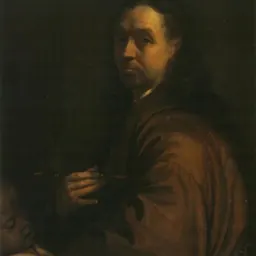
Michael Dahl (1656/1659 – 20 October 1743) was a Swedish painter who specialised in portrait painting and spent most of his career in England. He was one of the most internationally known Swedish painters of his time. Dahl painted portraits of aristocracy and royalty such as Anne, Queen of Great Britain, Prince George of Denmark and the exiled Christina, Queen of Sweden.
Childhood Michael Dahl was born in Stockholm, in 1656 or 1659: most of the sources point to 1659. His mother, Catarina Dahl, is assumed to have made many silent sacrifices to give Michael the opportunity of a good education, so that his talent was not to be wasted. According to letters written by Michael from Rome to his mother back in Sweden, she had raised him and his sister in an old-fashioned way and in the spirit of Christianity.
Dahl received his first lessons in art in 1674 from the Hungarian-born drawing-master Martin Hannibal, who had been requested to come to Sweden from Italy by the prominent Swedish painter David Klöcker Ehrenstrahl to aid him in the foundation of a portrait academy and to teach students and amateurs the first elements of painting. The Hannibal and Ehrenstrahl group consisted of a handful of students who were taught by Martin Hannibal and David Klöcker Ehrenstrahl. Since there were two teachers, the group was divided. The students were first under the leadership of Hannibal to learn the basics of painting, and if they showed skill, they had the chance of being picked out to continue their study with Ehrenstrahl.
Travels
England
On 30 July 1682, Dahl was issued a passport to be able to travel throughout Europe for the sake of his studies. His first destination on this educational journey was London. His studio was factory-like compared with Ehrenstrahl's, which Dahl's biographer Wilhelm Nisser terms "Ehrenstrahl's monopoly of glorifying Swedish Royalty".
Paris and Rome
Lack of documentation makes it impossible to determine when Dahl and Henry Tilson left for Paris, but it is known that they were still working in Paris in April 1685. At that time, the Swedish queen Christina, who had abdicated to convert to Roman Catholicism, was living in Rome. She still had a strong bond to Sweden and its people and was helpful when it came to assisting Swedish artists in the city. Therefore, the first thing Dahl did upon his arrival was to seek an audience with her. Dahl was not the only artist Christina was able to convert. David Richter the Elder who Dahl had studied with at Ehrenstrahl's, was converted when he visited Rome a few years earlier, in 1679. Christina seems to have given her consent, as a passport for a journey Rome–London was issued on 29 October to Henry Tilson, just over three weeks after Dahl wrote the letter to his mother. In November the same year two other Swedish painters, Burchardt Precht and Nicodemus Tessin the Younger, came to study in Rome and they do not appear to have been in any contact with Dahl or Tilson, so presumably the two young painters left immediately after the passport had been issued. Dahl adapted to his new life and after three years in London he had transformed into a young London dandy, who paid his attentions to a certain Mlle. Fanchou, though she was not the woman he was to marry. In 1696, thanks to Leijoncrona, he was able to settle in the neighborhood of the Swedish Legation in the fashionable quarter of Leicester Field (now Leicester Square). Leijoncrona also helped Dahl to win fame back in Sweden, and two years after he settled in London, on 5 October 1698, the well-known metallurgist Erik Odhelius writes in a letter: "Courteous greetings to Mr Dahl, whose renown daily increases here."
Dahl kept advancing in reputation, and in 1696 he painted the portrait of Charles Seymour, 6th Duke of Somerset who found him to his liking even though the Duke was known for being a very despotic and difficult man to handle. The Duke continued to hire Dahl and for over 20 years he painted members of the Duke's family. It was undoubtedly through the Prince that he came into the circles around Queen Anne, whose portrait he also painted. Together they had a son, Michael, and two daughters, Dorothy and Catherine. The family was very respected by art-interested people in the neighborhood and lived a pleasant life there until 1725, when they moved to Beak Street, which today is at the south end of Carnaby Street. King George was furious at this reply, and it ruined all Dahl's opportunities of being knighted.
Michael Dahl died in London on 20 October 1743 and was buried a week later in St James's Church, Piccadilly.
Don’t just read it —
keep it.
Full-length biographies made to live with: read them, listen on the way to work, watch them tonight.
- E-book
- Audio
- Video
Instant download · yours to keep · every purchase keeps this site free
Important facts
more
the elder Dahl, Michaël Dahl, I Dahl, Michaël, le vieux Dahl, Michaël Dahl (I), Mr. Dahil, michael dahl, Mr. Dahl, Dahle, Dahl, Mr Dall, Dhall, Michael I Dahl, M. Dahl á London, M. Dahl, A. DahllPeople in Michael Dahl's life
Named in this biography and alive at the same time


Related people
Same field, nearest in time


Contemporaries
People whose lives overlapped Michael Dahl's




Frequently asked questions
Who was Michael Dahl?
Swedish painter (1659-1743)
When was Michael Dahl born?
Michael Dahl was born on 29 September 1659 in Stockholm.
When did Michael Dahl die?
Michael Dahl died on 20 October 1743 in London.
What was Michael Dahl's occupation?
Michael Dahl was a painter.
What nationality was Michael Dahl?
Michael Dahl was Swedish.
Sources & further reading
Cite this page
APA: Biography.guide. (2026). Michael Dahl. https://biography.guide/michael-dahl/
MLA: "Michael Dahl." Biography.guide, https://biography.guide/michael-dahl/.
Chicago: "Michael Dahl." Biography.guide. https://biography.guide/michael-dahl/.
Data last updated: 2026-09-26 · Spot an error? Report a correction.
Page generated 2026-09-27 05:15 UTC