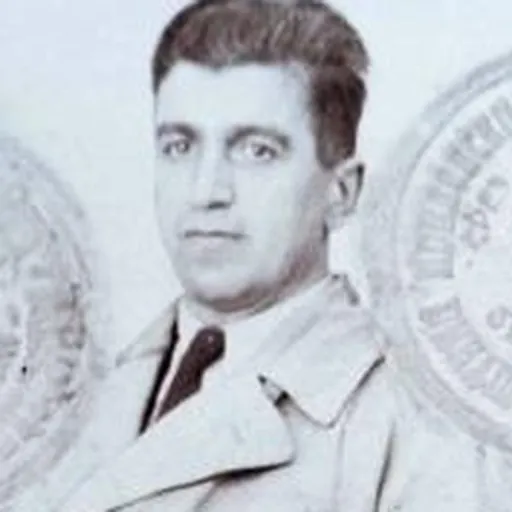
About Metodi Shatorov
Lived 1898 – 1944 (aged 46). Metodi Shatorov was a Bulgarian politician and partisan.
Metodi Tasev Shatorov (; , known also under the pseudonyms Sharlo/Šarlo and Panayot; January 10, 1897 – September 1944) was a Bulgarian Communist Party activist. Shatorov was one of the founders of the Internal Macedonian Revolutionary Organization (United) - IMRO (United) in 1925. He was leader of the Regional Committee of Communists in Macedonia in 1940–1941. Shatorov died under unknown circumstances. He has been celebrated in Bulgaria after the Second World War. However, his name was a taboo in Yugoslav Macedonia. His image was gradually rehabilitated after the country gained independence in the 1990s.
Biography Early years Shatorov was born on January 10, 1897, in Prilep, then in the Manastir vilayet of the Ottoman Empire. He graduated from the local Bulgarian Exarchate's junior school in Prilep and afterwards from the Bulgarian men's high school in Bitola. He also attended the Bulgarian pedagogic school in Skopje in 1914–1915. In 1918 the Bulgarian Army withdrew from Vardar Macedonia and Serbia annexed the area. He immediately emigrated to Bulgaria, settling in Sofia, where he became a member of the Bulgarian Communist Party (BCP) in 1920. Furthermore, Shatorov was arrested for his participation in the communist September Uprising in 1923. In 1925, he was a founder of the IMRO (United), He became a member of BCP's Central Committee in 1927. Due to his imprisonment in 1928–1929 by the Bulgarian government, he emigrated to the Soviet Union, where he became a functionary of the Comintern. On October 1, 1940, at CPY's Fifth Land Conference, taking place in Zagreb, he rejected the conference theses put forward by Milovan Djilas. Djilas' theses spoke of a popular front, restricting it to the workers and peasants. However, referring to the colonial character of Macedonia, Shatorov wanted a communist-led national revolutionary front of all Macedonian classes and groups, which had to fight against "Serbian imperialists and oppressors." Shatorov also stated that the party should support the expulsion of Serb settlers from Macedonia in order to win the trust of the Macedonians. He also accused Djilas of having a Serb chauvinist stance because of his use of historical analogies to defend the settlers. Shatorov also renamed the committee as "Regional Committee of the Workers' Party in Macedonia" and expelled its two ethnic Serbian members. The BCP supported the idea of an independent and unified Macedonia, contrary to the stance of the CPY. He became prominent with his anti-Serbian political views and adopted a stance in favor of a Soviet Macedonia and of waiting for the Red Army, thus got into a conflict with the CPY. BCP also was of the view that the locals were not ready to fight for the same reason.
To avoid the risk of a continuation of pro-Bulgarian policies, Yugoslav leader Josip Broz Tito tasked the special envoy Montenegrin Serb Svetozar Vukmanović-Tempo with organizing a Macedonian communist party in CPY's framework. CPY also managed to organize the Macedonian partisan movement as a national liberation struggle.
Death and legacy Shatorov was heavily wounded and died under unknown circumstances after September 5, 1944, when a battle between partisans and gendarmerie on Milevi Skali in the Western Rhodope mountains, between Septemvri and Velingrad occurred. As Shatorov was previously subjected to sharp criticism from the CPY, there are allegations that he was killed by Yugoslav communists' order as a politically inconvenient leader. This happened only several days before the Communist coup d'état of September 9 (backed by the Red Army) installed a new government of the Fatherland Front. As per the autopsy report, he died after September 9, i.e. after the old regime's end, and until then he was not discovered neither by his comrades nor by the new authorities.
In the People's Republic of Bulgaria, he was considered a hero of the anti-fascist resistance, but after 1990, Shatorov's activities have been criticized, as those of all Bulgarian Communist Party figures. The Yugoslav Macedonian historiography thought that he was trying to Bulgarianize the Macedonian communist movement. In the 1990s, during efforts to rehabilitate him, veterans of the National Liberation Struggle condemned the pro-Bulgarian character of both him and his followers. However, in November 2005, a scholarly conference of the Macedonian Academy of Sciences and Arts rehabilitated him and decided that he was "a great Macedonian patriot who felt Macedonian, fought for Macedonian national identity, and was not a traitor of the Macedonian cause." Shatorov is celebrated as a Bulgarian patriot in Bulgaria.
Gallery
Footnotes
Don’t just read it —
keep it.
Full-length biographies made to live with: read them, listen on the way to work, watch them tonight.
- E-book
- Audio
- Video
Instant download · yours to keep · every purchase keeps this site free
Important facts
People in Metodi Shatorov's life
Named in this biography and alive at the same time

Related people
Same field, nearest in time





Contemporaries
People whose lives overlapped Metodi Shatorov's



Frequently asked questions
Who was Metodi Shatorov?
Bulgarian politician (1898-1944)
When was Metodi Shatorov born?
Metodi Shatorov was born on 10 January 1898 in Prilep.
When did Metodi Shatorov die?
Metodi Shatorov died on 4 September 1944 in Pazardzhik.
What was Metodi Shatorov's occupation?
Metodi Shatorov was a politician and partisan.
What nationality was Metodi Shatorov?
Metodi Shatorov was Bulgarian.
Sources & further reading
Cite this page
APA: Biography.guide. (2026). Metodi Shatorov. https://biography.guide/metodi-shatorov/
MLA: "Metodi Shatorov." Biography.guide, https://biography.guide/metodi-shatorov/.
Chicago: "Metodi Shatorov." Biography.guide. https://biography.guide/metodi-shatorov/.
Data last updated: 2026-09-23 · Spot an error? Report a correction.
Portrait: Wikimedia Commons · author & licence
Page generated 2026-09-27 05:08 UTC