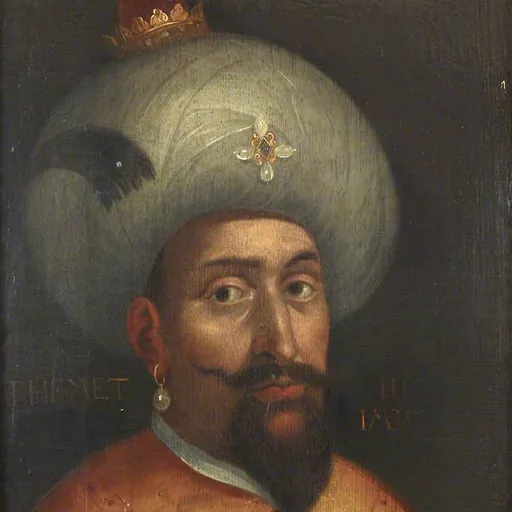
About Mehmed III
Lived 1566 – 1603 (aged 37). Mehmed III was a Turkish ruler and sultan.
Mehmed III (, Meḥmed-i sālis; ; 26 May 1566 – 22 December 1603) was the sultan of the Ottoman Empire from 1595 until his death in 1603. Mehmed was known for ordering the execution of his brothers and leading the army in the Long Turkish War, during which the Ottoman army was victorious at the Battle of Keresztes. This victory was however undermined by some military losses such as in Győr and Nikopol. He also ordered the successful quelling of the Jelali rebellions. The sultan also communicated with the court of Elizabeth I on the grounds of stronger commercial relations and in the hopes of England to ally with the Ottomans against the Spanish.
Early life Prince Mehmet arriving from the Old Palace in 1581-83. Sehinsahname''' 1592 (TSMK, B.200). Mehmed was born at the Manisa Palace on 26 May 1566 to Şehzade Murad and his concubine Safiye, an Albanian from the Dukagjin Highlands . He was the grandson of Şehzade Selim and his Haseki, Nurbanu Sultan, and the great-grandson of Sultan Suleiman the Magnificent and his Haseki, Hürrem Sultan (d. 1558). At the time of Mehmed's birth, Suleiman was still the reigning sultan of the Ottoman Empire. Upon hearing the news of the birth of his great-grandson, Suleiman gave him the name Mehmed after his own great-grandfather, Mehmed the Conqueror, to honor him.
Suleiman I died later the same year of Mehmed's birth during the Siege of Szigetvár in September 1566, and Mehmed's grandfather, Selim, succeeded him as the new sultan. When Selim II died in December 1574, Mehmed's father, Murad, succeeded him as Murad III. Mehmed was eight years old at the time.
Mehmed spent most of his childhood and adolescence in Manisa, where he was raised with his family and educated by his tutors, including Ibrahim Efendi. His circumcision ceremony took place on 29 May 1582, when he was 16 years old.
Murad III died in January 1595, when Mehmed was 28 years old. Mehmed then succeeded his father as the new sultan.
Reign
Fratricide Upon ascending to the throne, Mehmed III ordered that all of his nineteen brothers be executed. They were strangled by his royal executioners, many of whom were deaf, mute or 'half-witted' to ensure absolute loyalty. Fratricidal successions were not unprecedented, as sultans would often have dozens of children with their concubines.
Power struggle in Constantinople Coronation of Mehmet III in the Topkapi Palace in 1595. Manuscript of 1600 by Seyyid Lokman Mehmed III was an idle ruler, leaving government to his mother Safiye Sultan, the valide sultan. His first major problem was the rivalry between two of his viziers, Serdar Ferhad Pasha and Koca Sinan Pasha, and their supporters. His mother and her son-in-law Damat Ibrahim Pasha supported Koca Sinan Pasha and prevented Mehmed III from taking control of the issue himself. The issue grew to cause major disturbances by janissaries. On 7 July 1595, Mehmed III finally sacked Serdar Ferhad Pasha from the position of Grand Vizier due to his failure in Wallachia and replaced him with Sinan. However, the Ottomans eventually decided to face the enemy and defeated the Habsburg and Transylvanian forces at the Battle of Keresztes (known in Ottoman Turkish as the Battle of Haçova), during which the Sultan had to be dissuaded from fleeing the field halfway through the battle. Upon returning to Istanbul in victory, Mehmed told his viziers that he would campaign again. The next year the Venetian Bailo in Istanbul noted, "the doctors declared that the Sultan cannot leave for a war on account of his bad health, produced by excesses of eating and drinking".
In reward for his services at the war, Cigalazade Yusuf Sinan Pasha was made Grand Vizier in 1596. However, with pressure from the court and his mother, Mehmed reinstated Damat Ibrahim Pasha to this position shortly afterward.
Mehmed III accepting the surrender at Siege of Eger (1596). Eğri Fetihnamesi, 1598 (TSMK, H.1609) However, the victory at the Battle of Keresztes was soon set back by some important losses, including the loss of Győr to the Austrians and the defeat of the Ottoman forces led by Hafız Ahmet Pasha by the Wallachian forces under Michael the Brave in Nikopol in 1599. In 1600, Ottoman forces under Tiryaki Hasan Pasha captured Nagykanizsa after a 40-day siege and later successfully held it against a much greater attacking force in the Siege of Nagykanizsa.
Jelali revolts Another major event of his reign was the Jelali revolts in Anatolia. Karayazıcı Abdülhalim, a former Ottoman official, captured the city of Urfa and declared himself a sultan in 1600. The rumors of his claim to the throne spread to Constantinople and Mehmed ordered the rebels to be treated harshly to dispel the rumors, among these, was the execution of Hüseyin Pasha, whom Karayazıcı Abdülhalim styled as Grand Vizier. In 1601, Abdülhalim fled to the vicinity of Samsun after being defeated by the forces under Sokulluzade Hasan Pasha, the governor of Baghdad. However, his brother, Deli Hasan, killed Sokulluzade Hasan Pasha and defeated troops under the command of Hadım Hüsrev Pasha. He then marched on to Kütahya, captured and burned the city. Also among the English gifts was a ceremonial coach, accompanied by a letter from the Queen to Mehmed's mother, Safiye Sultan. These gifts were intended to cement relations between the two countries, building on the trade agreement signed in 1581 that gave English merchants priority in the Ottoman region. Under the looming threat of Spanish military presence, England was eager to secure an alliance with the Ottomans, the two nations together having the capability to divide the power. Elizabeth I's gifts arrived in a large 27-gun merchantman ship that Mehmed personally inspected, a clear display of English maritime strength that would prompt him to build up his fleet over the following years of his reign. The Anglo-Ottoman alliance would never be consummated, however, as relations between the nations grew stagnant due to anti-European sentiments reaped from the worsening Austro-Ottoman War and the deaths of Safiye Sultan's interpreter and the pro-English chief Hasan Pasha.
Death Sultan Mehmet III (detail) at the 1596 Battle of Haçova, north of Erlau in Hungary. Nadiri's Diwan, ca. 1605. TSMK, H.889 Mehmed died on 22 December 1603 at the age of 37. According to one source, the cause of his death was the distress caused by the death of his son, Şehzade Mahmud. According to another source, he died either of a plague or a stroke. He was buried in Hagia Sophia Mosque. He was succeeded by his 13-year-old son Ahmed I as the new sultan of the Ottoman Empire.
Family Consorts Mehmed III had three known consorts, none of whom, according to the harem records, held the title of Haseki Sultan: Valide Handan Sultan (Bosnia 1570 – 9 November 1605, Topkapı Palace, Constantinople; buried in Mehmed III Mausoleum, Hagia Sophia Mosque ). She was the mother and Valide Sultan of Ahmed I. Valide Halime Sultan (Abkhazia 1570 – after 1623, Old Palace, Constantinople; buried in Mustafa I Mausoleum, Hagia Sophia Mosque, Constantinople). She was his favorite consort and the mother and Valide Sultan of Mustafa I. Fülane Hatun (died 1598, Topkapi Palace, Constantinople). She died with her infant son during the outbreak of plague or smallpox.
Sons Mehmed III had at least eight sons: Şehzade Selim (1585, Manisa Palace, Manisa – 20 April 1597, Topkapı Palace, Constantinople; buried in Hagia Sophia Mosque) – with Handan. He died of scarlet fever. Şehzade Süleyman ( 1586, Manisa Palace, Manisa, - 1597, Topkapi Palace, Constantinople; buried in Hagia Sophia Mosque) – with Handan. He died of scarlet fever. Şehzade Mahmud (1587, Manisa Palace, Manisa – executed by Mehmed III, 7 June 1603, Topkapı Palace, Constantinople; buried in Şehzade Mahmud Mausoleum, Şehzade Mosque) – with Halime. Ahmed I (18 April 1590, Manisa Palace, Manisa – 22 November 1617, Topkapı Palace, Constantinople; buried in Ahmed I Mausoleum, Sultan Ahmed Mosque) – with Handan. 14th Sultan of the Ottoman Empire. Şehzade Osman ( 1597, Topkapı Palace, Constantinople – 1601, Topkapı Palace, Constantinople; buried in Hagia Sophia Mosque). Şehzade Fülan ( 1597/1598, Topkapi Palace, Constantinople - 1598, Topkapi Palace, Constantinople; buried in Hagia Sophia Mosque) – with Fülane. He died with his mother of plague or smallpox. Şehzade Cihangir (?, Constantinople – 1602). Possibly with Halime or Handan or any other concubine. Mustafa I ( 1600/1602, Topkapi Palace, Constantinople – 20 January 1639, Eski Palace, Constantinople, buried in Mustafa I Mausoleum, Hagia Sophia Mosque) – with Halime. 15th Sultan of the Ottoman Empire.
Daughters Mehmed III had at least ten daughters: Fatma Sultan ( 1584?, Manisa – after 1621, Constantinople?) – She firstly married in 1600 to Mahmud Pasha, sanjakbey of Cairo, secondly in 1604 to Damat Tiryaki Hasan Pasha (d. 1611) and had a son and two daughters, finally in 1616 to Güzelce Ali Pasha, Grand Vizier, until his death in 1621. Ayşe Sultan ( 1587?, Manisa – after 1614, Constantinople?) – She married Destari Mustafa Pasha, with whom she had a son and two daughters, who died in infancy. sources also suggest that she remarried to Gazi Hüsrev Pasha. She was buried in Destari's türbe (Şehzade Mosque) with their children. Şah Sultan (, Manisa – , Constantinople?) – She was married firstly to Damat Mirahur Mustafa Pasha in 1604, with whom she had children; she was widowed in 1610 and remarried Mahmud Pasha in February 1612. She was described as the most beloved sister of her younger brother Ahmed I. Beyhan Sultan (before 1590, Manisa – after 1629); married in 1612 to Damat Halil Pasha. They had two sons, Sultanzade Mahmud Bey and Sultanzade Ebubekir Bey. Hatice Sultan (1590, Manisa – after December 1617, Constantinople) – with Halime. She was married to janissary commander Mustafa Aga. She was buried in her own türbe in Şehzade Mosque. Fülane Sultan (1592, Manisa – after 1623, Constantinople?) – with Halime. She was married in 1604 (consummated in March 1606) to Damat Kara Davud Pasha, Grand Vizier. She had a son, Sultanzade Süleyman Bey, and a daughter. Her name is unknown. Hümaşah Sultan (? – ?); she was married in October 1613 to Cağaloğlu Mahmud Pasha, after her half-sister Hatice's death. Esra Sultan? (? – ?); she was married to Ali Pasha, being widowed in 1617. Ümmügülsüm Sultan? (? – after 1622); she was among the unmarried princesses in 1622 and possibly a daughter of Mehmed's. Akile Sultan? (? – after 1622); she was among the unmarried princesses in 1622 and possibly a daughter of Mehmed's. Hanzade Sultan? (? – after'' 1622); she was among the unmarried princesses in 1622 and possibly a daughter of Mehmed's.
Don’t just read it —
keep it.
Full-length biographies made to live with: read them, listen on the way to work, watch them tonight.
- E-book
- Audio
- Video
Instant download · yours to keep · every purchase keeps this site free
Important facts
Family & relationships
People in Mehmed III's life
Named in this biography and alive at the same time





Related people
Same field, nearest in time



Contemporaries
People whose lives overlapped Mehmed III's

Frequently asked questions
Who was Mehmed III?
13th Sultan of the Ottoman Empire (1595–1603)
When was Mehmed III born?
Mehmed III was born on 26 May 1566 in Manisa.
When did Mehmed III die?
Mehmed III died on 22 December 1603 in Constantinople.
What was Mehmed III's occupation?
Mehmed III was a ruler and sultan.
What nationality was Mehmed III?
Mehmed III was Turkish.
Sources & further reading
Cite this page
APA: Biography.guide. (2026). Mehmed III. https://biography.guide/mehmed-iii/
MLA: "Mehmed III." Biography.guide, https://biography.guide/mehmed-iii/.
Chicago: "Mehmed III." Biography.guide. https://biography.guide/mehmed-iii/.
Data last updated: 2026-09-21 · Spot an error? Report a correction.
Portrait: Wikimedia Commons · author & licence
Page generated 2026-09-27 05:00 UTC