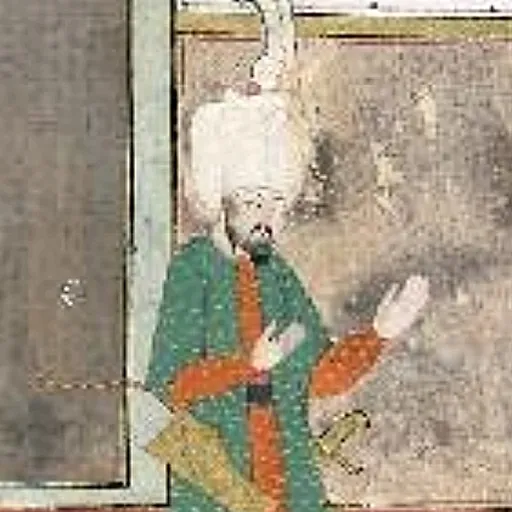
Damat Ibrahim Pasha
Grand Vizier of the Ottoman Empire (1596, 1596–1597, 1599–1601)
About Damat Ibrahim Pasha
Lived 1550 – 1601 (aged 50–51). Damat Ibrahim Pasha was a Turkish politician, statesperson, political writer and poet.
Damat Ibrahim Pasha (, ; 1517 – 10 July 1601) was an Ottoman military commander and statesman who held the office of grand vizier three times (the first time from 4 April to 27 October 1596; the second time from 5 December 1596 to 3 November 1597; and for the third and last time, from 6 January 1599 to his death on10 July 1601). He is known as the conqueror of Kanije.
Born at Mehmed-Kanije, on 28 May 1517, he attended military schools in several cities of the Ottoman Empire before being enlisted in the Ottoman army. After graduating, he was in active service during the Battle of Keresztes in October 1596, and held the position of grand vizier under Sultan Mehmed III until his death in 1601.
He is also called with the title damat ("bridegroom"), because he was a bridegroom to the Ottoman dynasty by marrying Ayşe Sultan, one of the sultan's daughters. By her he had a son, Sultanzade Mehmed Bey (died in infancy), and a daughter (died as newborn). He is not to be confused with either Pargalı Ibrahim Pasha, illustrious grand vizier of Suleiman the Magnificent, another devşirme and to the Ottoman court, or with Nevşehirli Damat Ibrahim Pasha, who held office in early 18th century during the Tulip Era in the Ottoman Empire.
Biography According to Turkish sources, he was "Bosnian or Croatian" and went through the Devşirme system. According to the contemporary Italian historian Giovanni Minadoi, Ibrahim Pasha became acquainted with the Venetian deputy consul of Aleppo, Chrestefero de Boni, once Ibrahim Pasha discovered they were both from Ragusa in modern Croatia.
He rose in the ranks during the period when virtual authority and influence was held by Sokollu Mehmed Pasha. In 1581, shortly after Mehmed Pasha's death, Ibrahim Pasha married Ayşe, daughter of the reigning Murad III and became governor of Egypt. But due to his absence from the capital and with Sokollu Mehmed Pasha dead, his influence waned for the rest of the reign of Murad III.
He made a comeback under the reign of Mehmed III, becoming grand vizier in 1596 for the first time. His recall was particularly due to the loss of territories in the border regions between the Ottoman Empire and the Habsburg monarchy in Hungary. Rather than dashing toward immediate action, he distinguished himself as an orderly, methodical, and prudent statesman who preferred to start by conducting a review of the entire Ottoman administrative system based on the focal point of the prepared campaign against Austria. The campaign as such proved a success and the Ibrahim Pasha acquired the title of "the conqueror of Eger" (north-east of Budapest) for his sultan, although he was the one who held the effective command. Since he favored solidifying the state structure and the gains acquired rather than pursuing Austrians, for which he has been dismissed from the post of grand vizier, at first for a short interval of forty-five days at the end of 1596, and then for a second time at the end of the following year.
The Damat Ibrahim Pasha mosque in the Fatih district of Istanbul. He was called back to the grand vizier post in 1599 on the condition that he was to launch a campaign against Austria. He started his campaign by feigning to menace Vienna directly by heading toward Esztergom (conquered by Suleiman the Magnificent in 1543 and lost back in 1595) but finally spent the winter in Belgrade. Then he began to put pressure on Austria through a more southern route by besieging the castle of Kanije. The Ottoman slaves in the castle exploded the powder magazines and very badly damaged the walls. But the castle had still not surrendered and an army of 20,000 soldiers commanded by Philippe Emmanuel, Duke of Mercœur arrived to the assistance of the besieged. But the Ottoman Army finally defeated both of the armies and the castle surrendered. Tiryaki Hasan Pasha was appointed as the governor of the newly conquered city.
Kanije had been transformed into the centre of new Ottoman attacks in Central Europe. In September 1601, an attempt by a huge Austrian army to take back the castle was thwarted by the governor Tiryaki Hasan Pasha. Damat Ibrahim Pasha died the same year. Esztergom was retaken by the Ottoman Empire in 1605 under Sultan Ahmed I.
Don’t just read it —
keep it.
Full-length biographies made to live with: read them, listen on the way to work, watch them tonight.
- E-book
- Audio
- Video
Instant download · yours to keep · every purchase keeps this site free
Important facts
Family & relationships
People in Damat Ibrahim Pasha's life
Named in this biography and alive at the same time



Related people
Same field, nearest in time

Contemporaries
People whose lives overlapped Damat Ibrahim Pasha's
Frequently asked questions
Who was Damat Ibrahim Pasha?
Grand Vizier of the Ottoman Empire (1596, 1596–1597, 1599–1601)
When was Damat Ibrahim Pasha born?
Damat Ibrahim Pasha was born in 1550 in Domislica.
When did Damat Ibrahim Pasha die?
Damat Ibrahim Pasha died on 10 July 1601 in Belgrade.
What was Damat Ibrahim Pasha's occupation?
Damat Ibrahim Pasha was a politician, statesperson, political writer and poet.
What nationality was Damat Ibrahim Pasha?
Damat Ibrahim Pasha was Turkish.
Sources & further reading
· Wikipedia: Damat Ibrahim Pasha
· DBpedia: Damat Ibrahim Pasha
Cite this page
APA: Biography.guide. (2026). Damat Ibrahim Pasha. https://biography.guide/damat-ibrahim-pasha/
MLA: "Damat Ibrahim Pasha." Biography.guide, https://biography.guide/damat-ibrahim-pasha/.
Chicago: "Damat Ibrahim Pasha." Biography.guide. https://biography.guide/damat-ibrahim-pasha/.
Data last updated: 2026-09-20 · Spot an error? Report a correction.
Portrait: Wikimedia Commons · author & licence
Page generated 2026-09-27 04:58 UTC