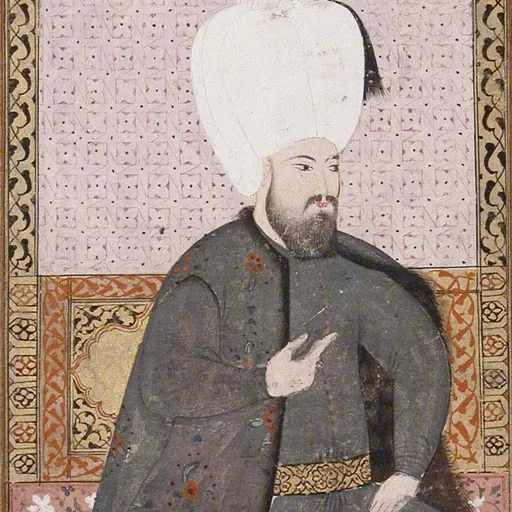
About Ahmed I
Lived 1590 – 1617 (aged 27). Ahmed I was a Turkish ruler, writer, poet and sultan.
Ahmed I ( ; ; 18 April 1590 – 22 November 1617) was the sultan of the Ottoman Empire from 1603 to 1617. Ahmed's reign is noteworthy for marking the first breach in the Ottoman tradition of royal fratricide; henceforth, Ottoman rulers would no longer systematically execute their brothers upon accession to the throne. He is also well known for his construction of the Blue Mosque, one of the most famous mosques in Turkey.
Early life
Ahmed was born at the Manisa Palace, Manisa, probably on 18 April 1590 to Şehzade Mehmed and his concubine Handan Sultan. He was the grandson of Sultan Murad III and his Haseki, Safiye Sultan. Ahmed lived in Manisa until his grandfather's death in January 1595, after which Ahmed accompanied his father to Constantinople for his enthronement.
Shortly after his enthronement, Sultan Mehmed III ordered the execution of his nineteen half brothers in accordance with the Ottoman practice of fratricide. Ahmed's elder half-brother Şehzade Mahmud was also executed by his father on 7 June 1603, just months before Mehmed's own death on 22 December 1603. Mahmud was buried along with his mother Halime Sultan, who died sometime after 1623, in a separate mausoleum commissioned by Ahmed in Şehzade Mosque in Constantinople (present-day Istanbul.
Reign
Ahmed ascended the throne after his father's death in 1603, at the age of thirteen, when his powerful grandmother Safiye Sultan was still alive. With his accession to the throne, the power struggle in the harem flared up; between his mother Handan Sultan and his grandmother Safiye Sultan, who in the previous reign had absolute power within the walls (behind the throne), in the end, with the support of Ahmed, the fight ended in favor of his mother. Ahmed broke with the traditional fratricide following previous enthronements and did not order the execution of his three year old half-brother Mustafa, the second son of Halime Sultan. Instead, Mustafa was sent to live at the old palace at Bayezit along with his mother and their grandmother, Safiye Sultan. This was most likely due to Ahmed's young age - he had not yet demonstrated his ability to sire children, and Mustafa was then the only other candidate for the Ottoman throne. His brother's execution would have endangered the dynasty, and thus he was spared.
His mother tried to interfere in his affairs and influence his decision, especially she wanted to control his communication and movements. In the earlier part of his reign, Ahmed I showed decision and vigor, which were belied by his subsequent conduct. The wars in Hungary and Persia, which attended his accession, terminated unfavourably for the empire. Its prestige was further tarnished in the Treaty of Zsitvatorok, signed in 1606, whereby the annual tribute paid by Austria was abolished. Following the crushing defeat in the Ottoman–Safavid War (1603–1612) against the neighbouring rivals Safavid Empire, led by Shah Abbas the Great, Georgia, Azerbaijan and other vast territories in the Caucasus were ceded back to Persia per the Treaty of Nasuh Pasha in 1612, territories that had been temporarily conquered in the Ottoman–Safavid War (1578–90). The new borders were drawn per the same line as confirmed in the Peace of Amasya of 1555.
Relations with Morocco
During his reign, the ruler of Morocco was Mulay Zidan whose father and predecessor Ahmad al-Mansur had paid a tribute of vassalage to the Ottomans until his death. The Saadi civil wars had interrupted this tribute of vassalage, but Mulay Zidan proposed to submit to it in order to protect himself from Algiers, and so he resumed paying the tribute to the Ottomans.
Ottoman-Safavid War: 1604–06 The Ottoman–Safavid War had begun shortly before the death of Ahmed's father Mehmed III. Upon ascending the throne, Ahmed I appointed Cigalazade Yusuf Sinan Pasha as the commander of the eastern army. The army marched from Constantinople on 15 June 1604, which was too late, and by the time it had arrived on the eastern front on 8 November 1604, the Safavid army had captured Yerevan and entered the Kars Eyalet, and could only be stopped in Akhaltsikhe. Despite the conditions being favourable, Sinan Pasha decided to stay for the winter in Van, but then marched to Erzurum to stop an incoming Safavid attack. This caused unrest within the army and the year was practically wasted for the Ottomans.
In 1605, Sinan Pasha marched to take Tabriz, but the army was undermined by Köse Sefer Pasha, the Beylerbey of Erzurum, marching independently from Sinan Pasha and consequently being taken prisoner by the Safavids. The Ottoman army was routed at Urmia and had to flee firstly to Van and then to Diyarbekir. Here, Sinan Pasha sparked a rebellion by executing the Beylerbey of Aleppo, Canbulatoğlu Hüseyin Pasha, who had come to provide help, upon the pretext that he had arrived too late. He soon died himself and the Safavid army was able to capture Ganja, Shirvan and Shamakhi in Azerbaijan.
The new Grand Vizier, Nasuh Pasha, did not want to fight with the Safavids. The Safavid Shah also sent a letter saying that he was willing to sign a peace treaty, with which he would have to send 200 loads of silk every year to Constantinople. On 20 November 1612, the Treaty of Nasuh Pasha was signed, which ceded all the lands the Ottoman Empire had gained in the war of 1578–90 back to Persia and reinstated the 1555 boundaries. mothers of the other princes and princesses. Hatice Mahfiruz Hatun ( – 1610/1615) — his first concubine; mother of his firstborn son, the future sultan Osman II, and other sons and daughters. Fatma Hatun — his second or third concubine. Mahpeyker Kösem Sultan ( – 2 September 1651) — his second or third concubine, haseki sultan, and possibly legal wife; mother of most of his children who survived past infancy, among them the future sultans Murad IV and Ibrahim I.
Sons Ahmed I had at least thirteen sons: Osman II (3 November 1604, Constantinople, Topkapı Palace – 20 May 1622, Constantinople; killed by the janissaries and buried in the Ahmed I Mausoleum, Sultan Ahmed Mosque) — with Mahfiruz Hatun Şehzade Mehmed (11 March 1605, Constantinople, Topkapı Palace – 12 January 1621, Constantinople, Topkapı Palace; executed at the order of Osman II and buried in the Ahmed I Mausoleum, Sultan Ahmed Mosque) — with Kösem Sultan Şehzade Orhan (1609, Constantinople – 1612, Constantinople; buried in the Ahmed I Mausoleum, Sultan Ahmed Mosque) Şehzade Cihangir (1609, Constantinople – 1609, Constantinople; buried in the Ahmed I Mausoleum, Sultan Ahmed Mosque) Şehzade Selim (27 June 1611, Constantinople – 27 July 1611, Constantinople; buried in the Ahmed I Mausoleum, Sultan Ahmed Mosque) Murad IV (27 July 1612, Constantinople – 8 February 1640, Constantinople, Topkapı Palace; buried in the Ahmed I Mausoleum, Sultan Ahmed Mosque) — with Kösem Sultan Şehzade Bayezid (December 1612, Constantinople – 27 July 1635, Constantinople, Topkapı Palace; executed at the order of Murad IV and buried in the Ahmed I Mausoleum, Sultan Ahmed Mosque) —with Mahfiruz Hatun Constantinople – 1617, Constantinople, Topkapı Palace; buried in the Mehmed III Mausoleum, Hagia Sophia) — with Mahfiruz Hatun Constantinople – 1615, Constantinople; buried in the Ahmed I Mausoleum, Sultan Ahmed Mosque) (1611/12 or 1615 Constantinople – 27 July 1635, Constantinople, Topkapı Palace; executed at the order of Murad IV and buried in the Ahmed I Mausoleum, Sultan Ahmed Mosque) — with Mahfiruz Hatun or Kösem Sultan. Constantinople – 18 August 1648, Constantinople, Topkapı Palace; killed by the janissaries and buried in the Ibrahim I Mausoleum, Hagia Sophia) — with Kösem Sultan Gevherhan Sultan ( or 1608, Constantinople – 18 April 1631, Constantinople; buried in the Ahmed I Mausoleum, Sultan Ahmed Mosque) — possibly with Kösem Sultan or Mahfiruz Hatun Ayşe Sultan ( or late 1608, Constantinople – 1657, Constantinople; buried in the Ahmed I Mausoleum, Sultan Ahmed Mosque) — with Kösem Sultan Constantinople – 1667, Constantinople; buried in the Ahmed I Mausoleum, Sultan Ahmed Mosque) — with Kösem Sultan Ümmühan Sultan (before 1616 – after 1688). Married Shehit Ali Pasha Zeynep Sultan (1617, Constantinople – 1619, Constantinople; buried in the Ahmed I Mausoleum, Sultan Ahmed Mosque) Abide or Übeyde Sultan (1618, Constantinople – 1648, Constantinople; buried in the Ahmed I Mausoleum, Sultan Ahmed Mosque); married Koca Musa Pasha (d. 1647) in 1642
Legacy Today, Ahmed I is remembered mainly for the construction of the Sultan Ahmed Mosque (also known as the Blue Mosque), one of the masterpieces of Islamic architecture. The area in Fatih around the Mosque is today called Sultanahmet. He died at Topkapı Palace in Constantinople and is buried in a mausoleum right outside the walls of the famous mosque.
In popular culture
In the 2010 film Mahpeyker: Kösem Sultan, Ahmed I is played by Turkish actor Gökhan Mumcu. In the 2015 TV series Muhteşem Yüzyıl: Kösem, Ahmed I is played by Turkish actor Ekin Koç.
Don’t just read it —
keep it.
Full-length biographies made to live with: read them, listen on the way to work, watch them tonight.
- E-book
- Audio
- Video
Instant download · yours to keep · every purchase keeps this site free
Important facts
Family & relationships
People in Ahmed I's life
Named in this biography and alive at the same time



Related people
Same field, nearest in time


Contemporaries
People whose lives overlapped Ahmed I's


Frequently asked questions
Who was Ahmed I?
14th Sultan of the Ottoman Empire (1603–1617)
When was Ahmed I born?
Ahmed I was born on 18 April 1590 in Manisa.
When did Ahmed I die?
Ahmed I died on 22 November 1617 in Istanbul.
What was Ahmed I's occupation?
Ahmed I was a ruler, writer, poet and sultan.
What nationality was Ahmed I?
Ahmed I was Turkish.
Sources & further reading
Cite this page
APA: Biography.guide. (2026). Ahmed I. https://biography.guide/ahmed-i/
MLA: "Ahmed I." Biography.guide, https://biography.guide/ahmed-i/.
Chicago: "Ahmed I." Biography.guide. https://biography.guide/ahmed-i/.
Data last updated: 2026-09-20 · Spot an error? Report a correction.
Page generated 2026-09-27 05:10 UTC